Showing posts with label nature. Show all posts

Tuesday, April 23, 2024

Things Past, Pastel, Passing, and Returning -- And Some Poems About Them

So already, latest April and earliest May, for me, together comprise the most beautiful part of spring--maybe because the beauty of this period is the most ephemeral. But that last "maybe" may miss the experiential point. It's the
abundance of breathtaking pastels that makes latest April and earliest May exceedingly and uniquely beautiful. Those pale, delicate colors create a seasonal softness, especially when combined with gentle breezes and mild temperatures.
 
Yes, these pastels fade or fall to the ground when the great seasonal leafing out begins, just as Robert Frost says in "Nothing Gold Can Stay"*:
Nature’s first green is gold,
Her hardest hue to hold.
Her early leaf’s a flower;
But only so an hour.
Then leaf subsides to leaf. . . .
But how breath-taking they are, how much they gladden our hearts, has nothing to do with how briefly they stay. Those of us who ritually undertake spring cleaning as a seasonal imperative need to march ourselves outdoors every day even just briefly so we don't miss what will lift our spirits even more than dust-free, shining baseboards.
 
April is the perfect month for National Poetry Month. Eliot and Whitman practically made sure of it with their April references in "The Wasteland" and "When Lilacs Last in the Dooryard Bloom'd." Then there's poetry's unique ability not only to nail--get right--the ephemeral quality of early spring, but to nail it down so it remains permanently ephemeral. Poetry is like the girl in the 2024 official National Poetry Month poster**: she will ever be mid-air and mid-ecstasy.

For my part, I've gotten myself outside so as not to miss out on this season's nearly daily changes. A few weeks back, before the time of pastel flowerings, I was on the lookout for the first of the skunk cabbage, especially because I'd recently read and loved Mary Oliver's "Skunk Cabbage."***

Oliver's poem conveys the muscular monstrousness of skunk cabbage: it's "brash" and "turnip-hearted"; its smell is "lurid"; its "rough/ green caves" are "Appalling." Its emergence expresses "daring" and "brawn," not "longing" and "tenderness": it rises out of the "chilling mud," reminding us that "the secret name/ of every death is life again"--but, initially, life that perceptibly, undeniably feeds on and reeks of the death that precedes it. Encountering it, we feel repelled and compelled simultaneously.

One of the members of my poetry reading group expressed frustration with skunk cabbage. It's so abundant--and so useless, she explained: we can't make anything out of it. But to my mind, it's use lies in its offering early proof that life will again grow out of widespread cold muck and decay that have begun to seem permanent. 
 
I appreciate Oliver's elevating humble skunk cabbage in a poem of praise that reminds us that "What blazes the trail [to the more "pleasing" expressions of seasonal rebirth] is not necessarily pretty." Generally, I'm grateful for good poems such as Oliver's because of what they hold and keep holding for whenever we want to return to them.
 
In the spirit of the power of poems to capture, affirm, and preserve, I will now take this blog post out of the springtime woods of Greater Boston and place it on the banks of the Androscoggin River in mid-autumn. But its gratitude for poetry and trust in poetry's power will remain.

The reason for this abrupt shift: were he still alive, my father would have been looking to celebrate his ninety-eighth birthday on Saturday, April 27. "Androscoggin Riverwalk" is a poem that I believe captures and preserves his interests and sensibilities and his engaged relationship with the world. I wrote it originally in response to a poetry prompt that required me to write directly to a person about a place. I knew immediately I wanted to write to my father, who'd died two years earlier, about the walk along, across, and then back along the Androscoggin River in Brunswick, Maine.  
 
A shorter version of it appeared in the 2023 issue of the Poetry Porch, but I offer to you a longer version of it here. 
 

You would have loved the riverwalk.
 

You would have paused to watch

The Androscoggin flowing past

Sloping slabs of gray stone

Sprouting pine and spruce.


But the narrow swinging bridge

That spanned the river,

Offering pedestrian transit

From bank to bank,

Really would have interested you.


Gingerly, you would have stepped 

      onto it,

Then, gaining trust in it and you,

Continued across it,

Stopping just beyond its far end

To pore over the placard

That told its story:


For decades, French-Canadians

Had moved across Le Petit Pont

Going to and from Cabot Mill,

And church and school,

All on the Brunswick side.


Nothing moved you more

Than tales of humble people 

Who, sensing opportunity

For their children and themselves,

Left beloved homes behind

For promising new ones.


The faces of the migrants,

Earnest in the placard photos,

Would have stayed with you

As you headed downhill

From Topsham Heights--


Until a hydroelectric plant

Came into view, compelling

An impromptu discourse

On the likely ties

Among river, plant, and mill:


Chance encounters 

With functioning vestiges

Of thriving industrial times

Often drew from you

Specialized knowledge

I hadn’t known you had.


Your exposition ended,

You would have set off

For the downstream bridge,

Pausing for a final time

To wonder at the bright-hued flags

Strung across a nearby prayer garden,

And to ask what a prayer wheel was,


And then continuing on,

Your thoughts now turned

Toward home and lunch.


An avid golf and tennis player, my father loved spring; it was the declining light in fall that got him down--and made him look forward to the winter solstice as the signal of the sure if slow return of warmth and light over the weeks and months ahead.


Thank you for reading this poem about him--and the rest of this post. And may you enjoy this miraculous season, the poems it writes, and the remainder of National Poetry Month.


* Frost, R. (n.d.). Nothing gold can stay. poets.org: Academy of American poets. https://poets.org/poem/nothing-gold-can-stay
** The American Academy of Poets creates this annual official poster.
*** Oliver, M. (n.d.). Skunk cabbage. Famous poets and poems.com. http://famouspoetsandpoems.com/poets/mary_oliver/poems/15874

Wednesday, May 31, 2023

In the Midst of Life We Are in Death . . . And Vice Versa

So already, last Saturday, May 27, was the second day of Shavuot, the Jewish holiday celebrating "the great revelation of the giving of the Torah at Mount Sinai, more than 3,300 years ago."* The second day of Shavuot is also one of several days during the Jewish calendar year that Jews recite Yizkor, the memorial prayer for deceased loved ones. In my early years, I understood that the prayer was said only for parents, siblings, children, and spouses; today, I understand that it can be recited for any dead loved one, and even for anonymous individuals and groups. 
 
I said it while sitting at the edge of the field at our cabin in Berlin--definitely deviating from various Jewish norms and rules, I'm sure--for my father and my friend Donald, who became family long ago. I also said it this time for two old friends who died in the past month: Jonathan, who succumbed to sudden altitude-related illness on Mt. Everest on May 1, and Delia, who died of unexpected cancer-related complications on May 22. Two Mondays, three weeks apart. 
 
Some time ago, I lost direct touch with Jonathan, my fellow Needham High School graduate who was such a great big brother to me during my freshman year at college, but I still kept tabs on his life through the reports of mutual friends. 
 
Most of the Roommates
In contrast, I was in good touch with Delia, a former college roommate. I always felt a special connection to Delia because she and my dad shared not only the same birthday, but the same habit of naturally and unceremoniously doing what they could when others needed a helping hand.

If it's one thing I've learned sitting at the edge of the field at the cabin, it's that life and death are always happening at the same time. A favorite old apple tree at the bottom of the field, as seen from our chairs on the field's stream side, is now distinguished by one huge dying branch bending toward the ground beneath: no doubt some combination of winter ice and wind forced that brittle bough toward the ground into its current bowed position. The cracking sound it made when it broke from the main trunk must have been loud.

Some season soon, that damaged branch will lie horizontally on the ground. But for now, it suggests to me that death happens gradually, whether or not that 's true. I keep thinking that Delia and Jonathan are still getting used to it, perhaps because I'm still trying to get used to the fact of their deaths.
 
Meanwhile, I'm relieved that it's just that branch, as opposed to the whole tree, that's dying: the tree's elbow-shaped bend that Scott loves to paint and draw and that I love to photograph is intact. And even the broken branch that's in the process of separating from the rest of tree is sprouting leaves in a few places.

It's hard not to think of trees of life (1) when trees all around are burgeoning with new life even as some parts of them, through all kinds of natural processes, are returning to the earth--and (2) when the holiday is Shavuot: the the Torah is often described as a "a tree of life to those who hold fast to it."
 
It's also hard not to think of trees of life when the family tree grows a new branch: the day before Delia died, my nephew and niece-by-marriage became the parents of their first son and my second grand-nephew. So as I greeted the terrible news about Delia, this new little boy in our family was happily much on my mind. "In the midst of life we are in death," and in the midst of death we are in life, I thought to myself, having sung "The Service for the Burial of the Dead" by Thomas Morley so many times during college.
 
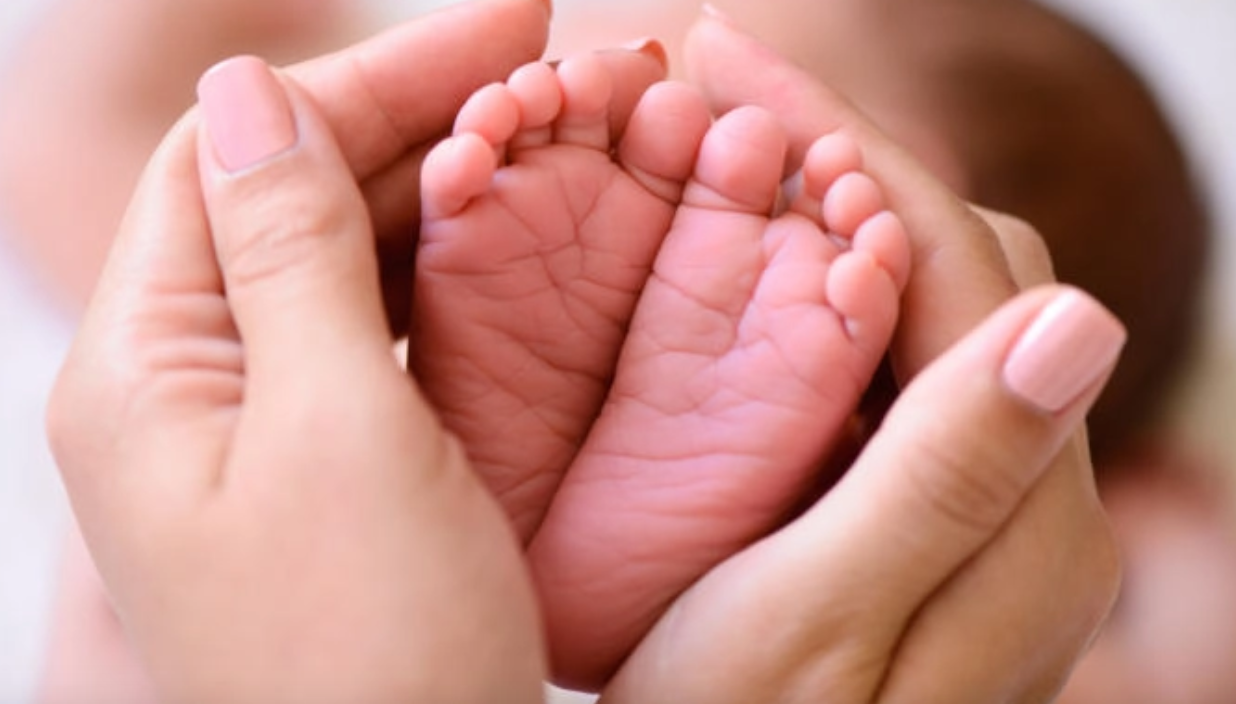
Such a beautiful baby boy whose name would not be revealed until the B'rit Milah, the ritual circumcision that would take place eight days after his birth.
 
In the Jewish tradition, babies are named only for people who are no longer living.** So my first question was whether my new nephew would be named Benjamin David, for my father who died in December 2020. My second jumping-the-gun question was whether the baby, if he were named Benjamin, would be called Ben or Benjie. 

I was hopeful: Delia had had her last pre-surgery chemo treatment on her and my dad's birthday. She was being cared for at the home of her older brother Benjie (I don't know he spells it) and his wife. After she died, I was communicating with her nephew Ben, sending photos of her, letting him know whom I'd notified of her passing. The name Benjamin was everywhere in the air, consoling me and giving me hope.

The Yizkor service also comforted me, giving me something to do that I didn't have to invent. The Lev Ha Shalem prayer book is always a great source of inspirational and provocative poems and readings in addition to the traditional prayers and translations. Because my husband Scott's art often, in my opinion, suggests a fluidity between life and death, I shared with him the poem "In Everything" by Lea Goldberg that was featured alongside one page of the service:

In everything there is at least an eighth part
that is death. Its weight is not great.
With that secret and carefree grace
we carry it everywhere we go.
On lovely awakenings, on journeys,
in lovers' words, in our distraction
forgotten at the edges of our affairs
it is always with us. Weighing
hardly anything at all.
(translated by Rachel Tvia Back)***
Scott asked me about the "eighth part"--why not a different fraction, he wanted to know. I said that eight is often an important number in Judaism: eight days of Passover, eight days of Hanukkah, eight days between a birth and a b'rit. But I didn't have a real answer, since other numbers are significant, too.
 
I wish I were naturally and completely easy with the perpetual overlapping of life and death. My impulse is always to try to keep life "safe" from death. So I'm appreciative of this poem in which the reality of the fraction of death in life does not taint life, does not weigh it down, does not make it less alive, less valuable, less wonderful. The idea that we carry death with "secret and carefree grace" reassures me. I'm certain that that grace is coming through me, not from me, and I'm grateful for it.
 
In this month of so much sad news--but with so many happy memories associated with that sad news--along comes a beautiful new baby and eight days later, the revelation of his name--Benjamin David, my sister told me in a text on Sunday morning. My father's memory--and the memories of Delia, Jonathan, and Donald--are indeed for blessings. All four of them shared a love of life.

* Chabad.org. (*2023, May). Hear the Ten Commandments on Shavuot. https://www.chabad.org/library/article_cdo/aid/2157/jewish/Hear-the-Ten-Commandments-on-Shavuot.htm (art also accompanying this post by Sefira Lightstone: https://www.sefiracreative.com/)
** Photo accompanying article: Klein, M. (N.D.). A historical view of choosing a Jewish name. My Jewish Learning. https://www.myjewishlearning.com/article/a-historical-view-of-choosing-a-name/
*** See page 337 of the following Lev Ha Shalem Yizkor pdf file: https://images.shulcloud.com/1039/uploads/passover-pages/YizkorforPesahandShavuotSIDDURLEVSHALEM.pdf

Wednesday, December 7, 2022

"The Vanished House": A Poem

So already,  I first met Margaret Atwood's poem "Shapechangers in Winter" last year around the time of the winter solstice, and I actually wrote about it in  a blog I posted on New Year's Eve day 2021. 

I thought of that poem today as I listened to the Broad Cove Chorale, the Hingham-based women's choral group I sang with before the COVID19 pandemic. Among the pieces they sang in their holiday concert were musical settings of poems by Christina Rossetti, William Blake, and Robert Lowell.

Thinking of all of these poems reminded me that last December, I wrote a poem in gratitude to three winter poets: Margaret Atwood, Wallace Stevens, and Robert Frost. 

The image* that most inspired it was that of the vanished house in the third section of Atwood's poem. Musing on it, I had recalled Wallace Stevens' poem "The Snow Man," which added to the haunting idea and image collection I was beginning to build. 

Sensing a need to pin my gathering impressions and ideas to something familiar, something already in my bones, I thought of a Robert Frost poem that I think you'll be able to identify without my revealing its name. It's one of those "great American poems"  that so many of us encountered as middle school or high school students learning to read and hopefully love poetry. It may be the poem's meter and rhyme scheme that most help you identify the Frost poem, so let its music wash over you or carry you. 

So here it is: my very allusive poem, "The Vanished House."  
 
The man who owned these woods, it’s said,
 
Lived on this spot, but now is dead. 
The village folk, they think it queer  
That his fine house should disappear. 
 
But others theorize otherwise, 
Themselves compelled by winter skies 
When snow and evening jointly fall 
Erasing home, erasing all.  
 
In a state of winter mind, 
They think he left his house behind, 
Found a strong will buried deep, 
A promise to himself to keep. 
 
And when he from that house self-banished-- 
That was when it up and vanished. 
The neighbor’s mare, who must have seen,
Shook her bells once and stayed serene. 
 
A vanished house no secrets keeps,
No view obscures of woodland deeps, 
No varnished truths perpetuates-- 
So, over time, it liberates.
 
It let him choose fresh-fallen snow,
A wood instead of house to go. 
And now, he breathes the cold in deep 
And smiles inside, and wants no sleep.  
                     
In town the neighbors still seek clues--
They stare at wood chips, frosted screws--
And looking back, and at, and near,
See not the house set to appear.

* Adjacent photo is a screenshot of Pixneo photo:https://pixnio.com/nature-landscapes/winter/forest-snow-winter-wood-tree-frost-cold-landscape-branch

Saturday, October 29, 2022

After the High Holidays 2022

So already, the Jewish High Holidays are now in the rear view mirror, and the road forward is into ordinary time--hopefully, infused with the energy, purpose, peace, and joy derived from observing the holidays.

In previous years, I've written about my efforts at teshuva, at preparing myself to take advantage of the opportunities for renewal, reconnection to G-d* and others, and refocused personal action and commitment particularly offered by Rosh Hashanah and Yom Kippur. 
 
In contrast, I've written much less about the holidays following Yom Kippur. Somehow the unfettered joy and celebration associated with these later holidays, the singing-and-dancing revelry, have always eluded me, even if a positive sense of a new beginning has not.

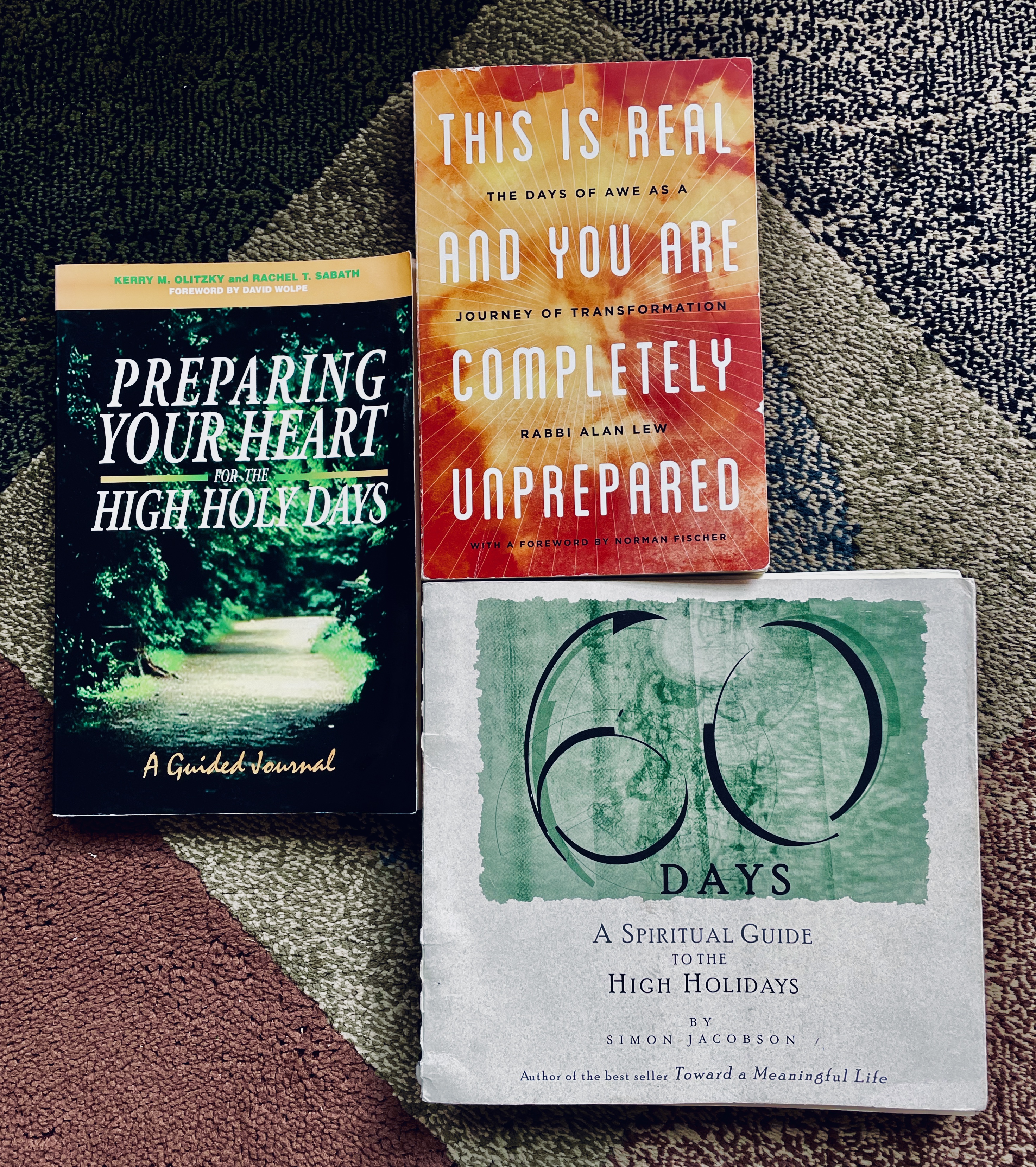
Because this year I went back to using Simon Jacobson's 60 Days: A Spiritual Guide to the High Holidays,** I was guided not only to prepare for the high holidays, but to pay attention to them while they were happening--and to continue to reflect on their effects during the week following them. 

So how did it go this time around? At the end of the sixty days, I can report that even though not once was I seen singing and dancing in the streets in these last weeks, I did feel some joy--best defined for me as feeling of lightness, freedom, optimism, and agency that knows what to do with itself. The following three "new" experiences attest to this.

The Sukkah at My Mother's Senior Living Community

Before I describe my first "new" experience, you should know that my birthday on the Jewish calendar is Tishrei 15, the first day of the post-Yom Kippur holiday of Sukkot. During the seven days of Sukkot, Jews allegedly spend as much as time as possible in the sukkot (plural of "sukkah") we build according to Torah-given specifications. Constructing and residing in these temporary habitations reminds us of the impermanence of human-made things and of life itself--and the permanence and eternity of G-d.

As an apartment dweller for my whole adult life, I've never built a sukkah in my yard. But being born on Sukkot always has always felt like a spiritual opportunity that I didn't know how to turn into a blessing.

Meanwhile, this year, though my sister, cousins, and I talked about getting together during the holidays, we never managed to do so. This lack of shared holiday festivity initially made me very sad: it seemed that the very different ways we live our lives as very secular Jewish people made gathering difficult. But my sadness dissipated when I read about the lulav (made of willow, cypress, and myrtle branches bound together in very specific way) and the etrog (citron) in 60 Days.** 

These objects symbolize four different kinds of people, all of whom are essential to the community, and none of whom--even those who study, pray, and do good deeds with real love in their hearts--matter more than others. The custom of Sukkot, both in and out of synagogue, is to shake the lulav and etrog*** together in six world directions--north, east, south, west, and toward the heavens and toward the ground. As Jacobson explains, "These movements manifest the unity of the 'four kinds'--and the Divine unity--in all the parameters of space in the entire universe, which it is our responsibility to elevate" (122).

Suddenly, I saw our family diversity as a microcosm of this world of diverse human types that can't always be knitted together well without real effort. I decided right then that I would host a family gathering on the first night of Hanukkah. To up the chances that everyone would be able to come, I sent "save-the-date" emails two days later.

On that same day--I'm finally getting to the experience that I've actually been preparing you to read about--as I was walking to my car after having visited my mother, I decided to walk into the sukkah that had been erected in the courtyard adjacent to where I had parked. No one else was there, but on a card table were a lulav, an etrog, and two laminated sets of instructions for how to shake them together. So I shook them. And in that moment, I felt joy--real connection to G-d; other people, past and present; and the natural world.

My second "new" experience happened about a week later when I was suddenly awakened very early one morning****  by an unfamiliar voice that said, "There's a good chance that G-d will strike you dead this year." Needless to say, I didn't feel joy.

At first, afraid, disturbed, taken aback, I wanted the facts. Who said it, I wondered. G-d speaking of himself in the third person? Some unknown person of much authority?  I myself, or a chorus of my inner demons? Given how much death has been in the foreground of my life in the last couple of years, it made sense that I might be wondering about the when and how of my own.

Quickly I went from fearful to coolly responsible. "Be careful," I told myself. "Be sure that Scott knows where all the financial stuff is and that he has the latest passwords. And do my sisters know where to find my mother's financial and medical stuff? I better remind them."

Untitled Recent Painting by Scott Ketcham
Next, my thoughts became more rational-theological. I reminded myself that I didn't believe that G-d would strike me dead--because I don't believe G-d strikes people dead. He wouldn't single me out and hurl a thunderbolt at me, force me off the road, make a tree branch fall on me, inject me with poison. But I also believed that he might let me die, that he probably would not intervene to protect me from a particular death at a certain time. I thought of a friend slightly younger than myself--someone loved and respected by many--who had died just days earlier of a protracted illness that everyone knew would be fatal. Dying happens all the time. So why not me this year?

Finally, with that possibility in mind, I thought of the holiday season's constant messages about the inevitability of death, the blessing of life, and the loving and eternal omnipresence of G-d. So five minutes after I heard this sobering pronouncement--which, thankfully, didn't decree that I would die this year--I was reminding myself to cherish my life and to live it fully and deliberately every day. 

Had I not been far into the process of doing the 60 Days book, I may not have gotten to this life-focused point at all, let alone quickly.

I am glad to be able to tell you that my third and final "new" experience was not in the least disturbing, though it too involved hearing words that felt more like they were coming through me than from me.

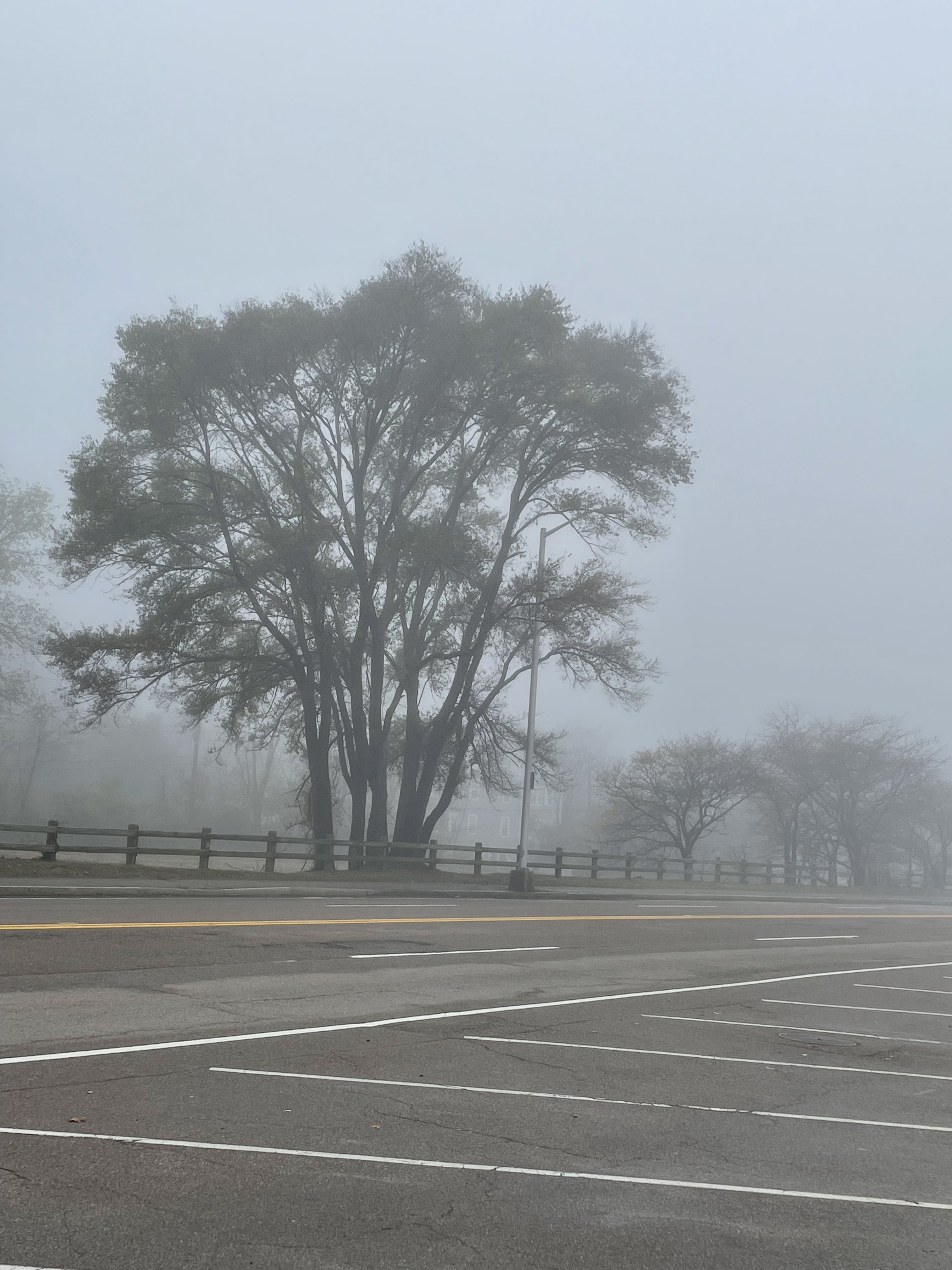
Last Tuesday, the middle of three warm, fog-blanketed days along the Massachusetts coast, I decided to walk near the salt marsh and the beach not far from my home. A primarily descriptive poem came to me as I got to the edge of the marsh on Quincy Shore Drive opposite Wollaston Beach:

I was in a fog
 
walking by the 
     marsh.
 
The green grass 
going gold 
was mist-muted, 
and the water, 
flowing seaward
with the ebbing 
     tide, 
was pale gray-
     green. 
Was the air 
     warmer 
than the water-- 
or the water 
warmer than the air? 
Just briefly
I wondered,  
warmed as I was 
by the spirits 
of the shrouded trees 
hovering above  
the damp rocks, 
the traffic lights  
barely visible, 
and all forgiven

I was surprised by "and all forgiven"--and then I knew I believed all was forgiven. That thought made me really happy.

By the end of the sixty days, I felt more peaceful--more centered, more purposeful, less frantic, less confused, and more certain that I was part of something vast and good if not apt to respond to my individual whims, moods, and wishes--than I had at the beginning of them. And equipped with this array of feelings,
I felt distinctly ready for ordinary time.

So what made experience with 60 Days different this time around? I think the answer is that I engaged with the book faithfully. I don't mean that I did it with perfect faith in and connection to G-d; that's always a struggle for me. I do mean that I was faithful to process, that I stayed the 60-day course with optimism, hope, and openness to the possibility. 
 
So here's to optimism, hope, and openness to possibility. May each of us, regardless of our spiritual and religious leanings, be able to muster those three things whenever we are next presented with the chance to do something challenging that we instinctively feel will help us live better lives in a better world. And may we especially be able to muster them if that challenging thing makes us feel uncomfortable, fearful, vulnerable, or even silly. Finally, may we all have new years marked by growth, peace, and, yes, joy.

*Since the Simon Jacobson, the author of the book that has been my High Holiday season companion, writes "G-d," I am writing "G-d" in this blog. But I've written "God" in other posts. The article linked here explains why some people write "G-d" while others write "God." I feel either spelling is fine.   
** Jacobson, S. (2008). 60 days: A spiritual guide to the high holidays. New York: Kiyum Press.  
*** Drawing accompanying Chabad.org staff. (2017). The lulav and the etrog: The four kinds. Chabad.org. Retrieved on October 28, 2022. https://www.chabad.org/library/article_cdo/aid/609564/jewish/The-Lulav-and-Etrog-The-Four-Kinds.htm
**** Photo on Twitter with hashtag #kitchenviews: https://mobile.twitter.com/hashtag/kitchenviews?src=hash