Showing posts with label spirituality. Show all posts

Tuesday, July 29, 2025

The Unlikely Pilgrimage of Harold Fry: A Novel for Pilgrims, Walkers, and Others Needing Boots and Reboots

So already, as many of you already know, I have moved my blog from Blogger to Substack. This way, "So Already" readers who want to receive emails notifying them that I have posted can do so. 

'Tis the season of summer reading. That's what's had me reading and writing about Rachel Joyce's The Unlikely Pilgrimage of Harold Fry.

So if you'd like to read "The Unlikely Pilgrimage of Harold Fry: A Novel for Pilgrims, Walkers, and Others Needing Boots and Reboots," here's the link:
https://joansowhat.substack.com/p/the-unlikely-pilgrimage-of-harold
 
Thank you for reading, if you do. And feel free to subscribe for free.

Tuesday, June 24, 2025

Revelation, Inspiration . . . & Then . . .

So already, as many of you already know, I have moved my blog from Blogger to Substack so that those who want to receive emails letting them know I've posted can do so. 

Recently, I've been musing on the connections among revelation, inspiration, and action.

If you'd like to read "Revelation, Inspiration . . . & Then . . .," here's the link--https://joansowhat.substack.com/p/revelation-inspiration-and-then 

Thank you for reading, if you do. And feel free to subscribe for free.

Painting by Karin Foreman: “Counting of the Omer” by Karin Foreman: https://karinforeman.com/counting-of-the-omer-sfirat-haomer-%D7%A1%D7%A4%D7%99%D7%A8%D7%AA-%D7%94%D7%A2%D7%95%D7%9E%D7%A8/counting-of-the-omer/

Monday, March 10, 2025

On God Avoidance and Other Activities in the Garden

So already, the other night as I was getting ready for bed, I realized I had no interest in reading other people's stories, fictional or not. That surprised me, because the week before I'd finished reading Daniel Mason's North Woods, which I loved--so much so that I'd
gone to the library a couple of days later to borrow an earlier Mason book. And two weeks before that, I'd finished reading Omo Moses' The White Peril: A Family Memoir, which I also loved, so much so that I blogged about in February.

It's my habit to read a little before I go to sleep, and I wanted to take in some words, but not the kinds of words I'd been taking in during the weeks before. As I climbed into bed wondering, "What words, what words?" I
realized I hadn't given God much thought or attention in the last few months. 

Why that thought at that moment? Probably for three reasons.
 
The first was that a couple of days earlier, I'd recalled how last fall, after my mother died, I'd gone to synagogue a couple of times and felt very disconnected spiritually. Despite the kindness of so many in my congregation, I knew I was not connecting with God through the services' formulaic prayer and familiar language, nor did I feel like making the effort to do so. My feelings were in no way a criticism of God, my fellow congregants, or liturgical prayer; they were simply an expression of my orbiting in this strange new mother-less galaxy.*

The second was that twice quite recently, God had entered my mind. But He'd stayed there only briefly, as if in passing.
 
The first time was while I was walking--something I hadn't done much recently because of February's stubborn ice, low temperatures, and gusty winds. As if to say "enough" to winter's persistent harshness, I headed out to my usual salt marsh on the last day of February when the potentially lethal ice had finally vanished from the trails. Being there reminded me that Donald Trump and Elon Musk don't have dominion over everything--certainly not over the salt marsh and the ducks' seasonal rhythms.
 
The second time was while I was reading Peter Beinart's Being Jewish After the Destruction of Gaza: A Reckoning. The book explores the assumptions and priorities of various Jewish individuals and groups as Beinart understands them politically, culturally, and historically; offers his opinions about their practical and moral costs and benefits; and asserts that a consideration of Jewish values and teachings can and must guide Israel's
way forward. In particular, I appreciated his discussion of Jewish chosen-ness, which is all about relationship to God and the obligations associated with that, and its implications for the future of Israelis, Palestinians, and American Jews.
 
The other night as I sat in my room, I found myself missing having some kind of an ongoing connection to God. But I also still wondered what part of my "what words, what words" conundrum was a response to Donald Trump's degrading treatment of Volodymir Zelenskyy  in the White House on a recent Friday, and what part of it was the latest expression of my experience of the loss of my mother--which is more akin to emptiness and disorientation than to sadness. 
 
Next to my bed was a book of daily meditations called Healing After Loss, a gift of a good friend, that I hadn't been reading regularly--only because I was feeling more weird than bereft. But seeing it there did remind me that I had a couple of other books written by rabbis that offered daily meditations, or short enough "chapters" to lend themselves to bedtime reflection. So I pulled out both Floating Takes Faith: Ancient Wisdom for a Modern World by Rabbi David Wolpe and Restful Reflections: Nighttime Inspiration to Calm the Soul, Based on Jewish Wisdom, written and edited by Rabbis Kerry M. Olitzky and Lori Forman. 
 
I read the first entry in the former and the March 3 entry in the latter. Remarkably, they both spoke to me, tempering my profound sense of puzzling absence.

The March 3 meditation in Restful Reflections, entitled "The Voice of God Has Never Stopped," talks about the Shema, translated as "Hear, O Israel"--the prayer that's known by heart in both Hebrew and English by virtually every American Jewish person, regardless of how they feel about being Jewish and how observant they are. The meditation's author, Rabbi Levi Meier, explains,
The 'Hear, O Israel' is a statement of faith, love and commitment to listen to God's voice. And to live that belief means bringing oneness and wholeness into the world. It means bringing people together, bringing unity and peace into the lives we touch. (51)**
For the last months, I've been wondering why I do what I do--literally, why I fill my hours with what I fill them with. Rabbi Meier reminded me that lots of what I routinely do, whether I'm an organizer or simply a member of the group, brings people together to do something meaningful and even pleasurable together. If that "meaningful" has peaceful aspects, my glass is half full, despite my nagging sense of absence.
 
A paragraph later, Rabbi Meier reassures that if one opens one's ear and heart sufficiently, "then the voice of God will enter your mind and your heart, and your actions will testify to the fact that God dwells here, now, in your room." Those words spoke directly to the possibility of lessening the distance between God and me, put there by me: what could be more distance-diminishing than having God come into my own room? It was as if I'd pressed "pause" on my personal spiritual CD player in late October, but the music had kept playing in the cosmos, ready always for me to press the button that would make the divine music "resume."

Next, I turned my attention to Floating Takes Faith. Actually I'd met Rabbi Wolpe once when he'd attended Shabbat services at my synagogue several weeks after October 7, 2023; he was the rabbi who had resigned from Harvard's antisemitism task force because he felt the group lacked a sense of urgency about the work it was doing. His column entitled "The First Question"--for some time, he'd published a column regularly in The Jewish Week--dealt with the first question God asks in the Hebrew Bible--to Adam, in the Garden of Eden, in Genesis 3.

"'Where are you?'" God asks, no doubt knowing that Adam is in the Garden of Eden--where else could he be? That was the part of the story I remembered. What I didn't remember was Adam's answer. As Wolpe explains, "Instead, it is a question of spiritual geography. Adam, understanding the import of God's question, answers that he was frightened, so he has been hiding."***

"Spiritual geography" immediately spoke to me since I've long been fascinated with inner landscapes. But Wolpe's reminder that Adam was hiding out of fear practically took my breath away. Just the week before, during my voice lesson, during a part of a Fauré song **** when I should have been singing out a beautiful ascending line, my voice teacher had said to me, "You sound like you're hiding."

I told her I probably was. My sisters had always hated my singing, so I had always felt I needed to conceal it around the house--and right now, I was singing in the house, my house. So my habit pulling back when I ought to be letting it rip was a well-established one. It won't surprise you to know that part of what I'm learning to do in my voice lessons is to let it rip--at least within the bounds of good vocal practice.
 
Letting it rip musically depends on a number of vocal factors, and one of them is having enough air, enough breath--and I often count on the experience of breathing deeply--whether I do so intentionally or suddenly realize I am doing it--to tell me that God is with me, or that there's the chance that God is with me.  
 
Wolpe's column comments, after talking specifically about Adam, that "Where are you"
. . . is not only the first question: it is also the eternal question. At each moment in our lives, this question is addressed to us: Where are you? Where are you spiritually? Where are you morally? What have you done with life, and what are you doing with it now? Are you proud of your conduct in the garden?"
Frankly, I don't want to deal with the question of what I'm proud of or not. I think there are any number of things I could be proud of, but an emphasis on being proud of how morally or ethically good I'm being (or striving to be) would too easily foreground judgment, put and keep myself at the center, and apply constant pressure.
 
But I like the other questions well enough, and I'd like to think more deliberately about what I'd like to do with my life going forward, should I be lucky enough to remain of sound mind and body. For sure I'd like to listen and hear. And I'd also like to get really comfortable with letting it rip, vocally and otherwise: the idea of not hiding out of fear appeals on every level.

So here I am, standing in the Garden. Except right now, for me, it looks a whole lot like my dining room, where I've been sitting for the length of this Sunday afternoon alternating between writing this blog and listening--to Ned Rorem songs (The Prince Consort's On an Echoing Road CD is beyond beautiful), to Paul Moravec songs (specifically to Jennifer Cano singing "A New America"--magnificent), to Gabriel Fauré songs. I am sure God is in these songs, and therefore He is in my dining room. Maybe it's the beginning of something--like less avoidance, or the renewal of something, or something altogether new. Time will tell.

* Screen Shot of Oort Cloud Formation Metal Print by Science Photo Library: https://fineartamerica.com/featured/oort-cloud-formation-claus-lunau.html?product=metal-print
** Olitzky, K.M. & Forman, L. (2001). Restful reflections: Nighttime inspirartion to calm the soul, based on Jewish wisdom. JEWISH LIGHTS Publishing.
*** Wolpe, D. (2004). Floating takes faith: Ancient wisdom for a modern world. Behrmann House, Inc.
**** Screen shot of "The Effect of Moonlight "(also known as "St. Valery Canal"), a painting by Eugène-Louis Boudin (1891), in the following blog: JDB. (2017, March 20). Clair de Lune redux. Wordpress. https://augenblickblog.com/2017/03/20/clair-de-lune-redux/


Thursday, November 7, 2024

New Flowers: Scott Ketcham's Latest Paintings

So already, what's going on in the painting to the right? Are morning glories about to be trampled? Whose footprints are those? And why would someone want to trample those flowers anyway? Ultimately, what do you pay most attention to--the vibrancy of those innocent blue flowers, or the menace of those treading footsteps? Or are those flowers really so innocent? Maybe there is a mutuality here, a dangerous invitation proffered by them that elicits--even strives to elicit--the human impulse to master and even desecrate. And perhaps the invitation equally endangers both the flowers and the trampling soles--or is it souls? 
 
The painting is called "But only those who leave for leaving," which is an English translation of a line from Charles Baudelaire's poem "Le Voyage."

Scott Ketcham's annual open studios will take place on Saturday, November 23 and Sunday, November 24 at the Sandpaper Factory in Rockland, MA (see bottom of this post for details). Among the works on display will be a number of paintings that will be featured in his solo show, "The Flowers of Evil," that will run will run from January 4 to February 22, 2025 at Ventress Memorial Library in Marshfield, MA.
 
Because Scott's paintings regularly portray tensions, I have tried in my blog over the years to convey how they make visible and alive the unsettling truth of such authentic "contradictions" as avoidant approach, luminous darkness, ascending descent, and the monstrous seductive. It was while contemplating the monstrous seductive that I first thought that the poetry of Charles Baudelaire would speak to Scott's soul--so I gave him a copy of Les Fleurs du Mal  (The Flowers of Evil) for Christmas. As I explained in another blog  about Scott's work, "
Given Baudelaire's many poems about mysterious, voluptuous women, I imagined that I would be stoking Scott's figure-painting fire . . . . So I was surprised when the book first inspired him to paint a series of floral still lifes." But hardly your typical pretty, reassuring floral still lifes.
 
There is something simultaneously irresistible and off-putting about Scott's tainted bouquets. Their hues, both natural and overripe, prompt vague alarm in the viewer. But the net effect of the balance embodied by flowers of themselves--vibrant with the thrust of brash brushstrokes but restrained by the fineness of thin lines scraped and etched--is a mesmerizing affirmation of life--but life necessarily (though not reluctantly) entwined with death. Baudelaire perceives the precipice and dances on it. Scott paints it.
 
Before you see more of Scott's paintings, a word about what you can expect from them in terms of how they reflect Baudelaire's poetry. Scott doesn't analyze Baudelaire's poems when he reads them; rather, he envisions them, allows the experience of them to wash over him. So the paintings you are about to see are not visual interpretations of entire poems; they are flights of painterly fancy inspired by words or phrases, especially as understood in the context of the sampled poem's mood and tone.

A few weeks back, curious about
how Baudelaire's imagery, sensibilities, and themes were manifesting in Scott's paintings and knowing I'd soon be writing this blog, I visited Scott's studio. He'd laid out all the "Baudelaire paintings" on the floors so I could wander among them. I felt strangely like I was wandering through the "forêts de symboles" (forests of symbols) in Baudelaire's famous sonnet "Correspondances." And I LOVED what I was seeing. 
 
Scott is hardly the wayward frequenter of brothels, errant screw-up, and dedicated bad boy that Baudelaire was, but his work has always conveyed the power of sensation; his belief in the glorious oneness of body and spirit; and his recognition that oneness can be shaped by circumstance and choice--including warped by them.
 
Consequently, Scott's longtime fascination with darkness is evident in this new body of work. But that characteristic darkness is generally more enigmatic than oppressive. It suggests a transcendent reality reflecting the eternal struggle between--or maybe the fraught companionship of--light and dark, of life and death in all of their literal and figurative possibility.
 
Yes, humans are mortal. Yes, they often choose to succumb to their desires with the self-deceiving hope that immersion in those desires will liberate them. Yes, they often use their power, especially their sexual and emotional power, to control and manipulate others rather than to liberate themselves--check out "Stupidity, Delusion, Selfishness, and Lust,"* to the left. And yes, they often disdain others' surrender to the inertia, malaise, and ennui that some societies tend to foster before surrendering to it themselves.
 
But artists have powerful imaginations that can lift them--and us--above the dulling, sinister mire, permitting both them and us to encounter the angelic, the eternal, and the beautiful, if only fleetingly.**
 

And those artists, in addition, can render their encounters with the demonic, the dying, and the grotesque that are always lurking in the shadows of the angelic, the eternal, and the beautiful. To paraphrase a line from Yeats, a terrible beauty can always be born*** when a passionate, skilled artist with a penetrating gaze sets to work. The creation of such beauty is the artist's foremost means of liberation and revolt, no matter how temporary.
 
Take, for example, "I dream of new flowers,"**** seen to the right. Those new flowers--are they an aesthetic improvement over the flowers we usually see in floral still lifes? They are if their creator is looking to disrupt a paralyzing norm, or to convey some hard, overlooked truth about the world that holds us in its clutches. I love how the painting's red bulbous blooms emerge from leaves of seeming twisted steel, suggesting an industrialized world that easily brushes aside, disdains, even crushes the human.
 
But maybe Baudelaire's aesthetic and struggles aren't your thing, and you find yourself wondering, "Why would I want to engage with the products of such a perverse, tortured imagination?" In that case, I think you might simply enjoy the enigmatic qualities of Scott's paintings.
 
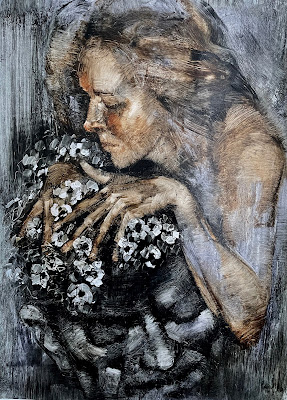
Take, for example, the painting on the left. What first catches your eye: the woman's lovely face and her intense engagement with the flowers? her slender fingers spreading themselves out lusciously among the delicate white daisies? or the gray-faced man who seems to be enduring having his skull serve as a planter? Its title, "The things we loathed became the thing we love," comes from the introductory poem to Les Fleurs du Mal.* But who exactly is loathing whom or what? And does it redeem us or debase us if we do come to love what we loathed? 
 
 
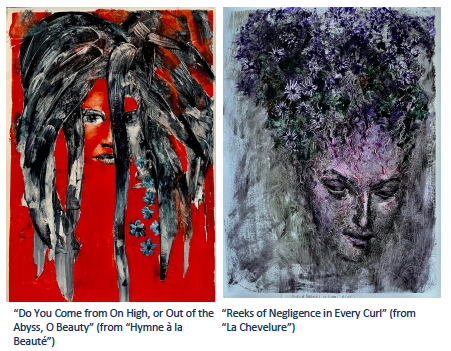
Then there are these two paintings, both of which bring Medusa to my mind.***** As the Book of Genesis says, "Now the serpent was more subtil than any beast of the field which the Lord God had made." But which of the women above is more subtle? more disempowering and dangerous? Are both to be equally feared--and pitied? When are the feared to be pitied, and the pitied to be feared? And did Medusa relish or hate being Medusa, anyway?

I leave you, "Hypocrite lecteur, — mon semblable, — mon frère!" ("hypocrite Reader — my double — my brother [/sister"]") with these questions, and an invitation to come to Scott's open studios later this month. I'd love you to experience Scott's poems inspired by Baudelaire's "sickly flowers."****** Thank you for reading, and hoping to see you in Rockland, Marshfield, or both.
 
* from "Au Lecteur."
** As Baudelaire explains it in "L'Albatros" ("The Albatross"), 
The Poet is like that wild inheritor of the cloud,
A rider of storms, above the range of arrows and slings;
Exiled on earth, at bay amid the jeering crowd,
He cannot walk for his unmanageable wings.
*** from "Easter, 1916."
***** from "La Chevelure" (The Head of Hair) https://fleursdumal.org/poem/203 and “Hymne à la Beauté” ('Hymn to Beauty)

Friday, September 15, 2023

Fielding Questions As a New Year Begins . . .

So already, when is a field a mountaintop?

  1. When it offers a "peak" experience.
  2. When, since you were a child, you've been unable to hear the song "The Sound of Music" without envisioning Julie Andrews* singing it exuberantly while running across a rolling meadow high in the Austrian Alps.

I bring this up because recently, I've been thinking again about the field in front of my husband Scott's and my cabin just over the New York border from Massachusetts. As some of you know, I've written about the field in past years as I've prepared for the Jewish High Holidays, often in conjunction with Simon Jacobson's 60 Days: A Spiritual Guide to the High Holidays.** In particular, I've written about the difficulties I've had stepping into the field, and especially with walking up to God--the King in the Field--and asking Him for what I want or need:
"When the king is in the field . . . every person has the opportunity, without petitioning for an audience, to go over to him, say hello and ask for whatever he or she needs. The king is smiling,  . . ., and he is predisposed to grant all requests. . . . It is a profound message of hope that we don't have to wait for Rosh Hashana and Yom Kippur to find G-d. We can go out to meet Him now" (26).
For reasons I don't fully understand, this particular "invitation" to connect with God has always filled me with feelings of both yearning and failure. Though on rare occasions I have spoken directly and personally to God on my own behalf, my inclination is not to do so.

But here's the irony: I love the field and 
generally feel that God is there as a presence, though not as a King. I associate the field with a state of integrated heart and mind that I seldom achieve in other places. Its natural beauty, seasonal cycles, and inherent spirit, combined with the quality of the time Scott and I spend together there, often makes the time I spend there a peak experience for me, so much so that when it's time to go home, I often find myself musing on the idea expressed on the back cover of Jacobson's book: "It's one thing to find happiness and life affirmation  when we escape to a mountain; it's quite another to be able to experience it when we are immersed in cruel, material life." Much as I may want to sustain the field feelings when I'm back home, I know too well from experience that I won't be able to for very long.

But am I confusing peak experience with some other kind of important positive experience? The bliss that I feel on my best trips to the field is not momentary; it extends over a period of days and leaves me deeply at ease rather than breathless with wonder. Can an experience be considered "peak" if it doesn't take one's breath away? And do such distinctions even matter? Isn't it enough to know there are multiple kinds of really positive experiences?

A funny thing happened to me on my way way to Rosh Hashana and Yom Kippur this year: as I was yet again working my way through 60 Days, I encountered some statements about the field that I'd completely overlooked in previous years:
Rosh Hashana and Yom Kippur are holidays. Elul [the Jewish month during which Jews prepare themselves for these holidays that happen early in the month of Tishrei] is amid workdays. We are in the field, we are still living our normal lives. Rosh Hashana and Yom Kippur have a very powerful energy, because on those days we petition the King in his inner sanctum. But in Elul, we petition the King on our turf (26).***
The field as my turf? In how many blog posts had I positioned myself on the edge of or at top of the field that I had characterized as sacred and set apart from the places where I transacted the daily business of living
among other people in the world?
 
Why had I overlooked this idea of the field, I wondered. My only explanation was that for decades. so much of my daily life has largely transpired on city streets and subway trains, in traffic jams and crowded squares, and in buildings and courtyards--places not at all reminiscent of fields. So in my life, the Berlin field and others not only represent, but actually are departures from "my turf."

But wait. Why was I obsessing over this? And about the criteria for peak experiences? "What a waste of time," I said suddenly said out loud --and then turned off my computer in disgust. 
 
But as I did, I remembered one of the questions I'd posed to myself as I'd begun my Elul reflections: "How can I break the habit of letting my mind get in the way of my heart?" Clearly, I hadn't made very much progress in this focus area.

The next morning, I awoke with no insights, and got busy with my day. I planned to visit my dad's grave at Sharon Memorial Park--it's Jewish tradition to visit the graves of loved ones before the High Holidays--before heading over to see my mother on the Skilled Nursing Floor at Orchard Cove. I shoved Sarah Hurwitz's Here All Along: Finding Meaning, Spirituality, and a Deeper Connection to Life--in Judaism (After Finally Choosing to Look There) *(4) into my bag just before leaving: I always a bring a book with me in case my mother takes an extended nap while I'm with her.
 
As usual, I got lost in Sharon Memorial Park. And I just had to laugh when I realized that now I lost in both the maze of the cemetery and the metaphor maze of my mind's making.
 
Finally, I found my dad's grave, where I spent some time imagining his voice and seeing his smile. And then I thought about how he is feeling increasingly gone to me: after all, my new grand-nephew--my dad's second great-grandson--could only have been given my dad's name--Benjamin David--if my dad were dead. And at the same time, I recognized that through this naming, my dad is somehow living on in the person of this beautiful little baby boy who will never know his voice and smile.

I would have liked to stay in the cemetery just a little bit longer, but the clock was ticking, and I didn't want to be late to Orchard Cove: for sure my dad would have wanted me to spend more time with my mother than at his grave. He always put her ahead of himself; he always put life ahead of death.
 
My mother was very cheerful when I arrived at her place, but she did sleep for about a third of my visit. So I had the opportunity to read most of the "Freeing God from 'His' Human-Shaped Cage in the Sky" chapter in Hurwitz's book.
 
It turned out to be just what I needed--a book that had questions that mattered and some answers to them. So thrilled was I to come upon them that I actually thanked my mother, my father, Sarah Hurwitz, and God (variously conceived, imagined, and explained in Hurwitz's chapter) for having combined forces to give me the opportunity to read it.

Early in the chapter, Hurwitz explains that "a God-shaped wall" had stood between her and God because she knew only one way to think about God: as "a Father/King in the sky who performs miracles, rewards us if we're good, punishes us if we're bad, and really enjoys our repetitive prayers to Him" (53). That wall began to crumble only after she went on a multi-day Jewish meditation retreat, and, in its aftermath, continued studying Judaism, but with a new understanding of where she had been going wrong before*****:
That retreat was when I first realized that I had been approaching the question of God backward. I had been starting with theology rather than experience. And even worse, I had been focusing on one particularly difficult theology--a theology that serves as a wall to the Divine for many modern Jews. (60)
It turned out that, like me, Hurwitz was generally prone to follow her mind before following her heart. As I reflected on the shift she knew she had to make, I realized again that the field is somewhere I actually did experience the Divine--until I tried to shoehorn that Divinity into the form of the King, to whom I should be speaking directly and am not.

Hurwitz further comforted me--and  included me--when she said, "While there are few things Jews agree on, there seems to be consensus that we cannot fully understand or adequately describe God" (62). After the retreat, she studied various Jewish conceptions of God; in fact, her book describes--yes, it seems somewhat contradictory that she would set out to describe them--at least nine different conceptions. There were more choices than I knew.

In retrospect, Hurwitz learned another important  lesson from doing her research, a companion lesson to the first that she learned: that "theology could be a gateway to even greater experience, expanding my sense of where and how the Divine could be" (63). Personally, I was glad that Hurwitz didn't talk about any fields--she'd said the Father/King was in the sky, not in the field--since I was tired of trying to apply metaphors to "spiritual realities" and, in the process, further distancing myself from the reality of the Divine.
 
For Scott, the field is the field—a place, not a symbol or metaphor, even though he experiences it and natural places generally as imbued with "spirit," a word he doesn't worry about capitalizing or not. If it offers an invitation to him, it’s an invitation to explore, to observe, to inquire, and sometimes to paint and draw. Earlier this month when I asked him why he'd extended the path around the field a few years back, he explained that his one purpose was to lessen the threat of Lyme Disease to both of us: where there are deer, there are deer ticks, and on a recent morning, we had seven deer in the field.
 
From Scott's perspective, the field and the path around it are one, despite the path's shorter grass, courtesy of his new weed-wacker. During his childhood summers, he simply walked through the fields on his grandparents' property in West Stockbridge, seeking to avoid only the shorter thorn bushes that occasionally cropped up among the tall, hissing grasses as he
made his way through them. He still misses those days of parting waist- and chest-high grasses with his arms. 
 
For me, the field and the path around it are both places and symbols. The path represents my personal journey around and in relationship to the field, the more traditional symbol of the potential for connecting with God during the month of Elul.

Sometimes I envy Scott his less complicated but no less profound relationship with the field and the path: there are certainly times I would rather just be at the field and not think about it what it stands for and requires. And on the other hand, sometimes I like  thinking about the field as being more than a field. 
 
Since reading Sarah Hurwitz, I feel newly empowered to choose between, or even to alternate between,"just a field" and "more than just a field." As Scott said this morning, "Metaphors aren't truth." They're merely products of imaginations intended to guide us or enlighten us. If certain ones don't work for us, or cease to work for us over time, we should push them to the side and find ones that do.

Tonight begins the new Jewish year. Shanah Tovah U'metukah! May 5784 be a sweet, beautiful new year for us all, one in which we find the tools and truths we need, or they find us.

* from the Amazon web site:  https://www.amazon.com/Sound-Music-40th-Anniversary/dp/B0006OR0VC/ref=asc_df_B0006OR0VC/?tag=hyprod-20&linkCode=df0&hvadid=385619273957&hvpos=&hvnetw=g&hvrand=10310214093701885398&hvpone=&hvptwo=&hvqmt=&hvdev=c&hvdvcmdl=&hvlocint=&hvlocphy=9002014&hvtargid=pla-403761234434&psc=1&tag=&ref=&adgrpid=82333347721&hvpone=&hvptwo=&hvadid=385619273957&hvpos=&hvnetw=g&hvrand=10310214093701885398&hvqmt=&hvdev=c&hvdvcmdl=&hvlocint=&hvlocphy=9002014&hvtargid=pla-403761234434
** Jacobson, S. (2008). 60 days: A spiritual guide to the high holidays. New York: Kiyum Press. 
*** Pieter the Elder Bruegel The Corn Harvest (August) Oil Painting Reproduction https://www.pieter-bruegel-the-elder.org/The-Corn-Harvest-August.html
**** Hurwitz, S. (2019). Here all along: Finding meaning, spirituality, and a deeper connection to life--in Judaism (after finally choosing to look there). Spiegel & Grau. 
*(5) X image for @HereAllAlong: https://twitter.com/HereAllAlong/photo

Wednesday, May 31, 2023

In the Midst of Life We Are in Death . . . And Vice Versa

So already, last Saturday, May 27, was the second day of Shavuot, the Jewish holiday celebrating "the great revelation of the giving of the Torah at Mount Sinai, more than 3,300 years ago."* The second day of Shavuot is also one of several days during the Jewish calendar year that Jews recite Yizkor, the memorial prayer for deceased loved ones. In my early years, I understood that the prayer was said only for parents, siblings, children, and spouses; today, I understand that it can be recited for any dead loved one, and even for anonymous individuals and groups. 
 
I said it while sitting at the edge of the field at our cabin in Berlin--definitely deviating from various Jewish norms and rules, I'm sure--for my father and my friend Donald, who became family long ago. I also said it this time for two old friends who died in the past month: Jonathan, who succumbed to sudden altitude-related illness on Mt. Everest on May 1, and Delia, who died of unexpected cancer-related complications on May 22. Two Mondays, three weeks apart. 
 
Some time ago, I lost direct touch with Jonathan, my fellow Needham High School graduate who was such a great big brother to me during my freshman year at college, but I still kept tabs on his life through the reports of mutual friends. 
 
Most of the Roommates
In contrast, I was in good touch with Delia, a former college roommate. I always felt a special connection to Delia because she and my dad shared not only the same birthday, but the same habit of naturally and unceremoniously doing what they could when others needed a helping hand.

If it's one thing I've learned sitting at the edge of the field at the cabin, it's that life and death are always happening at the same time. A favorite old apple tree at the bottom of the field, as seen from our chairs on the field's stream side, is now distinguished by one huge dying branch bending toward the ground beneath: no doubt some combination of winter ice and wind forced that brittle bough toward the ground into its current bowed position. The cracking sound it made when it broke from the main trunk must have been loud.

Some season soon, that damaged branch will lie horizontally on the ground. But for now, it suggests to me that death happens gradually, whether or not that 's true. I keep thinking that Delia and Jonathan are still getting used to it, perhaps because I'm still trying to get used to the fact of their deaths.
 
Meanwhile, I'm relieved that it's just that branch, as opposed to the whole tree, that's dying: the tree's elbow-shaped bend that Scott loves to paint and draw and that I love to photograph is intact. And even the broken branch that's in the process of separating from the rest of tree is sprouting leaves in a few places.

It's hard not to think of trees of life (1) when trees all around are burgeoning with new life even as some parts of them, through all kinds of natural processes, are returning to the earth--and (2) when the holiday is Shavuot: the the Torah is often described as a "a tree of life to those who hold fast to it."
 
It's also hard not to think of trees of life when the family tree grows a new branch: the day before Delia died, my nephew and niece-by-marriage became the parents of their first son and my second grand-nephew. So as I greeted the terrible news about Delia, this new little boy in our family was happily much on my mind. "In the midst of life we are in death," and in the midst of death we are in life, I thought to myself, having sung "The Service for the Burial of the Dead" by Thomas Morley so many times during college.
 
Such a beautiful baby boy whose name would not be revealed until the B'rit Milah, the ritual circumcision that would take place eight days after his birth.
 
In the Jewish tradition, babies are named only for people who are no longer living.** So my first question was whether my new nephew would be named Benjamin David, for my father who died in December 2020. My second jumping-the-gun question was whether the baby, if he were named Benjamin, would be called Ben or Benjie. 

I was hopeful: Delia had had her last pre-surgery chemo treatment on her and my dad's birthday. She was being cared for at the home of her older brother Benjie (I don't know he spells it) and his wife. After she died, I was communicating with her nephew Ben, sending photos of her, letting him know whom I'd notified of her passing. The name Benjamin was everywhere in the air, consoling me and giving me hope.

The Yizkor service also comforted me, giving me something to do that I didn't have to invent. The Lev Ha Shalem prayer book is always a great source of inspirational and provocative poems and readings in addition to the traditional prayers and translations. Because my husband Scott's art often, in my opinion, suggests a fluidity between life and death, I shared with him the poem "In Everything" by Lea Goldberg that was featured alongside one page of the service:

In everything there is at least an eighth part
that is death. Its weight is not great.
With that secret and carefree grace
we carry it everywhere we go.
On lovely awakenings, on journeys,
in lovers' words, in our distraction
forgotten at the edges of our affairs
it is always with us. Weighing
hardly anything at all.
(translated by Rachel Tvia Back)***
Scott asked me about the "eighth part"--why not a different fraction, he wanted to know. I said that eight is often an important number in Judaism: eight days of Passover, eight days of Hanukkah, eight days between a birth and a b'rit. But I didn't have a real answer, since other numbers are significant, too.
 
I wish I were naturally and completely easy with the perpetual overlapping of life and death. My impulse is always to try to keep life "safe" from death. So I'm appreciative of this poem in which the reality of the fraction of death in life does not taint life, does not weigh it down, does not make it less alive, less valuable, less wonderful. The idea that we carry death with "secret and carefree grace" reassures me. I'm certain that that grace is coming through me, not from me, and I'm grateful for it.
 
In this month of so much sad news--but with so many happy memories associated with that sad news--along comes a beautiful new baby and eight days later, the revelation of his name--Benjamin David, my sister told me in a text on Sunday morning. My father's memory--and the memories of Delia, Jonathan, and Donald--are indeed for blessings. All four of them shared a love of life.

* Chabad.org. (*2023, May). Hear the Ten Commandments on Shavuot. https://www.chabad.org/library/article_cdo/aid/2157/jewish/Hear-the-Ten-Commandments-on-Shavuot.htm (art also accompanying this post by Sefira Lightstone: https://www.sefiracreative.com/)
** Photo accompanying article: Klein, M. (N.D.). A historical view of choosing a Jewish name. My Jewish Learning. https://www.myjewishlearning.com/article/a-historical-view-of-choosing-a-name/
*** See page 337 of the following Lev Ha Shalem Yizkor pdf file: https://images.shulcloud.com/1039/uploads/passover-pages/YizkorforPesahandShavuotSIDDURLEVSHALEM.pdf