The other day, getting to and from my regular dentist appointment took me into the Boston neighborhoods where so many of my relatives -- including my parents -- grew up in the 1930's and 1940's. This brought back a lot of Jewish memories -- not my own, but those of my parents, who often and easily recollect stories of grandparents, cousins, aunts, and uncles, all of whom they lived near enough to to see relatively often. Over the years, I've heard many stories (often more than once!) of relatives whose Jewish lives were marked by different degrees of ritual observance and cultural and personal interpretation. My mother's paternal grandmother observed even the "minor" Jewish fast days; my paternal grandfather sometimes didn't fast on Yom Kippur. Varieties of "Jewish decisions and actions" elicited respect, curiosity, and criticism from other family members.

Behold, a good doctrine has been given you, My Torah; do
not forsake it. It is a tree of life to those who hold it fast, and
all that cling to it find happiness. Its ways are ways of pleasant-
ness, and all its paths are peace.
But here's the problem: I'm not a good Jew. When all is said and done, I don't "hold it fast" and "cling to it." I break dietary laws left and right (Oy!), do schoolwork on the Sabbath (Oy!!), and don't worship regularly at a synagogue (Oy!!!). Furthermore, I married late, and my non-Jewish husband and I have no children whom we are immersing in that Jewish legacy that is so meaningful to me (Oy!!!!).
I suspect the roots of this lie in part* in my having grown up in Jamaica Plain where I was the only Jewish kid in my class. By the time we moved to Needham where I actually did have Jewish classmates and could walk to our synagogue to attend youth group meetings, I felt no need to have a teenage community that was exclusively Jewish. In addition, it was the 1960s and 1970s, and people were trying to "smile on your brother" and "love one another": I was always being invited to the homes of friends of different cultural and religious backgrounds for their holiday observances. I remember being more interested in learning about everyone else's religions than in paying attention to my own. I suspect that one of the reasons for this was that I already viewed my Jewishness as quintessentially part of me, as something that would be there when I chose to embrace it. Sometimes I wonder if my story is a typically American Jewish story.
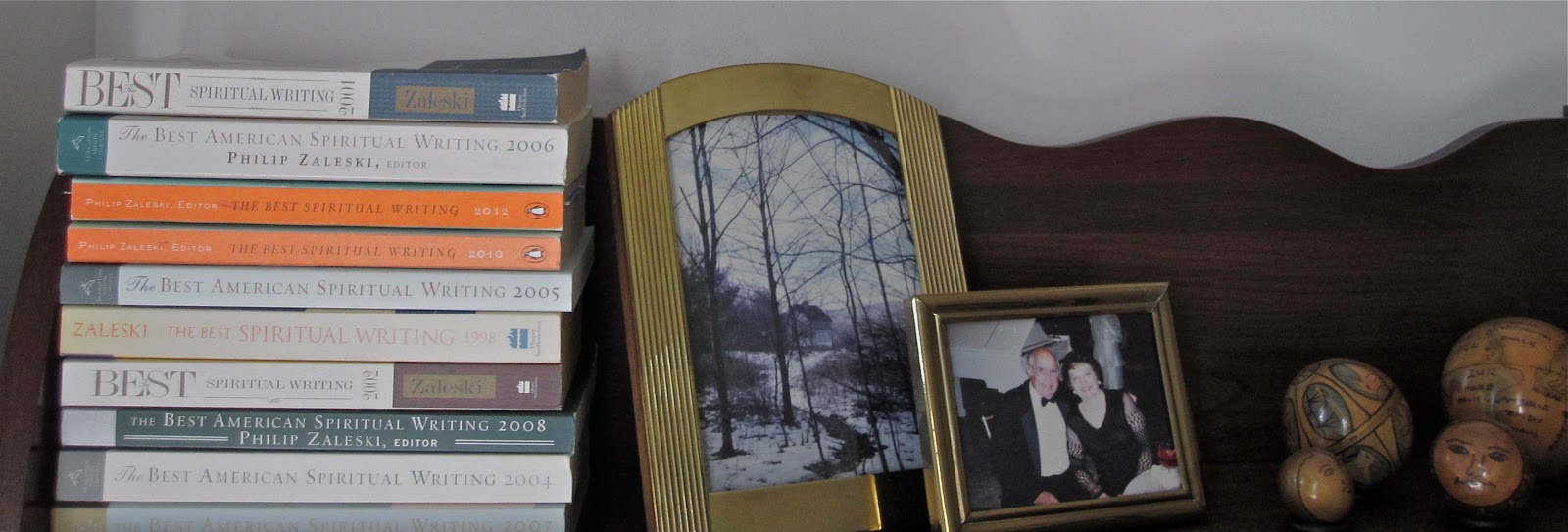
While Philip Zaleski always provides a foreward to begin the annual collection of carefully selected writings, each volume usually includes an introduction by some author, thinker, or leader generally regarded as "spiritual." The year that Peter Gomes was the guest introduction-writer, I -- responding to the spirit of Advent that was alive for so many of my Christian friends -- determined to read the entire volume as my own Advent ritual.** Though I definitely preferred some of the anthologized pieces to others, I was glad I read the whole book -- glad I'd carved out an opportunity to care about more than the relentless demands of the daily.

I had first encountered Ben Birnbaum when he participated in a Harvard Divinity School forum that centered on James Carroll's then recently published book, Constantine's Sword: The Church and the Jews, a History. As the assistant to the president of Boston College and the editor of Boston College Magazine, he was a self-reflective Jew whose formal ties to various BC Jewish-Christian initiatives made him an old hand at both personal and intellectual engagement with Christians and people of other religious backgrounds.
I read Birnbaum's essay for the first time during one of my periodic bouts with deep spiritual isolation: inevitably, I experience moments when I long for more Jewish friends or a Jewish community that might help me to understand my loneliness and then transcend it. Birnbaum's combination of personal memories, Jewish knowledge, and self-reflectiveness provided me with both spiritual hope and reasons to laugh. Early in the essay, he asserts what prayer is and isn't:
Prayer does not take you into your self or out of our world. It is not
a transcendental meditation. The relaxation response is not its goal.
Nor is prayer oratory. Rather, prayer places you in proximal, eyes-
front relationship with the Creator. And so the Hebrew word for
liturgical prayer is tefilah, an invocation of God as judge.
But then, right after speaking with didactic authority, he backs off: "But the Talmud is merely the glorious Talmud. It is not Judaism; it is not the lives of men and women, lived in the valleys and on the flats -- holy ground that is nonetheless ground."
Next he recounts a story: a boy who had been praying with a passage of scripture asked his father, a Chasidic rabbi, "'With what are you praying?' The rabbi answered, 'With the floor and the bench.'" This story echoes Birnbaum's experience: "In Brooklyn, New York, in the early 1950's, I learned to pray as most of us learn to pray: with the floor and with the bench, or in my case, with the sheet linoleum and gunmetal folding chairs in the Young Israel Synagogue of New Lots and East New York, . . .."
Temple Emeth Saturday morning youth services and the long High Holy Day services of my childhood: the duty and repetitiveness all came back to me with Birnbaum's gunmetal and linoleum. Pages later, I identified with Birnbaum's description of himself as a "modern," incapable of "feel[ing] comfortable except If I rest on vexatious ambiguity, the rough mattress I'm used to." But despite his stories and admissions, Birnbaum prays. So, I kept reading. I would have to learn more about "selfless devotion" and "'With all your might before God'" in order to quell the deep loneliness that I was feeling, but the reverence part I got. And I felt somehow consoled by Birnbaum's print companionship on the spiritual road.
Over time, I've been learning it's all about reaching out and reaching toward -- but that doesn't mean I've been doing much reaching. In 2004, I was part of a Cambridge Forum Round Table Discussion that featured author Katherine Paterson in an event entitled "'Are You There God?' Asking Big Questions in Children's Literature." When the third panelist, a minister on the faculty of Harvard Divinity School, spoke about her faith and its role in her life and her teaching, the moderator asked me what I believed.
Even my closest friends seldom ask me exactly if I believe and what I believe. But here I was in this very public forum that was being taped for radio. I felt that I needed to answer: anyone who teaches "Religion and Literature" to public high school students has to know what she believes so she's sure not to present it as "truth" that students are responsible for accepting and learning. I also wanted to answer the question.
So I prefaced my answer with two Jewish jokes, which I've never been able to forget.
In the first, a young man says, "Rabbi, I don't think I believe in God," to which the rabbi replies, "Do you think God cares?"
In the second, two rabbis are having a religious argument. When they realize neither will persuade the other, they decide to ask God. When God sides with one of the rabbis, the other says, "So now it's two against one."
I then explained that I loved that I came from a religious background in which argument and debate were the norm. I also explained that I believed in God but didn't have a close relationship with Him. That said, I wanted to make clear that I wasn't blaming God for this; I was the one who wasn't coming around very much.
Lately I've been wondering if I might like to make that relationship a little closer. At my core, I am Jewish, and I know I have been given a good doctrine. What holds me back is that spirit presents itself to me so many ways, events, places, and people. I am struggling to embrace my Judaism and experience it fully while needing not to deny spirit as it manifests itself "non-Jewishly" in the world.
So I'm going to keep reading. And I'm also going to try praying more, even though it tends to feel inauthentic to me, except when I'm lighting the Sabbath candles. We live in an innovative age. So already, who knows what will happen?
* They also lie in part in a certain kind of orneriness that I exhibit when people try to tell me what to do.
** Creating an Advent ritual: this is the kind of thing Jews don't usually do.