Sunday, December 15, 2013

Unfolding and Becoming at The Newman Junior High School

So already, as my teacher days wind down, I find myself thinking a lot about my student days.  While I've always understood the critical role high school played in my development as a person and educator, only recently have I understood that my junior high school experiences may have been even more pivotal. I owe this realization to a number of long conversations with my very good junior-high-school-then-high-school friend Betsy Hoffman (now Betsy Sugameli). Sometimes Betsy's and my memories and interpretations align perfectly; other times, her recollections and perspectives fill in gaps and challenge my ideas about what we all were thinking and feeling back then.

In the late 1960's, Needham had two junior high schools, the Newman and the Pollard.  Since then, the Pollard Junior High School has become Needham's only middle school, the Pollard Middle School, while the Newman Junior High School has become an elementary school called simply the Newman School. I attended the Newman Junior High School for grades seven through nine, from September 1967 to June 1970.

The Newman School, pictured here, looks much like our junior high school did, except our school lacked the decorative murals you can discern on the right-hand side of this photograph.  What you can also see here is the front courtyard part of the school where we hung out after our school buses deposited us in front of the school each morning.  It was here where we processed the news that Martin Luther King had been killed, where two months later we processed the news that Bobby Kennedy had been killed -- and wondered who would die next, and where two years later we tried to understand why the National Guard had shot to kill at Kent State. This we did against the backdrop of the steady stream of images from the Vietnam War -- gruesome deaths and hollow-eyed, exhausted soldiers -- provided to us by the evening news and Life magazine. 

Still, most of the time, despite these moments of consciousness and confusion, we were just busy being early-adolescent kids with activities to participate in, homework to do, and subjects and teachers to study. 

So first for the subjects and then for the teachers. There were definitely some important learning firsts for me at the Newman that shaped me as a learner and teacher both.

The "new curriculum" that threatened to ruin my eighth-grade sanity was IPS, or Introductory Physical Science. I remember the turquoise book with its grid-lined cover -- the seventh edition, which I found online, still features  that graph-paper motif that warns students to expect that graphed experimental data will be central to their daily learning endeavors. And that was the problem:  an excellent memorizer, I had powered my way through school up to that point by my ability to swallow and regurgitate minutiae.  And now I was confronted by inquiry:  each chapter consisted of roughly six pages of reading followed by many more pages of problems; who had ever heard of a textbook with more problems than pages of facts that I could memorize?  Disoriented and displeased by this shift in the learning world order, I fretted over every lab.  But Mr. Soucy was always patient, always quietly excited about the science itself, and always there after school when I or anybody else wanted to stay late for extra help -- which was often.  I admit that to this day, I still become anxious when I walk by a science lab and recognize the familiar smell of the "Distillation of Wood" experiment, but I learned from that experience that I could learn in a new way.

Gym class was another place where I gained some learning confidence -- probably because my natural non-athleticism was a complete non-issue.* In seventh grade, our teachers wanted us to have positive, safe experiences of the gymnastics equipment that we were encountering for the first time and that called for new skills and new strengths.  I wasn't good at gymnastics, but I loved it -- how it felt to do it and what it looked like when it was done right.  Most importantly, I didn't fear it.  In fact, I was willing to try to do almost anything we were learning because I was always flanked by at least two "spotters" whom I trusted to guide me or break my fall if necessary. Junior high gym class taught me the importance of spotters no matter what one is trying to learn.  Consequently, as a teacher, I've always tried to create classrooms in which students grapple with new and intimidating learning experiences in the supportive company of spotters, peers stationed very nearby to help them take learning risks without fear of serious academic injury.

While I can't recall if the choral group I was in was part of the Newman's music curricular program or an extra-curricular activity, I can remember being electrified by Vincent Persichetti's choral setting of e.e. cummings' "Sam Was a Man."** It was my first experience of both hearing and singing anything that seemed to defy in the most haunting, arresting way every expectation my fourteen-year-old self had of what and how people could sing together beautifully and movingly.  I was so taken by the way the different parts combined, divided, and moved that I learned to play them on the piano at home*** just so I could figure out how the piece worked rhythmically and harmonically as parts and a whole.  So began my romance with twentieth-century (and now twenty-first-century) choral music. 

Meanwhile, math served up new computer-science-related learning experiences. As junior high school students, we were supposed to master flowcharting in preparation for learning FOCAL and BASIC, two computer languages, once we got to Needham High. So one of my math classmates and I became pretty proficient at creating flowcharts that potentially solved problems -- though not as proficient as we had hoped.  As the co-founders of the Female League of Nostril-Flairers (FLONF), we created a flowchart (not the one you're seeing here) to help the flair-challenged learn how to flair their nostrils so, as members of the organization, they could participate successfully in flairathons.  Unfortunately, those who couldn't flair got caught in an inescapable loop that relegated them, like Tantalos or Sisyphos, to an eternity of futile effort.

Our math teacher, and our other teachers, were aware of FLONF -- just as they were aware, we came to find out, that another one of my classmates had created a religion around herself, and even a temple to herself called "The Marthenon." When my classmates and I had our teachers sign our ninth-grade yearbooks -- I wish I could find Zodiaction! -- I realized how much they had been paying attention. Though I don't remember it verbatim, I still remember the gist of the comment written by Mrs. Helen Rees, my Western Civilization teacher:  You've started an organization; now go start a school.  It was the first time any adult had invited me to envision myself as an adult capable of doing something creative and important.

It seems important also to talk about the one harmful teacher we had amidst the numerous caring and competent ones, lest you think the Newman Junior High School was an educational utopia. Steve Seidel often talks about the "apprenticeship of observation" -- the kind of learning that people do simply by watching, analyzing, and reflecting; Howard Gardner talks about "tormentors" -- the people whose contribution to our development is their capacity to model and embody everything we don't want to be, and that we commit to not being. We learned important lessons from our "bad" teacher, too.

One of my English teachers, who will remain nameless, was that "tormentor." I was one of her favorites whom she "let" do certain tasks for her. For example, after arriving late to class, coffee cup in hand, Mrs. Tormentor routinely had me administer quizzes after saying to me in front of the class, "You give the quiz, since you'd probably get a 100 on it anyway." Whenever I whispered, my aforementioned friend Betsy was accused of disrupting the class.  But there were more even more strange and dangerous things going on. During our study of To Kill a Mockingbird, Mrs. Tormentor forbade the use of the word "rape" during class discussion, and regularly pronounced "Negro" as niggero. Luckily, Mrs. Tormentor was so consistently lazy, mean, and prejudiced (African-Americans were not the only group about whom she generalized while teaching literature) that our class was united in despising her. Years later when I ran into her in a lecture hall at Harvard, she quipped, "Well it's good to see that at least one of you amounted to something," confirming what we'd all always known:  that she had had nothing but contempt for us. 

But while Mrs. Tormentor had little interest in teaching us English and no interest in us, Mrs. Ruth Winters, our math teacher, loved math and loved us.  As a matter of fact, this blog post primarily exists because she has been much on my mind over the months -- probably because I recently realized that I must be about the same age she was when she was our teacher.  I now recognize that hers was the first class that I hoped my own classes might feel and be like. 

Though she was my math teacher in both eighth and ninth grades, I first became aware of Mrs. Winters when I was a seventh grader. She was tall and formidable as she monitored the first-floor hallway in between classes. Her loosely styled hair and white frilled blouses gave her an old-fashioned look that intimidated me. It wouldn't have occurred to me back then to describe a woman as handsome, but Mrs. Winters was.  At some later point when I was reading or rereading The Adventures of Huckleberry Finn, I realized that some the language Huck uses to describe Charlotte Grangerford**** seemed just right for Mrs. Winters: "Then there was Miss Charlotte, she was twenty-five, and tall and proud and grand, but as good as she could be when she warn't stirred up; but when she was, she had a look that would make you wilt in your tracks, like her father."

But that was the great thing about Mrs. Winters, we quickly learned as her students:  she took no pleasure in making anybody wilt.  That hallway mask that silently commanded "Don't you dare run down this hall or even think about poking anybody" was replaced in the classroom by an easy, welcoming smile and a deep, ready laugh. Her eyes sparkled whether she was reporting on her progress making her daughter's wedding gown or explaining to us how the quadratic equation was derived and what it could be used for. Always the message about math was that it was hard, interesting, worthwhile, and do-able.  And born and raised in Kentucky, Mrs. Winters had memorable regionalisms to assure us that we could master the math at hand:  some techniques were "as easy as falling off a log backwards," while others were "like going around Kelly's barn -- and I knew Mr. Kelly."

There were two other things that happened during math class that had nothing to do with the learning of math content associated with Algebra I and Algebra II.   

The first involved two boys in our class who were regularly truant from school -- and who routinely got the highest marks on math tests. When B.B. and W.D. arrived on test days, they could easily prove while they were taking the test the theorems that the rest of us had been laboring over for the last two weeks, and they could also readily apply them. Mrs. Winters refused to fail them, despite what I now recognize must have been some administrative pressure: her job was to assess whether they had learned the math, she explained, and they had. It was important to her that we understand her thinking -- her belief that different students learned in different ways and that those ways needed to be acknowledged and respected.  Did she think there should be no consequences for the boys' truancy? No. But was a failing grade in math the right consequence? No.


The second involved several days in mid-June 1970.  At one point, Mrs. Winters announced that we had learned all the math we needed to learn for the school year, so we were going to play softball for the last few days of class.  Though I'm terrible at most sports, softball was by far my worst sport:  in sixth grade during our Presidential Fitness Tests, the legacy of JFK, I had thrown the softball the shortest distance of anybody in my class. But none of this mattered in June 1970:  we were going to spend an hour together for each of the next few days at the softball field that abutted the grounds of the high school with our real focus on simply being a group that had learned enough together and enjoyed being together.  Our softball skills didn't matter; our connections to one another did.


The spring of 1970 was an intense time.  On April 22, two weeks before the Kent State shootings, we celebrated the first Earth Day at the Newman by planting trees on the barren stretch of land between the softball field where my math class played in June and the grounds of the school. I like to go over to the Newman School every April during school vacation to check on those woods that we planted -- which you see here to the left. One year, I brought my mother with me, and she asked if I knew which tree was mine.  I told her I didn't know whether my little tree had survived to be among those standing and reaching toward the sky, but I still knew that I had helped to create those woods.

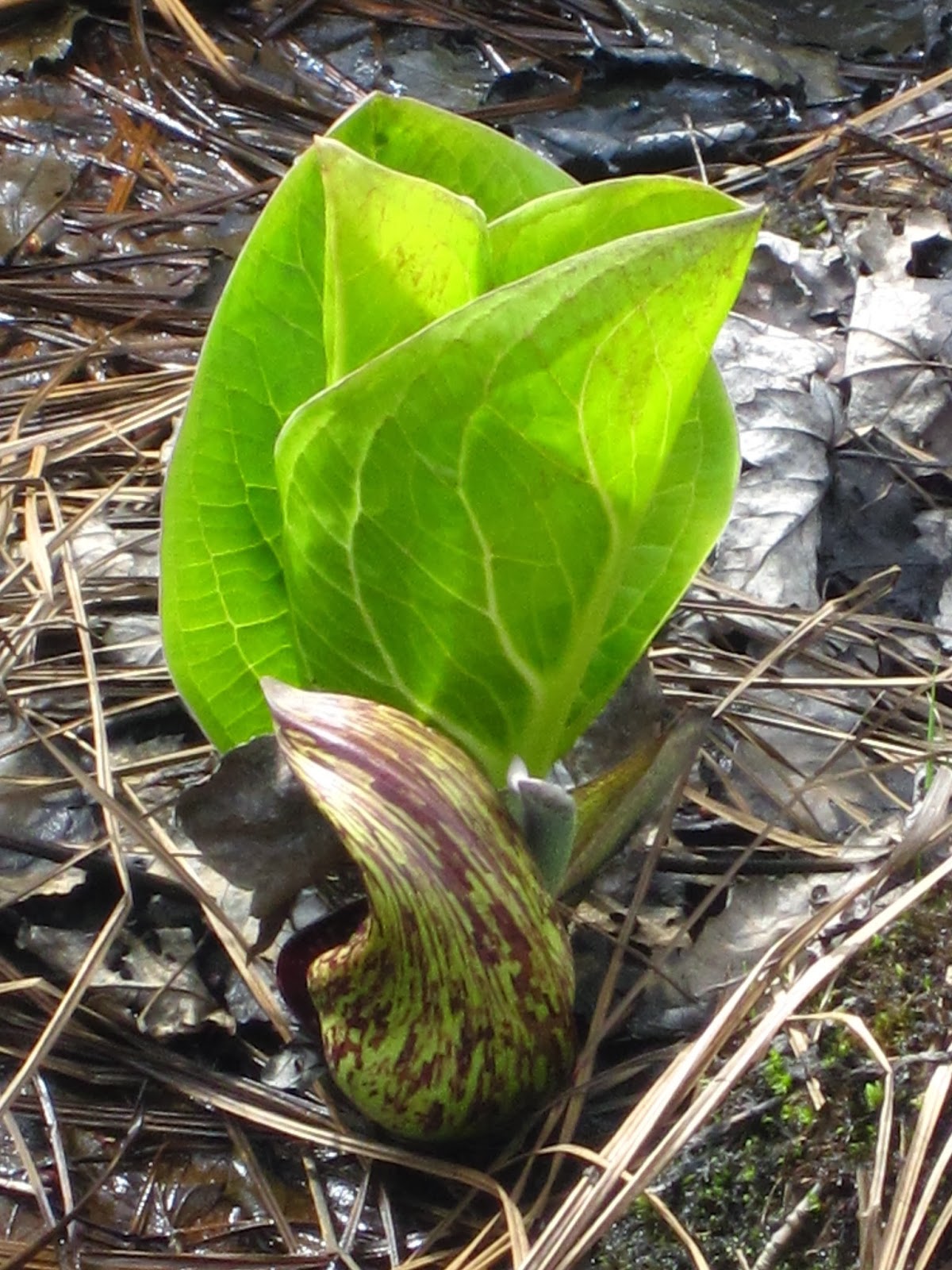
This year, I went over to check on the woods the day after the Boston Marathon bombings. It comforted me to be there. Things are different at the Newman School -- a daycare center abuts the area we forested, and several daycare teachers eyed me suspiciously because I seemed to be hanging around for no reason. Meanwhile, a series of nature trails have been added to the school grounds. So on that mild Tuesday morning, every sun-warmed pool was bursting with new green life.  In particular, skunk cabbage was blatantly and beautifully unfurling its leaves wherever I looked, reminding me how at this very same spot many years ago, I had been allowed and encouraged to unfold and bloom.  As a student at the Newman Junior High School, I overcame fears, developed new skills and knowledge, learned new ways to learn, was encouraged to imagine and act, and felt cared about.  It's so interesting to me that only recently have I realized how much my own values and commitments as an educator have been a direct reflection of my student experiences at the Newman Junior High School.

[If you haven't looked at my blog lately, please note that you will now find that you can scroll down on the "Comment as" menu to "Anonymous" and elect that option if you don't have an existing online identity that this blog-host site will recognize.  Your post will be ascribed to "Anonymous" unless you sign your actual post in some way that identifies you as the person commenting.]

* Gymnastic URL:  <http://www.123rf.com/photo_7596910_human-showing-postures-of-gymnastics.html>.
** The Cummings poem from Kennedy, Richard. Ed. E.E. Cummings Selected Poems. New York: Liveright, 1994. 58-59. Print.

rain or hail                                  heart was big
sam done                                   as the world aint square
the best he kin                           with room for the devil
till they digged his hole              and his angels too

:sam was a man                        yes,sir

stout as a bridge                       what may be better
rugged as a bear                      or what may be worse
slickern a weazel                      and what may be clover
how be you                               clover clover

(sun or snow)                           (nobody’ll know)

gone into what                          sam was a man
like all them kings                     grinned his grin
you read about                         done his chores
and on him sings                      laid him down.

a whippoorwill;                         Sleep well


*** "Sam Was a Man" music URL:  <http://thoughtfulgestures.files.wordpress.com/2012/07/sam-1.jpg> 
**** One of the original E.W. Kemble illustrations of the Shepherdson-Grangerford section of The Adventures of Huckleberry Finn.

Friday, November 29, 2013

Recalled to Life: The Gift of the CRLS Ninth Grade History Teacher Team

So already, "This is no country for old men," William Butler Yeats said in "Sailing to Byzantium." And nobody likes a crone.  Even though I'm probably too young for technical crone status, and it's more institutions than individuals that marginalize crones (and sometimes downright banish them from places of respect and influence), I couldn't resist that last declaration.  The minute that anyone declares that s/he is retiring by virtue of having been an educator long enough to qualify for the maximum pension, s/he begins to be perceived as "departing elder" rather than as "veteran teacher and colleague." 

So first of all, a warning:  this blog post is going to ramble.  It will begin with reflections of the experience of edging toward retirement, vent a bit, offer some thoughts about reading instruction, and and then offer thanks to a group of my colleagues -- very appropriate during the Thanksgiving weekend -- who may not know that they did me a great kindness recently.  The above image -- I've taken a screenshot of an image on the "Birthing the Crone" Home Page -- represents my understanding that an illuminating blog post could be a croning achievement. So let's hope, and here goes.

By Yair Haklai (Own work) [CC-BY-SA-3.0 (http://creativecommons.org/licenses/by-sa/3.0) or GFDL (http://www.gnu.org/copyleft/fdl.html)], via Wikimedia CommonsSince announcing officially my intention to retire from Cambridge Rindge and Latin School, I have felt institutional invisibility encroaching:  no more invitations to workshops and trainings, far fewer administrator solicitations of my opinions about potential policies, programs, or resources.  Even my Learning Community R mailbox has been positioned so that when I leave in January, the alphabetized flow of my colleagues' mailboxes will not be disrupted by an empty gap in the "S" area.  I think I often feel the way Eurydice might have after Orpheus turned around and looked at her, and she found herself slipping gently backward into the underworld -- and into the permanent status of "shade," as so many translations of The Odyssey refer to the underworld's inhabitants.

While I continue to feel valued by so many individual colleagues, from an institutional perspective, I have already passed on.  Interestingly, James Joyce also uses the word "shade" to refer to those who have come and gone in "The Dead," the culminating story of his collection entitled Dubliners.  This story, which will be the last piece of literature that my AP Literature & Composition students and I will explore as a class text -- I'm timing it so that our discussion of the story will take place on January 6, the same date that the characters in the story are celebrating Epiphany -- is so much about who matters for how long and to whom, and about all the petty vanities and misconceptions that accompany our alternatively prized and despised conceptions of ourselves.


I love "The Dead" more than I can tell you -- the book; the movie; the heart-wrenching details of place, food, and thought; the dialogue that sometimes becomes heartfelt communication; the attempts and failures to "only connect" musically and personally over the course of a sometimes excruciatingly long dinner; the last paragraph (I'm hardly alone in loving that paragraph). One of my favorite moments in the book occurs when, amidst the general praise of Aunt Julia's singing, Aunt Kate interjects her angry opinion about the Pope's not-recent decision to replace Aunt Julia and other female singers in the church choirs with boys:  ". . . I think it's not at all honourable for the pope to turn out the women out of the choirs that have slaved there all their lives and put little whipper-snappers of boys over their heads."

I mention this line and Aunt Kate's anger because I often feel that education, especially the business and policy of education, is often dominated by "little whipper-snappers of boys" and girls who bring energy, skill, commitment, confidence, and business cards to the endeavor of improving learning and schools, but whose limited experience in actual schools -- and that means with students, parents, teachers, and administrators -- is more significant than they believe.  That they are so often in the company of others with similarly limited experience may be what prevents them from recognizing how their own lack of experience undercuts their efforts to be persuasive not of business-people and policy-makers, but of people who actually work with children on a daily basis.  I suspect that the marked professional certainty that a number of them exude is in part a reflection of their characters and needs -- most specifically, the need to be influential and important and the need to be successful, even though no teacher always succeeds.

This is my way of saying that I don't take kindly to being treated like a shade by twenty-eight-year-olds, whether they are on the payrolls of the Cambridge Public Schools, the College Board, or any big educational foundation, who indulge me by pretending to listen to my counter-experience or counter-suggestion while thinking that I "once" must have been a good teacher. Luckily, we have few of those people at CRLS since, as people who work in an actual school, most of us are daily humbled by our classroom experiences. 

And all of the above is why I am so grateful to the whipper-snapper-free CRLS Ninth Grade History Team, the teachers who meet every Friday during first period to figure out how to better serve our school's ninth-grade history students, and their very competent and thoughtful dean of curriculum for asking me to come to work with them on helping ninth graders become proficient readers of primary source documents and other texts. With their invitation, the ninth grade teachers pulled me out of the pre-retirement shadows -- and gave me the opportunity to synthesize a lot of the thinking I'd been doing about the companion processes of reading, writing, speaking, and listening since I returned to the classroom as a teacher of AP English and recognized how much my high-achieving juniors and seniors struggled to make sense of long, syntactically complex sentences.  And if they were struggling, didn't it stand to reason that other CRLS students were also struggling?

My most intensive literacy-related learning experiences occurred  ten-to-fifteen years ago when, as a CRLS teacher, I had multiple opportunities to work closely with staff of WestEd's Strategic Literacy Initiative/Reading Apprenticeship Program.  When I was the literacy specialist at English High School in Boston during the 2001-2002 school year, my Reading-Apprenticeship-related know-how grew in leaps and bounds through extensive training and collegial learning opportunities, usually under the always thoughtful and always responsive guidance of either Randy Bomer or Margaret Ciardi. The district focus on implementing the reading and writing workshop model in all Boston classrooms meant that we spent many Saturdays in trainings in which we learned as both teachers of students and teachers of other teachers.

The challenge of helping others to read better is that all reading is essentially on some level an individual and invisible meaning-making process, even when we scaffold it, coach it, and externalize the thinking processes associated with it.  Fortunately, in the years between my specifically cross-disciplinary literacy-centered work at both EHS and CRLS, and the development of the Common Core with its emphasis on various kinds of literacy, other important professional learning experiences presented themselves and contributed to my and my colleagues' efforts to improve student reading.  Project Zero's Making Learning Visible project provided many ideas for how and when to capture students' thinking processes so that students themselves could see and hear, and therefore examine their own thought processes while reading, and then develop their own theories of and action plans for how they personally could read more strategically and successfully. My colleague Jennifer Hogue's "Slugs and Cherries" documentation gave many of us tools, guidelines, and hope -- a prototype that we could replicate in our own classrooms and embed in reflective discussion allowing students to guide themselves.

The Making Learning Visible work, which is based on the insights and practices developed in the Reggio Emilia pre-schools and infant-toddler centers, contributed another important approach to my reading arsenal.  Long ago, I learned from Project Zero MLV researchers that Reggio teachers almost never asked students to draw something, describe something, or extract the properties of something without placing it next to something else that it could be seen in relation to: in other words, I would have a much better shot at describing an apple if I could think about how it was and wasn't like the orange next to it. So didn't it make sense that I would be able to make more sense of a text if I could compare and contrast it with another different yet related one? When my students were struggling to make sense of both "When Lilacs Last in the Dooryard Bloom'd" and "The Love Song of J. Alfred Prufrock," responding to true-and-false questions that required them to compare and contrast the two poems helped them to understand both poems better. When they were struggling to make sense of Marge Piercy's "A Work of Artifice" and Billy Collins' "Bonsai," they helped further their collective understanding of both poems by crafting true-and-false questions in small groups and then asking them of one another.

The Question Formulation Technique, courtesy of the Right Question Institute, became another important knife in the reading comprehension drawer -- one that challenged some of what I'd been taught by our WestEd trainers. Like a number of reading comprehension approaches, the QFT stresses the importance of developing students' capacities and confidence not only to raise questions, but to recognize their questions' relative usefulness for a given purpose, be it reading or something else. WestEd provides a number of tools and resources for helping students to generate questions in various categories as a way to penetrate a text.  In contrast, the QFT specifically forbids the judging and classifying of student questions during the question-generating process, whether it is focusing on a text passage or another kind of QFocus, out of concern that doing so will predispose some students both to remain quiet (for fear of "doing it wrong") and to look to their teachers rather than to themselves for the validation of their thinking and questioning efforts.  The good news:  once the QFT process is complete, a teacher can choose to have students return to the questions they generated during the actual multi-step QFT process and categorize them according to any number of frameworks aimed at supporting and promoting critical reading and thinking. Such an activity, and such a sequence of activities, properly framed, should remind students of the worth of all of the questions they generated during the QFT process because of the authentic nature of all of those questions.  

Now add to the mix a couple of articles I read in the last year that made a huge impression on me, most notably "The Writing Revolution" in the October 2012 issue of The Atlantic Monthly and a very brief article in an ASCD Education Update entitled "It's Complicated:  Common Core State Standards Focus on Text Complexity."


The Atlantic article reminded me of important work we did in the early 2000's in CRLS' Learning Community 4 in conjunction with our reading of parts of The Thinking Classroom by Tishman, Perkins, and Jay: through some initial classroom research, we learned that our students confused the language of some thought processes -- for example, they thought "to describe" meant "to explain," and vice versa; and frequently they had indefinite understandings of what oft-used connective language -- words like "although," "furthermore," and "despite" -- meant in reading contexts. Generally, they lacked the language to express the thoughts and ideas they were having -- which is just what the teachers at New Dorp High School also discovered. New Dorp teachers, the article reports, explicitly taught this language of relationship among facts and ideas, and had students express their understanding of content by using it:  for example, a science teacher had students write discrete sentences beginning with "although," "if," and "unless" to describe the properties of and relationship between hydrogen and oxygen. When I read this, I immediately had thoughts about how such an approach would help my AP students, who tended to present all of their thinking in compound sentences that structurally made ideas within the sentence equally important, to write sentences that both subordinated lesser ideas and spelled out the precise relationships between the main and subordinate ideas.  I also began to wonder if my students' relatively infrequent use of subordinating conjunctions and common transitional phrases might signal their difficulties using these to aid their reading comprehension.


"It's Complicated" told me something I have known for several years as a result of listening to my students describe what they were thinking as they tried to make sense of long sentences, especially ones written before 1900:  most of my students do not have the language of syntax at all available to them as something they can use to talk to themselves or to one another.* The article also told me something that flew in the face of what I had been taught about bridging students and texts -- and that actually made total sense on the basis of my classroom experience: "text-to-self" questions, and other techniques that ask students to initiate their exploration of a complex text by making a personal connection to it should be avoided for reasons of "Instructional time," "Equity," and "Rigor" (7).** Reading this article brought me back to a number of classroom experiences during which students had identified strongly with less-than-major facets of texts and had been so emotionally caught up in their own related stories that they were unable to refocus on the texts that elicited them.  "Text-to-self" was not a bad thing:  it just needed not to be the first thing.

So where did all of this lead me?  To a series of "what if" questions that changed my practice around reading?
  • What if I taught syntax more deliberately?  And what if I came up with strategies for constructing and deconstructing long sentences that would work for students who know the terminology associated with grammar and syntax -- and for those who do not?
  • What if I had students do more writing about the texts that we read -- much briefer writing about the texts, perhaps even single-sentence writing about a given text -- but writing that needs to employ certain words or exhibit prescribed grammatical structures? 
  • What if I sequenced documentation-supported reading instructional activities, including the QFT, so that students could play a leading role in generating questions and identifying those that best promote textual understanding? And what if we used our QFT-initiated work to help students themselves to understand better what kinds of questions increase their reading comprehension, as well as when and how their personal connections to the content of a text at hand help and hinder their efforts to understand it?

The result was the Friday morning session I had with the Ninth Grade History Team on November 22. Because at least one of the group was the veteran of some of my old literacy-support professional development efforts, I framed my major points in terms of how they represented changes in my own reading-related instructional practice as a reflection of current reading best practice and research, and my own classroom experimentation.  We spent a good chunk of our time together talking about how we might help our students -- who might not know that Kate Middleton is the Duchess of Cambridge, and who might be unfamiliar with the words "togs," "vestments," and "perambulator" -- to make sense of the following two sentences:

        Because she was at school, of course, being that it was a Monday, 
        Marian missed the opportunity that Regina had to see Kate 
        Middleton’s newest togs, provided by the House of Alexander 
        McQueen, which had also designed and created the Duchess 
        of Cambridge’s much-admired wedding gown.  Audibly gasped 
        and oohed the crowd as they beheld the exquisite vestments that 
        so became their future queen;  obliviously napped Prince George 
        in the nearby perambulator.

I shared with the teacher group that the last literary place I could remember a perambulator's having figured prominently was The Importance of Being Earnest, so it was likely our students wouldn't know that word.  We discussed the messages of colons and semi-colons; we rewrote sentences that were in inverted order; we talked about breaking the sentence into many short, factual sentences and then recombining them in conjunction with a classroom discussion of the "connecting language" the original provided. There was hope; there was laughter.  I promised to come to at least one teacher's classroom to model the deconstruction/reconstruction process, perhaps based on some of the sample Accuplacer Exam questions we also looked at together.  As a classroom teacher, I often feel that I do right by my students. But as our session concluded on that Friday morning, I felt I had DONE something right by my colleagues.


And they had absolutely done something right by me.  In truth, the CRLS Ninth Grade History Team, like so many other working teacher groups at CRLS, is marked by their commitment to do the best they can for their students, by their desire and willingness to keep learning professionally, by their assumption of one another's good intentions, and by their affection for one another. A number of them have helped me out when I've needed teachers who would willingly be observed, or even videotaped so that other individual teachers and co-teaching pairs could benefit from their instructional skill and commitment, as well as their exemplary collegial relationships. A few weeks before our session together, they had welcomed me to "listen in" and had happily taken the time to answer my questions about the Stanford History Education Group (SHEG) and the stimulus-based questions they were designing as their common end-of-the-term exam. They were confident that I would come up with something that would meet their needs.

Truthfully, I had a wonderful time pulling together the resources I shared with this group.  It was a privilege to HAVE to crystallize all the purposeful yet somewhat random thinking I had been doing about linking reading, writing, inquiring, and discussing to support reading comprehension in the content areas.  And so two literary references came to mind for me.  The first was the famous line from "Ithaka"*** by C.P. Cavafy:  "Ithaka gave you the splendid journey"; and truthfully, working the Ninth Grade Teacher Team felt like both a journey and a homecoming. The second is the one that gives this blog post the first part of its title:  "Recalled to Life" is the the first book of Dickens' A Tale of Two Cities, which I taught many, many times between 1981 and 2001, and which refers to the status of Dr. Manette once he is discovered in an attic in Paris and "returned" to his home and family, at least to some degree and for a while. The Ninth Grade History Teacher Team recalled to life my inner literacy specialist and invited me to share what I learned in the process.

So many people I know view November as a month of short days and shades of gray, but I have always loved November as the month of golds -- and I wasn't disappointed on Thanksgiving morning when I took a walk along the Black's Creek salt marsh and watched the rising sun transform it from gray to gold.  While anticipating retirement is often joyful, there are hours of the school day when my increasing invisibility, even though it signals a certain liberation from responsibility for the future, weighs on me like a slight.  And so I thank the Ninth Grade History Teacher Team for providing me with a golden moment -- for making me very visible to myself and for reminding me that I still have much to share.

[I've changed the settings on my blog, so I hope those of you who want to post a comment will be able to do so without difficulty.  You will now find that you can scroll down on the "Comment as" menu to "Anonymous" and elect that option if you don't have an existing online identity that this blog-host site will recognize.  Your post will be ascribed to "Anonymous" unless you sign your actual post in some way that identifies you as the person commenting.]
* The article also points out that a lack of vocabulary is the other major source of trouble with reading complicated texts.  
** "It's Complicated: Common Core State Standards on Text Complexity." Education Update:It's Complicated:It's Complicated. N.p., n.d. Web. 29 Nov. 2013.
*** Translated by Edmund Keeley and Philip Sherrard

Sunday, November 10, 2013

"Down Where It's Tangled and Dark": Scott Ketcham's Latest Work

So already, on her Luck of the Draw album, Bonnie Raitt performs an original song about terror, truth, hope and love entitled "Tangled and Dark."* In its opening stanzas, the speaker demands her potential lover to know and see himself fully:  without his self-knowledge and at least some disclosure of it, they won't be able to have intimate, enduring, and therefore deeply satisfying love.

       Gonna get into it
       Down where it's tangled and dark
       Way on into it, Baby
       Down where your fears are parked.
       Gonna tell the truth about it,
       Honey that's the hardest part. . . .

       Gonna get into it, Baby
       Gonna give them demons a call
       Way on into it Baby
       Gonna find out once and for all
       Gonna get a little risky, Baby
       Honey that's my favorite part . . .

Raitt's song is on my mind because ever since I've known Scott (my husband), he's been painting his way toward something -- something elusive, important, and big.  Something inside of him and outside of him. He's been fully committed to it, doing it with love and hope -- and therefore often with despair and hopelessness.  But he's kept going. 

Meanwhile, he's always trusted in the shadows, always gravitated toward the murky, dark and opaque. While others have pursued shining mountain summits, he's often generally lagged behind to explore the turbid, teeming waters of some nearby bog or swamp.  

When he began pursuing his Master's of Fine Arts degree, however, his propensity for seeking out the "tangled and dark" intensified. The Johnson State College low-residency MFA program aided and abetted him.  For three summers, Scott spent eight weeks in residence at the Vermont Studio Center.  There he experienced the evolving art of others**, regularly shared his work with VFC visiting artists and JSC faculty members for their critique, immersed himself in making art without needing to spend time making meals, relished the fellowship of an artist community profoundly grateful to be creating art day and night, and often sat by the Lamoille River before or after dinner.  So much stimulation, interest, nature, and support -- and so much opportunity to enact his own and others' ideas about what he might try next to further explore and express the "tangled and dark."

Scott has done figure work almost exclusively this year; and just last spring, he wrote a paper entitled "The Liminal Body" in which he examined in particular the work of Kiki Smith, Robert and Shana ParkeHarrison, and Jenny Saville. In the introduction, he explained, "The body is essentially this inside which is primordially distinct from the outside mediated by a skin.  This casing, this shell, this membrane . . . is the margin, the threshold, the limen. From the magic moment we eject beyond the maternal limen, it packages this unity, enables connectivity, denies that periphery, keeps nihilistic forces of emptiness and formlessness at bay until that hour, that other magic moment when it surrenders us to the terrestrial limen."

The work that Scott showed at last year's open studio reflected his evolving sense of the body as threshold. Entitled "Merging and Emerging," last year's collection of work strongly suggested any number of connections.  I remember trying to make sense of one painting:  was the figure being born? being born from itself? giving birth to itself?  to someone else, infant or adult? Wordsworth's "The Child is the father of the Man" line kept coming into my mind.


This year's collection of work, has even gone deeper down, to where it's really "tangled and dark." I realize that as it grows in intensity, it asks for a different, more immediate response from the viewer. So last week when I went down to Scott's studio to see the body of work-in-progress, I felt put on the spot. It wasn't easy:  I had to experience that art because it outright demanded it of me as a human being right then and there.  Not that I couldn't think something later and different.  But I had to react "now" first.

Before I go any further, let me make clear that I think Scott's paintings are REALLY GREAT.  I know I'm his wife.  I know I'm biased.  But I know I'm right. They are compellingly beautiful and always haunting. Beautiful when they lure you into some world of voluptuous promise; beautiful when they unsettle and disturb you with their suggestion that death is always -- furtively, and perhaps even sinisterly -- enmeshed with vibrant life .  Beautiful when you stand fifteen feet away from them taking in the overall effect of the ambiguous entirety of each, and beautiful when you stand right next to them and look closely at the paint -- its colors, directions, textures, layers, and thicknesses.

And they are also really great because they ask us to encounter our own universal humanness, especially as it both transcends and cannot escape time and place -- and even, perhaps, our own skins. What does it mean to us that each one of us -- and our individual self in particular -- "is begotten, born, and dies"? What are all those things that beget us? How -- and how often -- are we born?  And how, and how often, do we die?

My reference above to a line from William Butler Yeats's "Sailing to Byzantium" reminds me of a quintessential experience I have while looking at Scott's work:  invariably, I remember some line of poetry or some story that worked its way into the stuff of my mind and imagination very long ago, and that has lived there ever since as something profoundly true, even if I almost always feel that I could understand it more deeply than I do at present.

Yes, I taught "Greek Mythology" and "Bible as Literature" for years; yes, I studied modern and symbolist poetry in college. But my point is that the poems, texts, and stories I recall were always the attempts of a poetic and/or spiritual imagination to wrap its arms around and then "give back" significant human experience or insight. I believe many of these writers and storytellers were seeking personal rather than universal truth -- a representation of a real encounter between their deepest inner selves and some idea or experience.  But I also believe that in drilling so deeply into the personal, the situational, and even the abstract philosophical, they invariably reached into essential experience.  Once they crossed into the essential, their art gained the power to enlighten so many more of us:  to connect us to ourselves, one another, our world, and our human situation.

So let me give you three examples of how my own comparative literature/English teacher experience leads me to respond to three of Scott's paintings.  When I first saw the one to the right, my first connection was to the story of Narcissus:  the figure initially seemed to me to be gazing into what might be a watery, reflecting surface.  But only a few glances later, I realized that none the faces in whatever that medium is over which the figure appears to be crouching -- not kneeling or sitting, as Narcissus might have done -- are reflections.  Perhaps they are faces of the same figure, but they may not be. Are these "figures beneath" other aspects of the crouching figure? They appear peaceful and unlined.  Could they be the ancestors from whom this figure is emerging?  But is he even fully human? Whatever is the case, he seems stuck somehow, perhaps even being pulled -- or pulling himself. Is he entering into or emerging from?  Narcissus is banished from my thoughts, though I started with him.

My next associations are to T.S. Eliot and Charles Baudelaire.  Are those lurking figures like the readers whom Baudelaire addresses in "Au Lecteur" (To the Reader), which opens Les Fleurs du Mal:  "Reader, you know this fiend, refined and ripe,/ Reader, O hypocrite — my like! — my brother!"***  Shades also of that ambiguous companion whom J. Alfred Prufrock addresses in the first line of Eliot's poem:  "Let us go then, you and I, . . .."


Or how about this one?  I know that my reaction to it is much more accepting and peaceful today than it was a week ago when I first saw it in Scott's studio -- and was completely repelled by the woman's affectionate (or is it controlling?) embrace of this figure that seems both simian and skeletal to me. But since then, I have begun teaching Walt Whitman's "When Lilacs Last in the Dooryard Bloom'd," in which Whitman journeys to a new understanding of and relationship with death -- in the physically close company of personified death:

Then with the knowledge of death as walking one side of me,
And the thought of death close-walking the other side of me, 
And I in the middle as with companions, and as holding the hands of companions, 
I fled forth to the hiding receiving night that talks not, . . .

Even before Whitman's poem reminded me of his speaker's being supported rather than hounded or tormented by death, I had already begun grappling with the relaxed contentment of the female figure's face. If death becomes transformed, or even transfigured in this work (but does it really?), maybe I could make peace with it.  After all, the Furies become the Eumenides at some point in Greek mythology.  When Scott came home that night, I handed him my copy of the Oresteia.  I was trying very hard to overcome my initial repulsion to this painting that I also thought was very beautiful.  It's been on my mind since I saw it. We've accepted each other.

And then there are the erotic paintings -- which are always beautiful -- and often puzzling. Frequently, you're sure there are two people, except for the times that you have a nagging feeling that maybe you're really looking at only one person, an aspect of whose self is engaged fully in a completely creative act with another aspect of that self. Or is that blurred aspect an expression of the realized union, physical and other, of the two people? Because I've often found it difficult to understand where one figure ends and the other begins in these paintings, I have vowed to reread in my retirement William Blake's Milton, and to read others of Blake's works in which divine female emanations need to be reunited with their sources if the world is to be restored to its full potential for enlightened generativity.  I fear that what I just wrote is a gross simplification or misrepresentation of Blake, but my point is that I find myself at a great distance from something I read in college that seems difficult and important, that has stayed in my mind along with my conviction that it matters since college, and that provides me with a way to enter into Scott's work, which I believe entices and matters in a similar way.


And that's the power of Scott's art:  it stays on your mind because it's so frequently beautiful, arresting, and simultaneously provocative of the dark, the deeply personal, and the universal -- and it signals to your gut before your brain can do anything to shape either your emotional or intellectual responses. I'm not saying that one can come to love all of his paintings; I can't.  But I can love lots of them right away, and come to love others of them over time.

So if you are intrigued and attracted by Scott's work, I hope you'll come to his open studios in Rockland, MA on November 23 and 24 -- and that you'll check out his new web site when it's up and running early next year.

And if you think you'd like to come but the "tangled and dark" is holding you back, remember what Eliot said via J. Alfred Prufrock:  "Oh, do not ask, 'What is it?'/Let us go and make our visit." 

[I've changed the settings on my blog, so I hope those of you who want to post will be able to do so without difficulty.  When you go to post, you will find that you can scroll down on the "Comment as" menu to "Anonymous" and elect that option if you don't have an existing online identity that this blog-host site will recognize.  Your post will be ascribed to "Anonymous" unless you elect to sign your post in some way to identify yourself as the person commenting.]


Whatever is begotten, born, and dies. Caught in that sensual music all neglect Monuments of unageing intellect. - See more at: http://www.poets.org/viewmedia.php/prmMID/20310#sthash.YtKuzlEb.dpu
* I used to play it for my students when we began our study of Oedipus Rex because it captured Oedipus' understanding that he needed to know the truth or risk not knowing and being who he was.
** The Vermont Studio Center hosts writers as well as visual artists.
***  "Tu le connais, lecteur, ce monstre délicat,/ — Hypocrite lecteur, — mon semblable, — mon frère!" — translated by Jacques LeClercq, Flowers of Evil (Mt Vernon, NY: Peter Pauper Press, 1958).