Thursday, December 18, 2014

Crossing Lines and the Christmas Truce of 1914

So already, last weekend, the Hingham-based Unicorn Singers and the Broad Cove Chorale joined musical forces to perform a musical-dramatic program commemorating the Christmas Truce of 1914.* The historical event is completely stunning in its own right. But it feels particularly stunning and relevant to me at our current precarious national and global moment. Who can cross what lines today? Who will cross them? How do we determine our personal and national bottom lines--and how well do we really know what they are? How does our knowledge of those bottom lines--or lack thereof--affect our abilities to reach out and cross other lines, particularly those that separate us from "our enemies"?

As the concert program explained, Unicorn Singer Joan Gatturna "dip[ped] into her experience as librarian, researcher, and historic storyteller to create the narration" for "All is Calm, All is Bright."** Michael Theobald, a former Milton Academy administrator, rendered that narration, composed largely of soldiers' letters and reports from the time, with sensitivity to the writers' thoughts, feelings, and backgrounds. Margo Euler, musical director of both groups, selected and conducted pieces that cast her singers sometimes as soldiers in the trenches; sometimes as citizens watching and waiting on their particular home fronts; and--particularly through Daniel Moe's "Fall Softly, Snow," Morten Lauridsen's "Sure on This Shining Night," and Ralph Vaughan Williams' "Dona Nobis Pacem: Reconciliation"--sometimes as a Greek chorus acknowledging war's terrible expense and yearning for healing, redemption, even for the end of war itself. Unicorn bass Rich Jensen arranged music to connect the program's five sections that ranged across time and space to suggest lessons learned and lessons lost from this extraordinary event.

The Unicorn Singers Performing at the October Gala****
In fact, last weekend's performances of "All is Calm, All is Bright" were not the Unicorn Singers' and Broad Cove Chorale's first, though they were my first***: the positive response to the combined groups' performances of the program several years ago led to the decision to do the program again on the actual centennial of the Christmas Truce. In explaining to the assembled at each performance that their ticket money was supporting the Wellspring Multi-Service Center's Diane Edson Fund, Unicorn Singer Kathy Reardon emphasized that Wellspring and the Truce shared a respect for the common humanity of all people that transcended the real and perceived differences among them.

Kathy's comments were part of what compelled me to use the Christmas Truce as a springboard for thinking beyond the Truce. Kathy did not equate making a charitable donation with reaching out to forge a person-to-person connection with someone dealing with extremely difficult life circumstances. Still, her comments got me thinking about how and when people "reach across,"***** and when exactly their "reaching across" communicates the equality of another person's humanity and their own.

Listening to the Unicorn men sing as soldiers on both sides of the conflict on that distant Christmas Eve, I recalled Erich Maria Remarque's All Quiet on the Western Front, which I'm sure I taught no fewer than twenty times over the course of my teaching career.  Paul Bäumer, the book's main character and narrator, dies one month before the Armistice is signed. In the book's final chapter, reflecting on his alienation and loneliness--few of those with whom he fought and lived are still alive, Paul says,  
And men will not understand us--for the generation that grew up before us, though it has passed these years with us already had a home and a calling; now it will return to its old occupations, and the war will be forgotten--and the generation that has grown up after us will be strange to us and push us aside. We will be superfluous even to ourselves, we will grow older, a few will adapt themselves, some others will merely submit, and most will be bewildered;--the years will pass by and in the end we shall fall into ruin. 
But perhaps all this that I think is mere melancholy and dismay, which will fly away as the dust when I stand once again beneath the poplars and listen to the rustling of their leaves.******
On the novel's next page, Paul dies: "He fell in October 1918, on a day that was so quiet and still on the whole front, that the army report confined itself to the single sentence: All quiet on the Western Front." In the last scene of the 1930 movie version of the novel,  a sniper shoots Paul, portrayed by Lew Ayres, as he reaches for a butterfly that flits incongruously and enticingly above the desolate landscape.

I also thought about Remarque's novel last June when the French railway strike required my husband Scott and me to rent a car and drive across France from Paris to Strasbourg on Route A4.******* Less than an hour outside of Paris, we began seeing signs for World War I battlefield memorials and cemeteries. My first surprise was how far west the Western Front had been: I had not understood how quickly and how far the German forces had penetrated into France. 

My second surprise was the tranquility of the countryside through which we were driving.******** Not that I would have expected the land not to have healed and the world not to have embraced its peacetime ways. But the landscape was so pristeen and picturesque that it was hard to imagine that anything had transpired in the region other than the routine changing of the seasons and the agricultural processes associated with them. 
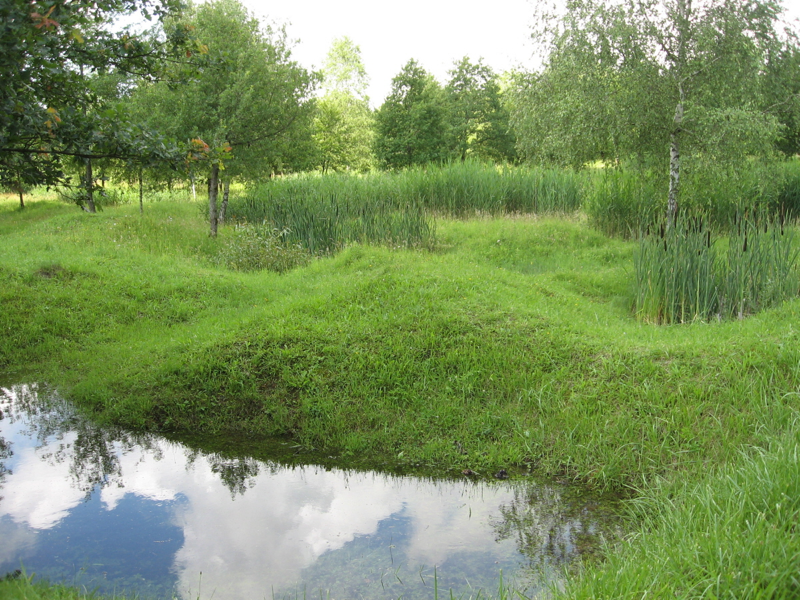
"Shell craters softened by nature, near Verdun."**********
We did not stop at the battlefield at Verdun, pictured here,********* but I'm not sure I would have assumed the contours of the land were the result of fallen shells had the photographer who took the shot at the left not expressly said so. All I could think was "all quiet, so quiet on the Western Front." Who did remember? Who would remember?

Thinking about the Christmas Truce itself, I found myself asking questions. No doubt historians and others might have some real answers to these questions, but I will still mention them.  How old were the men who stepped out of their trenches into No Man's Land on that winter night, hoping but not knowing that they would survive? My fantasy is that it took young men to take such a hopeful risk. What an amazing thing that these men, at least for a few hours, knew the enemy by face and name--as did many of the Greeks and Trojans in The Iliad and many Union and Confederate soldiers whose allegiances to state and family had dictated the side on which they fought.

Why were there no Christmas Truces in 1915, 1916, and 1917? Was the hope that war could conclude without massive casualties dead by 1915? Or did the higher-ups decide that demonstrations of common humanity had no place in wartime? Yesterday, Joan Gatturna informed me that there was talk at the upper levels of the military about disciplining the commanders of the soldiers who had made peace with their enemies for that one December night. However, the positive popular response to the event, reported by the press, led to the abandonment of that idea.

In addition, I found myself thinking ahead to what happened beyond 1918--another brutalizing, dehumanizing war of large scale. No truces in that war, even though the soldiers who fought in it probably had a clearer idea of what they were fighting for and against. No opportunities for face-to-face connection that wasn't linked to hand-to-hand combat, and even more effective technologies for killing large numbers of people at a greater distance, which allowed them to remain faceless and nameless from the perspective of their killers.

And so if anything, over time, we've generally increased the distance between ourselves and our adversaries--certainly in wartime, and perhaps even in peacetime. How many names and faces do we need to know in order to experience the humanity we share with those who intentionally or unintentionally are set against us, or against whom we set ourselves? Or can an abstract appreciation of our antagonists' humanity suffice to support the kind of "reaching across" needed for peace on earth based on justice for all? Social media makes it increasingly possible to speak to and about our antagonists. But when we speak from behind the semi-fabricated names and enigmatic images that we choose to represent us, we limit others' abilities to trust in our authenticity and good intentions.

Right now, around so many critical issues, the lines************ in America are drawn. Generalizations about any group are bound to misrepresent some members of the group and thus not to be perfectly, completely credible. But that reality is beside the point. There are generalizations, circumstances, situations, causes, effects, that are so entrenched and so predictable that we need to confront them, even if we can find people, places, times, and events that are exceptions to them.

So yes, there's anger and hurt on both sides, especially around the grand jury decisions in Ferguson, Missouri and Staten Island, New York. But that doesn't mean that from an institutional perspective, one side hasn't over time been frequently wronged, targeted, and/or disenfranchised as a result of the other group's exercise of its greater official and unofficial power. Those young men who walked into No Man's Land and shook hands with their enemies on that night in December 1914, though on opposite sides of the conflict, were probably equal in status and power to one another--and far less powerful than the men who, miles from where they stood, designed their movements and, to a great degree, orchestrated their fates.

Even so, those of us who belong to groups that have been victimized can't hide behind that history in every situation. As a Jewish member of the Unicorn Singers, I needed to get beyond my immediate reaction to "Deutschland Lied" ("Deutschland, Deutschland über alles") when the Unicorn men sang it. I don't think I'm exaggerating when I say that most Jews who lived--or whose parents lived--during World War II think immediately about Hitler, concentration camps, and the Final Solution when they hear that song. But in the context of our performance, it was a pre-Nazi era song sung by the German soldiers to cheer on their team during a pick-up soccer match with "the enemy."************ There are times that we have to cross lines that we draw instinctively inside of ourselves for understandable reasons.

We gave three performances of "All is Calm, All is Bright," and with each performance I grew sadder, more aware of how much war lay ahead of soldiers fighting in 1914, how many more young lives would be lost in the next years, and how, to a great extent, history would repeat itself in the same countries and beyond. Where did that wondrous Truce get anyone? I felt terribly lonely and discouraged. One of the last readings in the program was from a Scottish minister who wondered if the Truce might be interpreted as the work of the Divine on the night that, for his congregation, the son of God had been born. But all I could think about were all the crucifixes I had seen in fields and vineyards in the eastern parts of France through which we had driven. In most cases, the suffering Jesus had seemed so lonely and inconsolable to me. I had imagined him as carrying the suffering of the many townspeople whose sons had died in two wars.

Our musical dramatic program began and ended with "I Heard the Bells on Christmas Day." I hadn't known that the famous old carol was a musical setting of a poem Henry Wadsworth Longfellow had written to convey and then transcend his despair after his son was severely wounded in the Civil War and his wife had passed away in a terrible accident.************* There's so much anger and despair in America right now--but also a tremendous amount of energy looking to be channeled effectively. I am thinking a lot about how we might in this country reach across our differences and transcend, and maybe even transform, our anger and despair. Really doing so will involve a tremendous amount of authentic soul-searching; a willingness to be flexible, vulnerable, and surprised; and the courage to risk trusting others whose soul-searching, flexibility, and vulnerability may very much be works-in-progress. In my estimation, there are many people out there who have the skills and the will to foster that transformation. But I fear they won't be encouraged and appreciated.

I'm also thinking about the young people in our country************** who are standing up and speaking out, many for the first time, and who may not be burdened by the bitter hopelessness some of their elders have understandably developed over the years. Maybe the real message of the Christmas Truce is the hope of youth, especially when it supports the courage and activism of youth. If this is the case, I hope that we, their elders, are wise and brave enough ourselves to counsel, encourage, and comfort them wisely and hopefully.

As I was sitting in First Parish Church in Cohasset last Sunday during the latter half of our program, sometimes listening, sometimes singing, sometimes watching the late afternoon sunlight fade warmly, the final stanza of Matthew Arnold's "Dover Beach" came to mind:
Ah, love, let us be true

To one another! for the world, which seems

To lie before us like a land of dreams,

So various, so beautiful, so new,

Hath really neither joy, nor love, nor light,

Nor certitude, nor peace, nor help for pain;

And we are here as on a darkling plain

Swept with confused alarms of struggle and flight,

Where ignorant armies clash by night.
So many "ignorant armies" to think about. It's almost impossible to believe that an event like the Christmas Truce could happen. And what does it say about us that we choose to remember it not annually, but only at its major anniversary? Still, the Truce did happen, and that's what gives me hope. Hope that we might reach across lines, differences, and histories that divide us and do something new and something better than we have in the past. Hope that reconciliation that begins as a truce between two groups in conflict might grow into an enduring peace that respects, comforts, supports, and inspires all stakeholders.

* Screen shot of <http://www.todayifoundout.com/wp-content/uploads/2012/12/Christmas-truce.jpg>.
**  Screen shot from <http://www.bcc-us.org/>.
*** I became a Unicorn Singer in September--and felt immediately welcome.I chose the Unicorns because I wanted to sing again and knew I could attend rehearsals on what used to be school nights; because I wanted to feel more connected to the South Shore; and because I felt excited by the different kinds of concerts--and thus the different kinds of singing--the Unicorns do annually. Since joining, I've relished the group's spirit: every request for volunteers is met with a quick, enthusiastic "yes" response, often by multiple individuals. I take pride in the fact that a percentage of the proceeds from our ticket sales often benefit others: our concerts of last weekend benefitted the Wellspring Multi-Service Center's Diane Edson Fund, and our Valentine's Day Broadway Review will support Horizons for the Homeless. We work hard to make good music, but we do more than that, too.
**** A Donald Burroughs photo; thanks, Donald! 
***** Screen shot of <http://www.evenimenteoradea.ro/wp-content/uploads/2014/04/maini-atingere-cautare-sursa-foto-galleryhip-punct-com.jpg> 
*(6) Quotations from pp. 139 and 140 of Remarque, Erich M. AQWF - Full Text. N.p.: Myteacherpages, n.d. Pdf. "Simpson" is the person who probably created the pdf file.
*(7) Screen shot of <http://mw2.google.com/mw-panoramio/photos/medium/98257062.jpg> 
*(8) Screen shot of <http://upload.wikimedia.org/wikipedia/commons/thumb/0/07/France,_Marne,_Auve,_Autoroute_de_l%27Est_%28A4%29.JPG/290px-France,_Marne,_Auve,_Autoroute_de_l%27Est_%28A4%29.JPG> 
*(9) Screen shot of <https://blogger.googleusercontent.com/img/b/R29vZ2xl/AVvXsEhtLAh6Hb02gDPrlz8txTr-V8T6Oa5dNqclBl2QiW3FhBsq8OHWuwHMTJNK1m5-Wg8Bd97d7zCMWb6pNcT_-X197r3PAZ-ZmrqBQxSx-Aq0I0waUqGPE3mQ5RlWefNhmUL8VTQebj2qMw4/s1280-h/YIMG_2411.JPG>
*(10) Quoted from <http://modestine2.blogspot.com/2007/07/verdun.html>. 
*(11) Screen shot of <http://i.dailymail.co.uk/i/pix/2014/12/07/23D27FE600000578-0-image-a-25_1417934924261.jpg> 
*(12) Screen shot of <http://i.ytimg.com/vi/hriz6rcCT3Y/0.jpg>
*(13) "I Heard the Bells on Christmas Day" article on Wikipedia: <http://en.wikipedia.org/wiki/I_Heard_the_Bells_on_Christmas_Day> Downloaded on December 18, 2014
*(14) Screen shot of <http://cambridge.wickedlocal.com/article/20141201/NEWS/141209601>
*(15) Screen shot of <http://www.globalresearch.ca/the-forgotten-christmas-truce-of-1914-unlearned-lessons-which-could-have-prevented-a-century-of-war-1914-2014/5420256>

Thursday, December 11, 2014

Listening, Watching, and Waiting: A Retirement Update for Dark December

So already, it's been a while since I've posted in this blog. Interposed between the present hour and the time of my last post have been a trip to Singapore and Malaysia, and a number of delayed but hardly overwhelming obligations that needed my attention once I returned. I look forward to blogging about my Far East experiences once my thoughts about them are more fully formed. But my thoughts about retirement almost a full year into it are in a new, liberated place.

We're now in the double digits of December, and dusk comes early. Holiday greeting cards are starting arrive. Some offer good wishes and a current photograph of the family of well-wishers; others supplement good wishes with family news; still others convey spiritual and political convictions that augment or even replace the family update. While some of my friends and acquaintances are joyfully (if frantically) immersed in the rituals and obligations of the season, others are busy responding actively to difficult national news, mourning the deaths of loved ones, and/or navigating complex work and family situations that require immense reserves of energy and patience. Some are, miraculously, managing it all.

For some reason, in comparison to many of the people that I know, I'm feeling calm--uncharacteristically calm for me. Not detached, but calm. And expectant and hopeful. This new calm started to collect in me, despite my travel-related anxieties of late October and early November, when I began diligently following the advice my husband Scott gave me early in the fall*: to stop trying to figure out my retirement and instead, to get busy doing anything that I liked doing. There's plenty I like doing, but I needed permission to act with no other goal than satisfying my momentary sense of what might be pleasurable and meaningful.

Initially, I valued Scott's advice because it freed me to explore options and interests without the pressure of identifying a direction for the next phase of my life--and without feelings of guilt related to "wasting valuable time" on larks and whims. I quickly understood that Scott was advising me to trust in time, and also in emotion and intuition as the expressions of my essential self. However, only recently--actually, when I read the Galway Kinnell poem featured in the December 3 Writer's Almanac**--did I realize that Scott had also been encouraging me to trust more in the world, to partner with it by being open to its bountiful, variegated phenomena and experiences, with which I potentially might engage meaningfully and joyfully.

The poem's notion of trusting nothing but the hours themselves felt like sheer deliverance to me. The hours were the constant stuff, the dependable thing. As I felt myself leaning toward trusting the hours, the poem's imperative title resurrected the final lines of John Milton "On His Blindness" from the basement of my memory:

     Thousands at his bidding speed
     And post o're Land and Ocean without rest:
     They also serve who only stand and waite.***

No need to speed. Waiting too is service. A kind of faithfulness to what we already know to have meaning and value. As Kinnell's second stanza reminds, "You're tired./ . . ./ But no one is tired enough." Kinnell delivers his injunction in the next line: "Only wait a little and listen." Which inherently suggests that there's something to be waited for and listened to. There's a world there, whether it's an inner or outer one.

Meanwhile, the outer world served up Singapore and Malaysia to be seen and listened to--each exquisitely memorable in its own way, each familiar and extraordinary for reasons I am still contemplating. And each captivating enough to transform of my expectations of late November, which I've always loved. And if expectations of late November can be changed, if new ways of loving November can develop, what other expectations and feelings might be forged and changed?

November is monsoon season in the Singapore and Malaysia; downpours punctuate the day's heat and humidity. The whoosh and clatter of those downpours--very dramatic--were, for me, peaceful and soothing. On the eve of Thanksgiving halfway around the world, I stood in Singapore's beautiful, lush botanical gardens (in the photo on the right) sheltered from one such downpour, watching and listening, only 24 hours after I'd been looking toward Thailand from a boat off the coast of Langkawi, an island off of northern Malaysia (see my view in the photo on the left). 

Kinnell doesn't say "Wait forever"; he says "Wait, for now." Alertness and attention are what he encourages, receptivity to and recognition of the moment--"the only time"--when each of us can "hear/ the flute of your whole existence, rehearsed by sorrows,/ play itself into total exhaustion." There's definitely sadness here that comes with loss and memory. But it's coupled with hope. I experience his language of "only time" as being about potential opportunity rather than missed opportunity. A certain type of exhaustion--complete, unfettered, cleansing depletion--is to be prized; there's a desirable, substantive emptiness to be found.

At my current retirement moment, I'm feeling alert to the stimuli and opportunities that I trust the world--its hours and spaces--will serve up. And I'm also feeling that my authentic responses to those stimuli and opportunities will yield, eventually, a coherent, or perhaps incoherent, kind of knowing and a set of associations to accompany it. Something real, worth knowing, and worth heeding.

And so I end this post with some recent artwork my cousin Annita Soble**** posted on her Facebook page as part of her Chanukah greeting.***** Yes that is a deer in the headlights--a somewhat ghostly, transparent deer that may not be associated to a particular person's stunned paralysis. But my attention is on the driver of the car, who's taking the time to stick his head out of the car window, probably to confirm that he's actually seeing what he thinks he's seeing. Oh, the curiosity and the wonder; he'll never forget this commute! Meanwhile, all the cars heading robotically in the other direction spew exhaust--perhaps even to the point of Kinnellian exhaustion. Are any of the drivers noticing the the menorah that burns bright and timeless in a window that looks out on the thoroughfare? I don't know. But I am. Here's to the bright and the timeless. May we watch for it, listen for it, see it, hear it, and experience the hope that goes with it, especially in this holiday season!
 
* I first wrote about Scott's retirement advice in my September 28 blog post.
** http://writersalmanac.org/page/9/
*** http://www.bartleby.com/101/318.html 
**** Check out more of Annita's art at <annitasoble.com>. 
*****  Another version of this drawing appears on the cover of Fifth Dimension, a publication of the Jewish Russian Learning Center.


Wednesday, November 12, 2014

Bird Watching in Scott Ketcham's Art

"Blue Departure"
So already, a few days ago, when I asked my husband, Scott Ketcham, if he liked the painting he had been working on all day, he said he did. "Take a picture of it on your smartphone so I can see it," I said. The newly finished painting I got to see is the one you're seeing to the right. Scott's been even busier than usual in the last few weeks because Open Studios are less than two weeks away.* 

Recently, Scott's been giving titles to his paintings on the advice of the man who designed his new web site, <scottketcham.com>. Scott, who has generally had no interest in naming his paintings, has taken to creating titles as a marketing necessity. When asked about his title choices, he explains that his sole intent is to give the viewer a foothold in his work without usurping any of his/her right to see and interpret as s/he sees fit. He also admits it's never bad for a prospective collector to be able to refer to the painting in which s/he's interested by its name.

But though the titles he's assigning mean very little to Scott, they are meaningful to me. I'm endlessly curious--and baffled--by the source from which Scott's vision and imagination spring--or maybe I should say climb, or rise, or erupt, or limp, because all of these words seem apt for some painting or other. So his titles, not completely arbitrary despite Scott's casual attitude toward them, provide me with some clues. Take "Blue Departure" above: to my eye, a man, a woman, and a giant bird seem entangled, not departing--and "entangled" always connotes tension and struggle. Are they struggling to free themselves from being forged and frozen, or is it inescapable Dionysian frenzy from which they seek liberation? ? But wait--the the face of the female figure defies either interpretation: I see a benign smile on her face--as if she's in the midst of a sleeping or waking dream. And so I'm left to accept that the painting itself somehow reconciles struggle and peace. But I really don't know how and why it does that. 

For a while, Scott's work has sent me wandering the literary and mythological backwaters of my education, formal and informal. It happens in flashes: 
  • a conviction that I need to reread Louise Glück's poem collection Averno because I'm wondering how Persephone's semi-annual passage between the underworld and upper world, between death and life, connects to what Scott's expressing; 
  • an urge to research the significance of the phoenix, to weigh in my own mind the counter-forces of destruction and rebirth; 
  • a desire to immerse myself both in the William Blake poems populated by Zoas and emanations, and in Jewish writings about the Shechinah, the feminine aspect of G-d that makes so many ardent Jewish monotheists uncomfortable.
  • a resolution to revisit The Subtle Knife, the second book of Philip Pullman's His Dark Materials trilogy in which the protagonist has a special knife that permits him to slice his way through both spirit and matter into other worlds--and that must be used with the utmost care.
My Persephone hunt led to Wikipedia, which explained the significance of Lake Avernus, and thus Averno:
Avernus was of major importance to the Romans, who considered it to be the entrance to Hades. It gained its name from the Greek word αορνος (originally αϝορνος) meaning "birdless", referring to the belief that birds flying over the lake would drop dead from the poisonous fumes that it emitted. The name Avernus was often used by Roman writers as a synonym for the underworld.**
A portal to the underworld with the power to kill birds? Given the significant role birds often play in Greek prophecy, what did the birdlessness of this important place signify?

In Averno, I came upon "Persephone the Wanderer," in which Glück says,
They say 
there is a rift in the human soul
which was not constructed to belong entirely to life. Earth

asks us to deny this rift, a threat
disguised as  suggestion--
as we have seen 
in the tale of Persephone
which should be read

as an argument between the mother and the lover--
the daughter is just meat. 
In Scott's paintings in which the male and the female sometimes blend, sometimes mate and bear, sometimes make the abstract and conceptual palpable and visible, the rift that Glück identifies is everywhere manifest and hardly pretty.

And then there's the question of the relationship between this boundary-straddling soul and the perception and pursuit of beauty.  In "October," the long poem just before "Persephone the Wanderer," she asserts, 
It is true there is not enough beauty in the world.
It is also true that I am not competent to restore it.
Neither is there candor, and here I may be of some use.
I believe that Scott goes everyday into his study looking, trying to restore that beauty, seeking it inside and outside of us all. I suspect he spends little to no time assessing his competence "to restore it." Somehow it calls to him, elusive but real, and he responds to its call, pursuing it, eschewing doubts and distractions as best he can, and looking to find it and render it--the truthful beauty that must reflect the "rift in the human soul/ which was not constructed to belong entirely to the earth." As if that's all he can do.

Which brings us back to "Blue Departure." Are the two human figures lovers, or male and female aspects of "something" separating or uniting, creating or destroying? Is the bird, having mastered them, fading and depleted? Which one or two have birthed the other(s)? Should we be thinking of them as a trinity, and toward what end? But that's just it: there doesn't seem to an end: the three seem linked eternally. But where are they?

"The Gold is Within"
So many questions --and also so many  Scott Ketcham paintings that include or suggest birds in their content. Even as I sit at my dining room table writing this post, I'm looking at the painting you see on the left, entitled "The Ancient Inside."  Here the bird is inside of a figure who's probably female--but perhaps not. This painting represents an instance when the title Scott gave the painting helped me to interpret, or to begin to: does that bird inspire or lift up, or does it burden, control, overmaster the figure whose feelings remain mysterious to us? And does "Ancient" mean very old in the sense of antiquated, or of eternal? I think the latter. "The Gold Within," a later painting to the above right, suggests by its name that this inner "being"--here detectable as a human face--is positive and welcome. I'm intrigued by the feathery, wing-like quality of the figure's right side. The title provides another hint and potential puzzle: "Gold" and "God" are just one letter apart. Is that inner gold the divine spark that Jewish and other religious thought places within each one of us, or is it a more personalized essential self?


"Blue Annunciation"
"Bird Call"
And there are other bird paintings from earlier years. Does the figure in "Blue Annunciation" announce herself, or is she the Gabriel figure who comes to announce another's message? And in "Bird Call," is the figure calling the birds, or being called upon by them? Despite the birds' swirling flight and their shadowy translucence that recalls the murderous birds in Hitchcock's "The Birds," the flgure appears calm, deferential, and engaged--a partner in whatever is transpiring.


"Landed Like Icarus"
I was already thinking of Icarus when I came upon a painting on Scott's web site that I didn't remember ever having seen before. "Landed LIke Icarus" captures the violence of Icarus' plunge. Were Scott's painting literal, Icarus would have been depicted without wings because the sun would have melted the wax that held them fast. But Scott's Icarus remains winged--and now that I look closely at it again, I begin to wonder if this is in fact a painting of a dead bird that has simply reminded Scott of Icarus. In all the years I've been with Scott, he's often photographed dead animals we've come upon in natural settings. (Doesn't everybody?)  Regardless of how human his subject is in this painting, Scott has blended the human and avian and suggested that efforts to soar and to fly are always fraught with risk. Death is brutal and beautiful here: feathered yet final, intense yet soft. And birds must fly: that's what they do.

Thoughts of Icarus led me to thoughts of Daedalus--first, Icarus' father who designed the labyrinth on Crete, and then James Joyce's protagonist in A Portrait of the Artist as a Young Man. The girl in one of Stephen Dedalus' well-known epiphanies is distinctly birdlike: 
 "A girl stood before him in midstream, alone and still, gazing out to sea. She seemed like one whom magic had changed into the likeness of a strange and beautiful seabird. . . .
     . . .
    -- Heavenly God! cried Stephen's soul, in an outburst of profane joy. (pg 171-172)**
"Profane joy"--I feel that in much of what Scott paints. But I also feel sacred joy. And in addition to that, something far darker, something far more elusive, both threatening and comforting, that refuses to recuse itself, even when joy, sacred or profane, reveals itself and dominates.

"Soaring While Earthbound"
"Apotheosis"
Last year, there was a metamorphosis in form in Scott's work: the inner bird became the container for the figure, ultimately spawning the figure, perhaps the emerging artist, who sometimes had his/her own wings, even if he/she hadn't yet spread them. Always, always, struggle accompanied this emergence: not so much a sudden "young man artist" Stephen Dedalus-style epiphany, but a hard-won product of tormented exertion willingly embraced. Passion. Apotheosis requires no less, and neither does a world crying for profound beauty and its potentially transformative effects on the human spirit. 

But since birth and death are often companions, we must be prepared for destruction, too. In Hermann Hesse's Demian, the title character embraces the god Abraxas, in reference to whom he shares the following with the novel's narrator: “The bird fights its way out of the egg. The egg is the world. Who would be born must first destroy a world. The bird flies to God. That God's name is Abraxas.”****

Reading Demian made Scott curious about Abraxas, a god, considered Egyptian in origin by some, in whom were combined spiritual opposites often embodied in different gods or beings in other traditions.***** "The Birth of Abraxas," the largest painting in this photo of Scott's Johnson State College winter 2014 exhibition, was one result of this fascination.  Interestingly, though, there is neither an egg nor a bird to be seen: just two distinctly human figures.

"Sulfuric Getaway"
While the human form dominates in much of his recent work, Scott hasn't stopped painting birds. "Sulfuric Getaway," which I shared in another blog post, balances the human and bird figures (which may actually be separate aspects of a single figure) and suggests that the bird has been sacrificed in the process of birthing the man whose "sulfuric" quality raises its own set of questions. And "Blue Departure" stays on my mind with its tripartite ring of figures. In the word "Departure," I hear more than an announcement of the new: I hear the active setting forth of a newly realized self that has meaningfully integrated the "ancient inside" with important, not ancient aspects of the self.

Still, the act of setting forth doesn't ensure progress. Vague boundaries appear everywhere in these paintings: between death and life, birth and death, male and female, mother and child, man and woman, human and avian, inner and outer, above and below, here and beyond, dark and light, intensity and release, struggle and peace, physical and spiritual. Perceiving where they are, let alone crossing them, is difficult. That's why Persephone, that expert boundary-crosser who is swallowed up annually by what's beyond and below, stays on my mind. Her coming and going literally destroy and restore the world. Among the animals symbolically associated with Persphone: talking birds.******

I don't know where Scott's work is headed, but I feel it moving, sometimes slouching towards Bethlehem, sometimes stretching upward though still much tethered, sometimes soaring. So I intend to keep up my bird watching and bird wondering. And if these paintings intrigue you, please head down to Scott's Open Studios on November 22 or November 23.

* This flyer contains all the information about Scott's Open Studios:


** http://en.wikipedia.org/wiki/Lake_Avernus
*** Hermann Hesse, Demian: Die Geschichte von Emil Sinclairs Jugend <http://www.goodreads.com/quotes/225268-the-bird-fights-its-way-out-of-the-egg-the>  
**** <http://aportraitoftheartistasayoungman.weebly.com/meaningful-passages.html>
***** <http://en.wikipedia.org/wiki/Abraxas>****** <http://www.goddessgift.com/goddess-myths/goddess_symbols_persephone.htm>

Friday, November 7, 2014

Precious Life, and the Surrender to Adventure

So already, ever since I've stopped working at Cambridge Rindge and Latin School, I've been thinking about how precious and fragile life is.

Hardly an original thought, I know. But too many of my colleagues who ended long careers in the same school district and who looked forward to discovering and embracing the blend of productivity and ease that suited them personally didn't live much beyond their official retirement dates. In the last two months, cancer has claimed two of them, one of whom, a really nice, always optimistic woman with whom I worked closely for a number of years on Cambridge's new teachers' program, received her diagnosis less than a month after her last day of work. And the Kimbrough Scholars Project* does its social justice-related educational work to extend the legacy of Les Kimbrough, who died not far into his post-retirement years. 

Even when death hasn't snatched my fellow retirees, it's spectre has often been lurking nearby. The retirement party of another member of the Kimbrough Memorial Committee had to be postponed because she suddenly needed--I'm pleased to say, very successful--bypass surgery. Others spent much of their respective first years of "freedom" mourning departed spouses or sitting at the bedsides of gravely ill or gravely injured loved ones.


CARLOS A. THOMAS

Obituary |  Condolences


CARLOS A. THOMAS Obituary


Thomas, Carlos A. 1/14/1979 to 11/1/2014. A life tells a story, and that of Carlos A. Thomas, in spite of ending too soon, tells one of connection and service. Carlos had passionate interests in art, music, and community, which he embraced throughout his young life. Carlos developed significant skills as a web developer and designer, starting his own company "Dynamic Data Design" (www.dynamic-data.net) to provide technical support specifically to nonprofits, as he was aware they are often inexperienced at technology and strapped for cash. A strong believer in building community, Carlos sought out connections that later became friendships, due to his low key yet enthusiastic personality and his wide variety of interests. Carlos and his family moved to Fitchburg in 2006, where he and his wife LaNeia had two children (ages 12 and 4) and worked on a number of community issues. Carlos has also been active in Fitchburg Youth Soccer, including coaching (and photographing) both local and traveling teams. In 2012 this powerhouse of a young man was diagnosed with Stage IV kidney cancer, which eventually stopped him in his tracks: likely the only thing that could. In "Being Mortal", Atul Gawande writes: The only way death is not meaningless is to see yourself as part of something greater: a family, a community, a society". Carlos saw himself as part of all these things. Following cremation by Keefe Funeral Homes (www.keefefuneralhomes.com), his life will be celebrated at the Fitchburg Art Museum, 5 PM on Saturday, November 8th. In lieu of flowers, donations to support Carlos's children can be made at http://climbingforcarlos.wordpress.com or to Applewild School (www.applewild.org ) "In memory of Carlos A. Thomas".

Published in The Boston Globe from Nov. 5 to Nov. 6, 2014
- See more at: http://www.legacy.com/obituaries/bostonglobe/obituary.aspx?n=carlos-a-thomas&pid=173054102&from=fb_npapp_obitread#sthash.9g1bN4q3.dpuf
The death of a former student just days after I attended Frances Cooper-Berry's funeral reinforced all of my recent feelings about the arbitrariness of life and death. Carlos Thomas was never a student in my classroom; he was one of those kids I got to know because he was a good friend of another student who actually was in one of my classes. The nature of the Pilot School was that teachers got to know their students' friends because the "friend clusters" in which the kids so often traveled were generally inseparable. I always found the constancy of these little groups sweetly, beautifully teenage.

Carlos was smart and mysterious, always ready with a wry smile and a philosophical comment. I can't say that I knew him well, but my memories of him are vivid. I always felt that he was assessing my sincerity and my values. And that despite his reservations about me, he appreciated our back-and-forth. I liked him.

Carlos' obituary** in today's Boston Globe fits perfectly with the Carlos I thought I knew--it refers to his vigor and commitment that only death could stop, and quotes from Atul Gawande's "Being Mortal" to assert that his was a life with meaning. Still, I find myself thinking of his two children, not even yet teenagers, and imagining how their worlds have been completely upended by his illness and passing. And I find myself wondering how Carlos' life might have unfolded in the years ahead had it not been ended by rampaging disease.

As for me, to date I'm one of the lucky ones. At the moment, all I have to fear is fear itself. The problem is that I've never known if I agree with Franklin Delano Roosevelt's first inaugural address pronouncement, though I've always wanted to. Some fear is justified--though probably not as much as I've been feeling as I've anticipated my upcoming trip to Singapore and Malaysia. 

I know. This is the moment when you're thinking that I should be excited, that I should be feeling as lucky as I am--to be healthy, to have such an opportunity to work (in Singapore) and play (in Malaysia) in places I've never laid eyes on before and that are reputed to be great places to visit. Some of the fear, probably better characterized as anxiety, is professional--and more natural: my educator colleagues and I are hoping that the ways we've planned to engage several large educator groups in exploring and embracing Making Learning Visible practices and principles are relevant, compelling, culturally responsive, and downright inspiring.

I've generally been good at handling professional anxiety--accepting it as the companion to the kind of stretching that professional growth requires. But I've never been good at distance travel or adventure. Anticipating adventure and distance travel, for me, is always about imagining the bad things that can happen, not the fascinating things I hope to experience. It's only when I get to my destination that I begin to feel the wonder, and the privilege of feeling the wonder.

Probability suggests that I won't perish in an ISIS attack, won't contract Ebola, won't experience the aftermath of an eruption of Krakatoa, won't perish in an airplane-related accident (even though Malaysia has been associated with more than its share of these in the past year). But probability always merely suggests and never insures. 


At any rate, I've been insured--and registered, vaccinated, passworded, and documented, too. At the moment I'm as legally and medically protected as one could be. Still, I think it's my quest for solace, certainty, rootedness, and protection that made me spend part of yesterday afternoon polishing silver and brass--the Sabbath candlesticks that belonged to my maternal grandmother, the Kiddush cup that belonged to my paternal grandmother. As if somehow I could channel the protection of my grandmothers through those objects that were part of how they blessed and kept those they loved, including me.


Meanwhile, everywhere life is shaking and moving, even though it's November and all is cold, dark, and damp. But the gold of the late fall trees flames against the sky's slate gray and dares the darkness. And the day's news is all life: my cousins Eli and Annita--I shared some of Annita's art in this blog in April and some of Eli's thoughts in May--have a new baby boy. Scott's in major production mode, gearing up for his Open Studios the weekend before Thanksgiving.*** Even my Christmas cactuses are getting into the act with their new, tiny, tender buds.

Years ago, when I went to my first World Music/CRASH Arts-produced concert at the Somerville Theater, I came across a familiar name among the donors listed in the program: Frances Cooper-Berry. When I next saw Frances, we talked about World Music and its commitment to "Music and Dance from the Far and Near Corners of the Globe." I remember how excited she was as we talked about the events planned for the rest of the season and the organization's mission. Frances was all about letting the world in, and going out to meet it whenever she could.

Yes, there's sadness this week. Irony and arbitrariness, too. But the big lesson of the week--the lesson that gets taught too frequently, and that we forget until we're taught it again--is that time is the precious commodity, because so often, time is life. And fear, like time, can limit life. I can't think of a single one of those who has passed who wouldn't have thought I was truly fortunate to have this travel opportunity--and who wouldn't have encouraged me to focus less on the fear and more on the opportunity.

So in their honor, I'm dedicating myself to welcoming my fast-approaching adventure as the positive thing that it is. Yes, some fear and anxiety are probably reasonable. But to place them front and center isn't, even though it's so natural for me. Yesterday's timely Writer's Almanac poem has me acknowledging the relationship between fear and guilt--my guilt, because I really don't have the kind of "heavy heart" at the moment that others I know do, because I have been so lucky so long. At the back of this connection is a robust, counterproductive fatalism--an inescapable belief that "there are rules that cannot be broken," a nagging, superstitious fear that too much good fortune puts a target on one's back, tempts fate. It lunges like a chained attack dog whenever I suspect that things are going well, perhaps too well.

Sometimes, the only way to solve a problem is to give thanks for having the problem--especially if it's luck or it's privilege that gives us the problem. Regardless, life is precious, much too precious to squander through fear that relegates us to routine, even beloved, satisfying routine, because of its certainty. So I've begun to do it, or at least to try to do it: to surrender to adventure, to relish its imminence, to stop wondering if I deserve it, to stop fearing as if fear itself could ward off disaster. And even yesterday, on the first day of trying, I felt real glimmers of excitement. Which doesn't mean that I'm not keeping my fingers crossed and praying--really praying--that in a few weeks, in a room filled with sunlight and the strains of "music from a confident age," I'll be able to acknowledge to myself that what I feared would happen "in my story did not happen." It's all about loving to be alive. Life is good.

Thomas, Carlos A. 1/14/1979 to 11/1/2014. A life tells a story, and that of Carlos A. Thomas, in spite of ending too soon, tells one of connection and service. Carlos had passionate interests in art, music, and community, which he embraced throughout his young life. Carlos developed significant skills as a web developer and designer, starting his own company "Dynamic Data Design" (www.dynamic-data.net) to provide technical support specifically to nonprofits, as he was aware they are often inexperienced at technology and strapped for cash. A strong believer in building community, Carlos sought out connections that later became friendships, due to his low key yet enthusiastic personality and his wide variety of interests. Carlos and his family moved to Fitchburg in 2006, where he and his wife LaNeia had two children (ages 12 and 4) and worked on a number of community issues. Carlos has also been active in Fitchburg Youth Soccer, including coaching (and photographing) both local and traveling teams. In 2012 this powerhouse of a young man was diagnosed with Stage IV kidney cancer, which eventually stopped him in his tracks: likely the only thing that could. In "Being Mortal", Atul Gawande writes: The only way death is not meaningless is to see yourself as part of something greater: a family, a community, a society". Carlos saw himself as part of all these things. - See more at: http://www.legacy.com/obituaries/bostonglobe/obituary.aspx?n=carlos-a-thomas&pid=173054102&from=fb_npapp_obitread#sthash.c332wQXe.dpu


* I talked about the Kimbrough Scholars Project in my June 30, 2014 post entitled "Watching Freedom Summer" twice.
** <http://www.legacy.com/obituaries/bostonglobe/obituary.aspx?n=carlos-a-thomas&pid=173054102&from=fb_npapp_obitread>
*** "Sulfuric Getaway" by Scott Ketcham: <http://www.scottketcham.com/post/97321402092/215-sulfuric-getaway-2014-48x32-oil-on> 
**** "In November" by Lisel Mueller: <http://writersalmanac.publicradio.org/index.php?date=2014/11/06>