Wednesday, September 30, 2015

From 60 Days to 60 Years

So already, tomorrow I am turning sixty years old. And today, when I sat down to write my "morning pages," I ended up writing a blog post instead. 

But I really had already broken the rules of writing "morning pages," as Julia Cameron lays them out in The Artist's Way: A Spiritual Path to Higher Creativity, her book that presents a twelve-week course for developing creativity. You're supposed to wake up a half hour earlier than you usually do and write three, handwritten, stream-of-consciousness pages. But when I got out of bed at 6:00 a.m. allegedly to write those pages, I did a bunch of other things instead: I folded some laundry that had been air-drying; reorganized my underwear drawer; washed a load of dishes; cleaned the sinks, mirrors, and counter tops in my two bathrooms; and--I think that was all. That was ALL? That was enough!


Photograph by Melissa Rivard
Was this frantic, unfocused activity about turning sixty tomorrow, or what? The need to have certain things in my home just so--as if those counters wouldn't get dirty again, and again, and need me to attack them with lemon-scent Soft Scrub. You would have thought I was expecting my own personal supermoon-lunar eclipse combination*! But it does feel that climactic. My favorite fantasy is that, as it happens in the movie of The Wizard of Oz when Dorothy first steps into Munchkinland and Oz, the world will suddenly move from black-and-white to color. My worst fear is the opposite--that my world will shift from color to black-and-white. Not that I don't recognize the ironies here: Dorothy encounters witches and worries about meeting lions and tigers and bears as she journeys through Oz--and what she seeks most is to return to the black-and-white world of Kansas, where the heart is. 


But dirty dishes and Dorothy--what's going on here? It's a milestone birthday. Time is passing. When I turned fifty, there was still a chance I was only halfway through my life. Unless we discover I'm the reincarnation of Moses,** it's practically a certainty that I won't live to double my age. And would that be a good thing anyway? Tomorrow, even if I buy new make-up as is my plan, I will still look like me, sound like me, act like me. The point is I probably have lots of time, but much less than I did ten years ago. And given how much choice I have about how to spend the ample time I still have --I'm a healthy person who no longer works full-time--there are opportunities for balance, meaning, and satisfaction. 

And just as many opportunities for craziness, despair, and fragmentation.

So back to The Artist's Way. In my last blog post, "Field Notes for the Month of Elul," I spoke about my chronic resistance to following through with my spiritual preparation for the Jewish High Holidays as guided by Simon Jacobson's 60 Days: A Spiritual Guide to the High Holidays.***  My resistance was the norm rather than the rule, despite the fact that whenever I did follow through, I recognized that I gained something--not always something that felt comfortable, but something worth thinking and feeling about:
The month of Elul was in progress, and inspired as I was by Van Gogh's work, I resisted the 60 Days daily routine, approaching each day's prompts with anxiety and doubt. But a pattern developed: each day I sat down fearful that that I'd have little or nothing to say in response to the prompts--and then I began writing and responding with so much to say that I often exceeded the notebook space I had allotted for the day's reflection.
What I've been realizing in the past weeks as I've turned to The Artist's Way to help me become more disciplined and optimistic not just about writing, but also about becoming "a writer," is that I'm replicating that same pattern of resistance. And this even though when I do as Julia Cameron recommends, I am always glad I did.

But trying to establish a new purpose and "work identity" is not the same as trying to negotiate a closer relationship with G-d. Or maybe it is in some ways. Teaching always felt like a calling to me, a means of contributing something of value to individual and collective lives. But while I felt teaching was always both an art and a science (and not only those two things), I never considered myself an artist, even though I was a relatively creative teacher. Somehow, lives devoted to creativity always seemed to me to be the province of people who were talented and imaginative in ways I wasn't. I never felt I had enough vision, enough originality, enough ability to envision what hadn't yet been envisioned to make my creativity central to my productivity.


And it's that productivity notion that continues to dog me. When I finally sat down this morning to write those morning pages that morphed into this blog post, I calmed right down. Outside of my window, which was wide open, it was a rainy, mild, terrible day, and I could hear the heavy rain alternating between torrential downpour and steady sheet. I thought about the weather forecasters' early morning predictions of further weather woes this weekend as the anticipated remnants of the just-forming Hurricane Joaquin passed close to Boston. I also thought about how one of the joys of retirement is doing just what I was doing: sitting indoors next to a window and watching rain fall as opposed to standing on a subway train with other soggy commuters, all of us resigned to our long, damp days ahead.


Who wouldn't be proud of such a clean bathroom?
That's when it happened: I saw a streak on my window, and I had to pull myself back from leaping up and grabbing that bottle of Windex I'd just used to clean those bathroom mirrors.

That would have felt productive. Really? What does it mean that I keep setting goals and making plans for myself, and then disregarding them--not to do nothing at all, but to do other things? 

Part of my resistance problem is my long history of non-procrastination. This habit of getting things done without delay, a great strength when I worked fifty-to-sixty hours a week, is a terrible weakness during this next phase of my life when my goal--professed and actual--is to explore and adopt new ways of being in and contributing to the world. When I went off to school everyday, my non-procrastination reflected my sense of responsibility, even hyper-responsibility. But embedded in it was a "principle" that I haven't managed to dislodge yet, though my husband Scott advises me to let it go all the time: You shouldn't go out to play until you've finished your homework. Scott and Julia Cameron agree that I owe it to myself to "go out to play" because there will never not be homework to get done. Delaying gratification, delaying me, isn't always the best plan.

There's additional wisdom in what Scott and Julia Cameron advise: not all of the work that will be there to be done is equally valuable. When I had an education job that didn't require me to stand in front of groups of kids multiple times a day as dictated by a ringing bell, I quickly realized that I could be busy all the time--and could easily be doing all the wrong things, the things that wouldn't really help students and teachers do better and feel better. Behind the facade of energetic activity, you can hide from the things you fear doing and don't fully understand, from things that intimidate you or make you unhappy.

So yes, you can--I can--stop cleaning, producing, organizing, planning; I can stop responding right now and even later on to all the demands, temptations, opportunities that the virtual and face-to-face worlds serve up. Which doesn't mean that it's easy, even when you're almost sixty years old, to know precisely when to say "yes" and when to say "no." But what does seem important is to answer non-neurotically, in ways that enlarge oneself, open doors, serve one's own best interests, and do right by the world.

Yes, I'm deliberately including the phrase "do right by the world" in the list of considerations for choosing what to do. Because since I've begun reading The Artist's Way, I've stopped assuming that "one's own best interests" probably run counter to the best interests of others. This recognition of an earlier negative assumption has allowed me to identify another very significant contributor to my resistance: my sense that my pursuit of creativity could only be selfish, could do no good.

"One Short Moment of Dread" by Scott Ketcham
I reasoned as follows. When I was a full-time educator, I shared with others a common understanding of what skills and I knowledge I had to do right by the world; and I honed and used those skills and that knowledge, and loved using them, for thirty-five years. So what right did I have to cease to use them, to try to contribute in some new, creative way--especially when my talent and my vision were so lacking as compared to those of the people I regarded as "real artists"? I live with a gifted oil painter whose figurative work renders humanness hauntingly, beautifully, provocatively, timelessly, and originally. And I also know that he's been working at his art for years. Still, whenever I was just about to begin working on my creativity Artist's Way-style, I momentarily felt dread,**** born of the fear that trying to explore and develop my own creativity was a self-indulgent waste of time and energy--time and energy that might better serve the world if otherwise dedicated. Better to keep the day job, even if I didn't have one.


But thanks to The Artist's Way, 60 Days, and Lewis Hyde's The Gift: Creativity and the Artist in the Modern World,***** I've begun to think of creativity, its sources and its purposes,  differently than I did even three months ago. All three books view "spirit" as the source of creativity, however individuals might choose to name or envision that "spirit," and all three view creativity as essential to the world.

So yes, my dread is slowly dissipating. But my old habits and mindsets persist in being difficult to change. And that's where Julia Cameron's instructions help--all the more so because they reflect the view of the cosmos offered by 60 Days. I first stumbled upon the felicitous connections between Cameron's and Jacobson's books while reading "Week One" of Cameron's creativity course. In it, she provides a list of "creative affirmations,"****** directing her readers/students to choose to "work with" any that resonate with them, or to create and explore some of their own. 

Some, like, "I am willing to learn to let myself create," seemed like encouragements that might help me stay the course when I got the urge to run for the Windex or balance my checkbook. Others, like "As I listen to the creator within me, I am led" and " I am willing to let God create through me," echoed the ideas from 60 Days that I was already contemplating: part of the work of each Jew preparing for the high holidays is to strive to unmask and cultivate his/her inner Divine spark so that it can reach out both into the world and toward its source, G-d. Yet other affirmations, like "Through the use of my creativity, I serve God," filled me with equal amounts of guilt, hope, and uneasiness. I'm changing, making progress toward new understandings, but not yet confident that my own creativity is sufficient to sit at the heart of my "work." That said, I do recognize that over the years, I've been the person who most limited my own creativity.


The Wellesley College Sukkah Under Construction
Last Sunday night's supermoon-lunar eclipse mega-show occurred on the eve of my birthday on the Jewish calendar, Tishrei 15. The truth is I've already had one sixtieth birthday this week--on the first day of the festival of Sukkot. I've always felt lucky to have been born on such a happy Jewish holiday, one which requires Jews to build Sukkahs and spend as much time as possible in them with family and friends over the course of the next week. 

Still, I've never felt spiritually evolved enough and safe enough to embrace Sukkot's central message, symbolized by the Sukkah and explained by my 60 Days book as follows:
"The huts remind us of our total dependency on G-d--that our seemingly sturdy man-made shelters are nothing in the absence of His care. These huts remind us of the 'Clouds of Glory' which hovered over and protected the Israelites as they wandered in the desert on the way to the Land of Israel" (118).
There are developed and underdeveloped parts of me that resist "total dependency," but there is no part of me that resists the idea of sitting outside in the moonlight during the warm nights of early fall. And I love that this holiday requires people to build, to create--in this case, shelters that are deliberately insufficient to shelter them, but plenty sufficient for family gatherings and good times. It's safe to say that lots of people have been celebrating since my first sixtieth birthday last Monday.

On the eve of my second sixtieth birthday, my official American one, I am wandering, trying to trust by acting as if I already trust, trying to be for me and not against me as I strive to embrace and develop my creativity. I am making progress. There's plenty of time left. Expect more blog posts, supermoons, and rain.

* Melissa Rivard's photograph is shared with her personal permission. She posted it initially on her Facebook page.
** My Moses action figure, a gift from my husband Scott during my "Bible as/in Literature" teaching days. 
*** Jacobson, Simon. 60 Days: A Spiritual Guide to the High Holidays. 2nd Revised ed. New York: Kiyum, 2008. Print. 
**** More of Scott's paintings can be found at <scottketcham.com>. 
***** I am so grateful to Omo Moses for having recommended this book to me--and can he write!!! 
****** Cameron, Julia. The Artist's Way: A Spiritual Path to Higher Creativity. New York: J.P. Tarcher/Putnam, 2002. Print.  Cameron's creative affirmations appear on pp. 36-7.

Wednesday, September 9, 2015

Field Notes for the Month of Elul

So already, it's less than a week before Rosh Hashanah, and the King has been in the field for a few weeks now. That's the way the Alter Rebbe, Rabbi Schneur Zalman, describes G-d's nearness and availability to Jews during Elul, the month of the Jewish calendar during which Jews prepare themselves for the forgiveness of and the reunion with G-d that they hope to realize during the Jewish high holidays. Simon Jacobson explains the Alter Rebbe's chosen metaphor for G-d during Elul as "a king who is returning home from his travels" (26)* in 60 Days: A Spiritual Guide to the High Holidays:
"When the king is in the field . . . every person has the opportunity, without petitioning for an audience, to go over to him, say hello and ask for whatever he or she needs. The king is smiling,  . . ., and he is predisposed to grant all requests. . . . It is a profound message of hope that we don't have to wait for Rosh Hashana and Yom Kippur to find G-d. We can go out to meet Him now"* (26).
As a Jew who longs for this holiday season to have the positive redemptive power for me personally that it's intended to have for all Jews collectively and individually, I've known the King is in the field, believed it, been glad of it--and still resisted going into the field.

Two "Paradoxical" Tasks
As I understand it from Jacobson's book, the kind of repentance this holiday season calls for--certainly about seeking G-d's and others' forgiveness, but as importantly about striving to forge an authentic connection or reconnection to G-d, to deepen an existing connection to Him, and to be our most enlightened, compassionate selves in relation to others and ourselves--requires what seem initially to be two almost paradoxical tasks: taking initiative and getting out of one's own way* (28, 30). How can we walk boldly and confidently into the field when we're divided beings, minimally composed of two parts, one of which must somehow get out of the way of the other? Sounds as if we'd manage clumsy initiative at best.

But that's just the point: it's okay for our initiative to be clumsy. The paradox evaporates when we realize we don't have to be bold, self-assured, and flawlessly prepared--words we associate with taking initiative in businesses, institutions and organizations. The initiative we take just needs to be heartfelt and sincere, aimed as much as we can aim it at finding G-d and speaking directly to Him. This isn't easy for those of us who are filled with doubts about ourselves, about G-d, or about both. But just watching ourselves make that effort, take the initiative to step out of our selves and into that field more than we have managed to do before, is empowering and uplifting.


Trouble in Berlin
Embracing the field but avoiding G-d: that's been my chronic problem. Having used Jacobson's book to prepare myself for the holidays for the last two years, I've come to think of G-d as being extraordinarily nearby because thanks to the "the King is in the field" metaphor, I actually do imagine G-d as being out among the goldenrod in the field that extends toward the woods from the front of our cabin in Berlin, New York. So I've liked sitting in the Adirondack chairs in front of our house and looking at that field, and I've liked lying in bed at night knowing that the moon-bathed field just beyond our front door was hardly empty. But just liking that field and experiencing it as inhabited by the Divine is not the same as stepping into it to encounter G-d--not just divinity but the Divinity--the source of that spark in me that Simon Jacobson often speaks of in 60 Days as the Divine essence, and that I believe lives within my own soul and everyone else's.

So I recognized that I had two problems, which I suspected were related to each other:  embracing the field but avoiding G-d, and not understanding my avoidance and resistance not only to going out to the field, but even to picking up 60 Days on some days. 

At one point I realized that even though I could sincerely and strongly encourage others to go out into the field and to speak directly to G-d as Jacobson's book encourages, I still wouldn't go into that field myself. I began to see this as a function of hopelessness--my own personal hopelessness. I could hope enthusiastically for others, could feel that "I am for my beloved, and my beloved is for me"*(7) was meant for them. But I couldn't get beyond the feeling that I was unworthy of being hoped for, consoled, embraced, supported, loved; I couldn't stop believing that somehow I was supposed to do for myself what I imagined G-d gladly doing for others. 

I'm not sure there's a more lonely feeling than hopelessness that's been tripped over and "discovered" as if it hasn't been lying there all the time. Clearly this combined sense of unworthiness and ultra-responsibility was the part of me that I had to get out of the way of that other part of me--the part in which my Divine essence resides, the part of me that might easily and naturally extend itself through me into the field, into the world, toward G-d if I could remove the obstacle blocking its path.

Visiting Van Gogh at the Clark Art Institute 
The challenge of walking out into the field to speak to G-d directly was already weighing on me when my husband Scott and I drove to the Clark Art Institute in August for its "Van Gogh and Nature" show. It felt comforting to be heading over to the Clark: last year its show called "Make It New: Abstract Painting from the National Gallery of Art 1950-1975" had featured the Helen Frankenthaler color field paintings that had helped me for the first time feel connected to and comforted by the King in the field.**

The Van Gogh exhibit inhabited the same space that "Make it New" had occupied last summer. The first room featured Van Gogh's early Dutch-influenced landscapes--somber, serene, and beautiful, more confirmations of my dark state of mind than counter-suggestions. I was in no need of a dose of desolation, but even that desolation was reverent.***

It was the central room of the exhibition, a room partially illuminated by oblique natural light, that ejected me from my state of hopeless sadness. Van Gogh had painted most if not all of the works in this room while he was a voluntary psychiatric patient in the hospital in Saint-Rémy.  "'I still have work to do,'"**** Van Gogh had explained to his brother. And so he painted nature, which he regarded as "'beautiful,'" very often painting the view from his hospital window.


Among the eight or nine masterworks on the walls of that room, there was one that made me ridiculously happy, banished my despair suddenly and completely. It was one of those works Van Gogh had painted while looking out of the window of his hospital room onto the abundant wheat fields beyond the hospital grounds. I imagined that Van Gogh's Divine essence must be so fully integrated into his soul and painter self that it just had to flow from and through him onto that canvas: the golden wheat in the foreground of the painting practically shimmered with it. Standing among the other viewers, I suspected I was not the only one mesmerized by that shimmer--how much of it was paint, how much light, how much Van Gogh's vision and sensibilities, how much the Divine through Van Gogh? From my 60 Days point of view, the King was surely in Van Gogh's wheat field.

Van Gogh's Fieldwork in Saint-Rémy
I looked at the painting for a long time, then went back and looked at it again. How important was it that "work" had yielded this painting with such power to arrest,  captivate, and transform? 

To contextualize the work in the Saint-Rémy room, the Clark had provided a direct quotation from Van Gogh on one of the walls: "'In the face of nature it's the feeling for work that keeps me going." Initially, it was the phrase "feeling for work" that moved me: for so many years, I loved teaching, knew I was in the right field, and knew my work mattered, even "in the face" of education as it seemed to be evolving--or devolving in too many cases and places. I realized that in this next phase of my life I need work that I can have a "feeling for," and teaching might be part or all of it. I still have work to do.


Another version of the same scene from the window
But "face of nature" also suggested something uneasy and adversarial in Van Gogh's encounter with nature. Did the "beautiful" environs of Saint-Rémy intimidate as well as inspire? Or was it Van Gogh's own psychological nature, the problems that had led him to the hospital, that threatened? Whatever the case, work helped him to manage his demons if not dispose of them during his Saint-Rémy stay.******

If Van Gogh was also painting to express his Divine essence or to connect with G-d, the exhibition didn't say so explicitly. Scott told me that as a young man, Van Gogh was deeply religious and had even trained for a religious vocation. It's not unlikely that "the emotions that take hold of me in the face of nature"**** drew some of their power from the religious enthusiasm of his youth.
“the emotions that take hold of me in the face of nature.” - See more at: http://www.clarkart.edu/mini-sites/Van-Gogh-and-Nature/exhibition#sthash.jAivC3vu.dpuf

Resisting and Embracing My Fieldwork in Berlin
The month of Elul was in progress, and inspired as I was by Van Gogh's work, I resisted the 60 Days daily routine, approaching each day's prompts with anxiety and doubt. But a pattern developed: each day I sat down fearful that that I'd have little or nothing to say in response to the prompts--and then I began writing and responding with so much to say that I often exceeded the notebook space I had allotted for the day's reflection. 


I was familiar with the prompts from my two previous years of using the book, but each time I sat down to write, I felt like I was both stronger and weaker than I'd ever been before. I could talk about my deepest disappointments, my strongest fears, and my most shameful pettinesses--and I could also name and use my strengths, confess my vulnerabilities in ways that illuminated rather than hid quintessential aspects of myself from myself. 

It might be easier to start talking to G-d honestly if one has some practice talking as honestly as possible with oneself. And so I began moving into the field, haltingly but honestly, not all the time, sometimes at moments when I thought I couldn't or wouldn't, but knowing my goal was to speak to G-d. I knew that there was an upcoming daily prompt that would ask me to write Him a letter, and the prospect of that made me nervous. But when I got to it, fearful I couldn't and wouldn't do it, I did do it. 

I'm not easy in the field, but I keep trying to be there. And it's not often that I can actually speak up to G-d in my own voice, but I've gotten it into my head and heart that my efforts to reach toward G-d within and without are in of themselves good. So I keep trying: that's my work at the moment, at least some of it, and I'm trusting in it. Thus far, the more I give to it, the more I get from it. And the 60 Days book provides all kinds of suggestions for connecting to the season through Jewish teachings, traditions, and texts. When I can't talk to G-d, I can still do something.

Moving Forward and Deeper
Just this past weekend a few close college friends and I headed Down East to the family summer home of another close college friend. From the Fisherman's Cottage on Scheiffelin Point, we looked out on Frenchman's Bay, towards Mount Desert Island and Cadillac Mountain. The view on the late Friday afternoon we arrived was spectacular--nearby islands framing vistas of further blue-silver water and further blue-black islands, gateways opening onto further vistas extending placidly, seemingly endlessly toward the horizon.


During the day on Saturday, every part of the broad expanse of water in front of the first set of islands had its chance to sparkle shamelessly as the sun made its way across the September sky. Though the coastal colors and view were completely different, I found myself thinking about the wheat that shimmered in Van Gogh's paintings. How would Van Gogh have gotten all of us to pay attention, breathe deeply after he took our breath away, give thanks even more for the world than for him and his extraordinary gifts? I enjoyed how art and nature working in tandem could help us to transcend our small but nonetheless significant selves. 


Later, looking out on Frenchman's Bay as the sun got ready to set, long after the shimmering I'd been watching all day had passed too far to the west to be visible from the porch, I focused on the islands, softened now by a hint of haze. "Depth of field," I muttered to myself. My 60 Days radar had detected another field where G-d was standing, waiting without impatience.

The following morning when the opportunity to kayak on that blue-silver field arose, I just had to say yes, had to get close to that sparkling water, had to reach that first set of islands so that I could see beyond it to the gateways and vistas not visible from the Fisherman Cottage's porch. I'd never kayaked before, but the water was calm and the kayak moved easily, as if it were helping me. We didn't see seals, but we did see porpoises--and there was no time like the present to do something new, to venture.

Looking Beyond Frenchman's Bay and Elul
Because I've been embracing art and nature as repositories of the Divine, requiring myself to say to myself what I know about myself even when it makes me profoundly uncomfortable, acknowledging to myself and others that I believe that the King is in the field, and striving to get myself into that field to talk to him as myself and for myself, I'm beginning to step beyond some of the limiting negativity that has prevented me from reaching, let alone soaring, spiritually and personally.
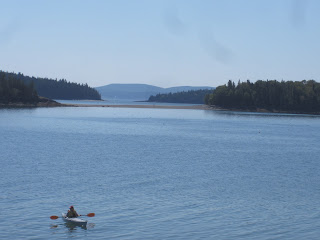

I'm thinking about depth of field this Elul--not just trying to move into the field, but to go deeper and further in than I've managed to do the last two Eluls. I'm accomplishing this in tiny increments--I think. But if I'm managing to do it at all, it's because I'm being both more honest with myself and others--and more forgiving of myself and others, recognizing my petty judgments of others for the ways they mirror my own weaknesses, speaking up and out even when it feels strange to do so, owning the ways I often keep the world too small and too safe for fear of doing the brave thing because of how easily it might just crash and burn.  

When I really get honest with myself, and when I try to act as well as think, I have my best and only chance of being my best self. Furthermore, I get better at consoling myself because I stop focusing on the ways I've felt misunderstood, neglected, unappreciated, or lacking in capacity to reach in and beyond myself. And once I feel that I'm "right-striving" and "right-consoling"--I'm able to walk into the field unapologetically, even when my steps are uncertain. Sometimes I can speak up, and sometimes I can't. But sometimes I can. It's enough to make me feel hopeful.

Recently purchased new year's cards
L'shanah tovah to all of you who are reading this, regardless of what you believe and celebrate. May a happy, healthy new year lie ahead for you, and may you easily walk in those fields and forums where you feel loved and held, and challenged to be your best selves.

* Jacobson, Simon. 60 Days: A Spiritual Guide to the High Holidays. 2nd Revised ed. New York: Kiyum, 2008. Print.
** I blogged about this experience in September of last year:  <http://soalready.blogspot.com/2014/09/the-king-is-in-color-field.html>
*** Screen shot from Boston Globe Review; the painting is called "Winter Garden": <https://www.bostonglobe.com/arts/2015/06/11/vangogh/f3j52YuR2ik6PfAjG2P7bP/story.html>. 
**** "Van Gogh and Nature." Exhibition. Clark Art Institute, n.d. Web. 08 Sept. 2015. <http://www.clarkart.edu/Mini-Sites/Van-Gogh-and-Nature/Exhibition>.
***** I can't say for sure if this is the exact painting that I saw, or that it is called "Wheat Field Behind Saint-Paul Hospital with a Reaper": I do know that Van Gogh painted this scene many times and that I tried to choose the online version that I felt best represented the foreground as vibrantly gold.
****** Screen shot of image on <http://www.themasterpiececards.com/famous-paintings-reviewed/bid/99911/Vincent-van-Gogh-Paintings-1888-1890>; "Wheatfield with a Reaper" is the title of this painting.
 

Monday, July 20, 2015

Seeking Balance--And Finding It in The New Yorker

So already, I've been feeling agitated, and mad about it. On a slow, enraged burn about it or something else, or lots of something elses, maybe. Whatever the source of my feelings, I suspect their intensity is in part due to some aspect of the present moment, the connectivity to everything good and bad, thanks--or no thanks--to technology. That the bad is winning out in the news these days is definitely part of the problem.

So hungering for a slower, non-technological experience, longing for something to inspire me or at least distract me thoughtfully, wanting to recline on my sofa rather than hunch over my laptop, I picked up the July 20 New Yorker last Friday afternoon. Because I was feeling angry, useless, and generally out of sorts, I expected to find little in it to engage me.

Instead, though, I found lots to engage me. First there was the Sempé cover illustration with its arch title, "Under the Same Hat." Ah, that everyone had such a summer garden in which they and their friends, cool and composed, might gather around the ritual of tea or something else. Nice idea, but hardly likely, Sempé's title suggests. It mocks and jabs lightly but surely at the similarly attired foursome assembled amidst four perfectly pruned trees. Perhaps the genteel, closed social circle exists to affirm the world view its members trust one another to hold fast to in the face of the crazily changing, majorly disordered world beyond the garden. And just how how often, and for how long, do the members of this foursome imagine the existences of the inhabitants of that majorly disordered world? I know what I think, but I could be wrong about them. And it's not that no one should ever drink tea in a garden, either. Maybe the problem is those hats.

Despite my desire to escape the world's problems, the first actual article I was drawn into explored a long overdue earthquake's potential impact on the Pacific Northwest, given the region's current inadequate state of readiness for such an event. Reading the scenarios Kathryn Schulz sets forth in "The Really Big One" reminded me of reading Jonathan Schell's The Fate of the Earth in three New Yorker installments in the early 1980's. There are haunting lines in Schulz's article, and they seem to apply to so many situations that crop up on my news feed routinely:
"The Cascadia subduction zone  . . . poses a danger to us today because we have not thought deeply enough about the future. That is no longer a problem about information; . . .. Nor is it a problem of imagination. If you are so inclined, you can watch an earthquake destroy much of the West Coast this summer in Brad Peyton's 'San Andreas,' . . .. As these movies attest, we excel at imagining future scenarios, including awful ones. But such apocalyptic visions are a form of escapism, not a moral summons, and still less of a plan of action. Where we stumble is in conjuring up grim futures in a way that helps us to avert them."
More bad news for sure: if the ladies in Sempé's cover illustration are drinking tea anywhere near Seattle, they won't stand a chance, even if their hats convert into flotation devices. But there was something helpful in Schulz's analysis and her tone. Imagining can't be the endpoint, and we're in big trouble if envisioning our own destruction makes us feel we're responding adequately to the possibility of it. But Schulz's tone makes it possible for people who've been looking the other way or simply living in ignorance of this information to begin acting helpfully right now.

Near the end of the article, Schulz talks about a Pacific Northwest school superintendent who has unsuccessfully sought funds to build a campus outside what the article calls the "tsunami inundation zone." No such funds are being made available to him, due to certain regulations, and he lives with the knowledge that one of the elementary schools for which he is responsible cannot be evacuated to a location that would ensure the students' safety. Schulz's article was hardly uplifting, but I was grateful to Schulz for sharing Superintendent Doug Dougherty's willingness to imagine a terrible scenario and do all in his power to prevent it. I am waiting to see if something good and proactive might come of Schulz's advocacy for Dougherty and his students.

I was next drawn to a Tony Hoagland poem, a good counterbalance, I hoped, to the serious problem Schulz's article had educated me about. I always count on Tony Hoagland to slap me upside my head, always by holding the mirror up to himself and keeping it in place until we both laugh and know all too well who we are, even if those around us may not see it. In "Giving and Getting," Hoagland experiences rubbing the feet of an old friend who's been hospitalized as being "like reaching into some/ thick part of my heart that couldn't feel/ and kneading away at it . . .." Recognizing that he's receiving although he's ostensibly giving, he reflects on his "persistent selfishness," manifested by "one of my hands offering the gift, the other/ trying to take something back." And the problem is that this self-knowledge doesn't make the selfishness okay, doesn't in of itself reconcile and accommodate those ideas and acts which are mutually exclusive:
Giving and getting 
like two horses arriving at the same time

from opposite directions
at the stone gate

that will allow only one to pass.**
Any mention of horses in a poem invariably reminds me of Mark Doty's "Source"* and James Wright's "A Blessing." So Hoagland's poem washed over me as if redemption, usefulness, and peace were indeed possible, imaginable in a basically good world. Our own weaknesses, our arrogant selfishness--we can transcend them as long as we look reverently beyond the universe of ourselves. And yet, when we do look beyond ourselves, how hard it is to reconcile the flat, placid world where these two horses stand, far from any ocean shore, with the endangered coastal world of the Pacific Northwest. That's our challenge, holding it all, not being drowned by it while thinking about the seriousness of drowning.

Holding it all somehow is one of the problems of the protagonist of Lauren Groff's short story, "Ghosts and Empties." Groff shares Tony Hoagland's reverent irreverence, his ability to mock himself, but her story is more serious than Hoagland's poem, perhaps because its protagonist is a wife and a mother whose behaviors necessarily have impact on those in her family. I still don't understand Groff's title much at all, but her first paragraph spoke to me right away, even though I'm not the mother of sons:


"I have somehow become a woman who yells, and because I do not want to be a woman who yells, whose little children walk around with frozen, watchful faces, I have taken to lacing on my running shoes after dinner and going for a walk, leaving the undressing and sluicing and reading and singing and tucking in of the boys to my husband, a man who does not yell."

I too have a husband who doesn't yell; I too often go stomping around the neighborhood when I'm out of sorts, and walking around the neighborhood when I'm less agitated and the world can penetrate my consciousness without my rolling it into a ball and hurling at someone or something else.

But as a rule, I don't go at night, when Groff's protagonist goes. She explains that as her neighborhood goes dark, "a second neighborhood unrolls atop the  daytime one." This was the first hint she offered me of a parallel universe, one that's dangerous and aggravating, but also mystical. To explain how the neighborhood is "imperfectly safe"--dangerous and not dangerous--the narrator reveals that 
"There was a rape a month ago . . .; and, a week ago, a pack of loose pit bulls ran down a mother with a baby in her stroller and mauled both, though not to death. It's not the dogs' fault; it's the owners' faults! dog-lovers shouted on the neighborhood e-mail list, and it's true, it was the owners' fault but also those dogs were sociopaths."
That no one died is the good news; but if you're looking for compassion, it might be better to be a dog in Groff's narrator's neighborhood than a human being. And can dogs be sociopaths? I don't know, but I can feel that our narrator is up to her ears in a certain kind of exasperation that reflects my own on occasion, even though I almost always feel people, including myself, are doing the best they can.

But in general, Groff's narrator likes strangers at a distance, as do I: there are certain people whom she encounters on her rounds, wonders about, monitors the lives of, cares about: she fears that the old woman who walks a Great Dane "the color of dryer lint" is not well, wonders if the obese teenage boy who is endlessly on his treadmill can see "how with each step his stomach ripples as if it were a pond into which someone had tossed a fist-size stone," and fantasizes about the hymn-singing of the nun-remnant--"the three kindly sisters squeaking around that immense [monastery] space in their sensible shoes." 

There's something so beloved in her attention to the inhabitants of that second nighttime neighborhood. But they aren't the only ones taking up space in her mind, so she keeps yelling.

Which brings me to my favorite paragraph in this story, which is only three pages long in its entirety--something else I liked about it.
"It's too much, it's too much, I shout at my husband some nights when I come home, and he looks at me, afraid, this giant gentle man, and sits up in bed over his computer and says, softly, I don't think you've walked it off yet, sweets, you may want to take one more loop. I go out again, furious, because the streets become more dangerous this late at night, and how dare he suggest risk like this to me, when I have proved myself vulnerable; but, then again, perhaps my warm house has become more dangerous as well. During the day, while my sons are in school, I can't stop reading
about the disaster of the world, the glaciers dying like living creatures, the great Pacific trash gyre, the hundreds of unrecorded deaths of species, millennia snuffed out as if they were not precious. I read and savagely mourn, a if reading could somehow sate this hunger for grief, instead of what it does, which is fuel it."
Why--and how--does she think she's proved herself vulnerable? My guess is that anyone experiencing her passionate energy would think her strong rather than vulnerable. But if vulnerability is associated with feeling out of sync with the world marked by loneliness, ongoing dimunition, and large and small disasters, I so understand her feeling of vulnerability. And, oh, I so relate to her experience of compulsively "reading about the disaster of the world." 

Still, the phrase in this paragraph that really pulled me up short was "this hunger for grief." When I was younger, I characterized grief as something that we necessarily endured with the hopes of moving beyond the excruciating pain of it at some point. But in the last few years, I've begun to recognize grief--hard, true grief that can hardly bear the loss of someone or something dearly loved, that sits so deeply within a person that it's all she can do to breathe--is something to savor on an important level. When you grieve, really let yourself know the pain of loss and permanent change, you feel terrible--terribly true to yourself and terribly alive. And everyone wants and needs know that they're really, truly alive, at least some of the time.

Every once in a while, some version of this grief, probably a distant cousin of it, rears up in me, surprises me, and holds me fast. The last time was when I was watching Woman in Gold on a flight from Dubai to Boston. I didn't know why I cried as hard as I did during the last half hour of the movie--it had to be about more than my understanding of the number and nature of profound losses experienced by the Helen Mirren character. So I sniveled and wept, taking comfort in the fact that everyone around me was sound asleep and insensible to my struggles to breathe through my congested nose. I knew I was crying for me, too, about something I still can't identify.

Which leads me to Groff's narrator and the kind of wandering and neighborhood monitoring that is dangerous for her to give up--and not to give up. Groff's narrator doesn't give up her nighttime walks, and it's a good thing: during her second year of criss-crossing her neighborhood, she notices that the obese boy, "my flabby friend," has undergone "a transformation so astonishing it's as if a maiden had turned into a birch tree or stream" (as the former teacher of "Greek Mythology," how I loved this line!). She reacts audibly: "I yelp aloud because of the swiftness of youth, these gorgeous changes that insist that not everything is decaying faster than we can love it." 

Has that been the root cause of the problematic yelling, the fear that all would decay and die before it could be loved, before she could love it? By this point in the story, the narrator isn't talking much about her yelling, which may have ceased altogether. The world too changes; and as the vernal pool frog-singing builds to a crescendo, the narrator has an experience of profound beauty, courtesy of the lighting installed by the new owner of the former nunnery which illuminates the full span of the branches of an ancient, commanding oak tree:
I've always known the tree was there, . . . But it has never before announced itself fully as the colossus that it is, with its branches that  that are so heavy they grow toward the ground then touch and grow upward again; and thus, elbowing itself up, it brings to mind a woman at the kitchen table, knuckling her chin and dreaming. I stand shocked by its beauty, . . .
Groff's narrator writes herself into natural and mystical worlds with her domestic metaphor. It's as if she herself, like the oak tree, has needed to grow down toward the dark earth before ascending again toward light. Which she's finally doing.

"Beseeching Apparition" by Scott Ketcham****
And with her nod to dreaming and the reality of that which has never before been fully seen despite its having always been there, the narrator concludes the story with a long paragraph in which she divides herself into body and spirit, separate but interdependent and contributory to her understanding of the world: "I hope . . . [my sons] understand . . . that all these hours their mother has been walking so swiftly away from them I have not been gone, that my spirit, hours ago, slipped back into the house . . .," and eventually "slid through the crack under [their] doors" to breathe them in and out. She still fears the distance between her husband and herself--"my husband and I will look at each other crouching under the weight of all that we wouldn't or couldn't yell," no doubt augmented by "all those hours outside walking, my body, my shadow, the moon." But she's no longer desperately anxious, and furious about it:  somehow, she's made peace with the idea that "nothing is not always in transition." I think she's optimistic that her sons will be able to understand that some of her distance was to spare them the experience of dreading her when she couldn't help but yell.

It's at the tail end of the story that I diverge most strongly from Groff's narrator: she asserts that the moon laughs, but not at us because "we . . . are too small and our lives are too fleeting for it to give us any notice at all." If anything, social media has been convincing me that we can be big and powerful, that we can organize and act, that we need not feel defined by what is and has been, though we must learn from it. That's the wonderful opportunity it creates.

But here's the shadow of that opportunity: with that understanding of our potential individual and collective power comes a whole new responsibility for wielding that power. If we belong to multiple virtual and face-to-face communities that endlessly and very responsibly share information about injustices and disasters churned out by a world in which violence, ignorance, and indifference do so much harm--the kinds of situations and tragedies that Groff's narrator was reading endlessly, addictively about--choosing how and when to act becomes a constant and therefore potentially exhausting responsibility and imperative. Especially when tragedies proliferate simultaneously, it's hard to know which to attend to and respond to first. Plus new tragedies create a need for us to educate ourselves so that when we do respond, we can do so knowledgeably and effectively. There's always so much to do and to learn. Can we be blamed for wanting and needing to retreat from it all at times?

I haven't yet figured out how to take good care of me and good care of the world simultaneously. And having now almost finished writing this blog post, I now understand that this has been at the root of my feeling so uncomfortable--and so angry about feeling uncomfortable that what I really, really wanted to do was yell--at everyone, anyone, everything, anything.

I know that Wordsworth, the romantic poet who worried about the effects of industrialization on society and the human spirit, was lamenting those of his era's increasing disconnection from the world of nature, but as I was lying in bed this morning, I found myself recalling one of his great sonnets:

The world is too much with us; late and soon,*****

Getting and spending, we lay waste our powers;—

Little we see in Nature that is ours;

We have given our hearts away, a sordid boon!

This Sea that bares her bosom to the moon;

The winds that will be howling at all hours,

And are up-gathered now like sleeping flowers;

For this, for everything, we are out of tune;

It moves us not. Great God! I’d rather be

A Pagan suckled in a creed outworn;

So might I, standing on this pleasant lea,

Have glimpses that would make me less forlorn;

Have sight of Proteus rising from the sea;

Or hear old Triton blow his wreathèd horn.
The world is much with me much of the time, but I love the world, and it's very much in my nature to pay attention when tragedies and injustices occur, and to want to respond in some way. So the answer must be to recognize when the world is threatening to become, or has become, too much with me, and then to do what I need to do to reclaim or keep my balance.

"Attendants" by Scott Ketcham****
I picked up the The New Yorker when I was feeling desperate to reclaim my lost balance, and it took good care of me this week, inviting me to slow down and step back, providing me with companionship, consolation, and redemptive images that I can conjure at moments of anger, despair, and overload. It helped the world be much with me, but it also gave me a much needed place for myself, both inside and outside of the world.

Now it's late Monday morning. Outside my window, summer hangs in the air as if it just might be endless; the trees couldn't be greener and more lush than they are. The humidity feels like it won't relent, but that's summer. At the moment, I'm feeling more like the front figure in the painting at the right than like the disgruntled, lonely wanderer I sometimes feel myself to be. I think that when the imbalance warning bell sounds, I'm going to be able to find or regain the balance that's necessary for both doing and being. Perhaps all it takes is an hour or two off and a good magazine. If I take those kinds of breaks more frequently than I have been, I think I should be able to do right by me and right by the world.

* "Horses at the Gate" photograph downloaded from <http://freehdw.com>: Free HD Wallpapers for Wide Screen. 
** The poem "Source" follows the poem "Broadway" on this link.
*** Screen shot of <http://rantaboutfilm.com/wp-content/uploads/2015/03/womaningoldposter.jpg>
**** Check out other paintings by Scott Ketcham at <scottketcham.com>. 
***** <http://www.poetryfoundation.org/poem/174833>