Thursday, January 30, 2020

At the Orono Public Library

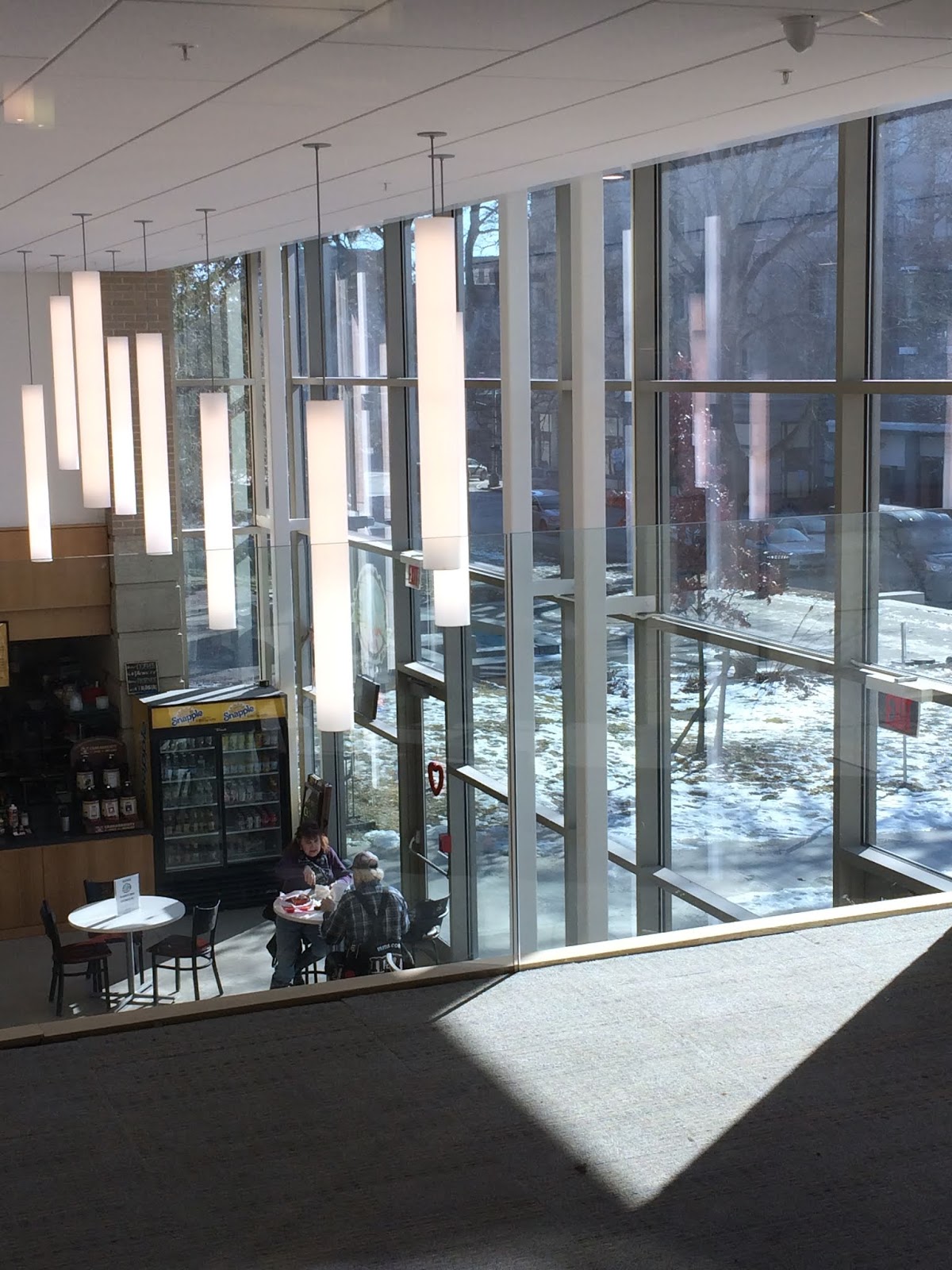
So already, I am writing to you from the Orono Public Library on the second day of my writing retreat. Outside it's 20° under one of those late January hard, cold, blue skies--just stunningly clear and bright; inside it's heater-humming warm and cheerful. 

Every once in a while, you imagine what a designated block of time spent in a particular way might be like; every once in a while the reality of it measures up to the hope of it. So far, my writing retreat has lived up to my hopes for it.

A promise I made myself as this retreat began was that I would write my daily morning pages, as prescribed by Julia Cameron in her various books for aspiring and blocked creatives. I'm bending the rules here by writing today's pages in the form of a blog post and sharing them with all who might read this, but Cameron herself says there's no wrong way to write these pages.

It's not that I haven't read and replied to some emails while I've been up in Maine; it's not that I haven't spoken to my parents or had a chat with the visiting nurse who's about to discharge my dad from her care, given his complete recovery from the pneumonia he had earlier this month. This hasn't been the kind of retreat that has enabled me to leave the whole world behind. But it's definitely let me leave enough of it behind.

Truthfully, I had forgotten what that felt like. It seems like forever since I woke up in the morning and had a day, let alone a series of days, about wishes and aspirations rather than obligations. If in yesterday's blog I wrote about experiencing a sense of homecoming when I read Wordsworth's poetry in early December, today I can honestly say that many miles from home, sitting in quiet libraries under the blank slate of Maine's bright blue winter sky, I am also experiencing a sense of homecoming. 

Maybe writing retreats always need to be about both homecoming and departure, though in what order I don't know. A couple of weeks ago, I went on a weekend visit to another very good friend from college. Thanks to the long, quiet train rides to and from Philadelphia, and much to my relief, I discovered that even if I hadn't been able to write very much since November, I could still read in an engaged way. 

Of course, visiting old friends also always reminds me that I'm not someone who is engaged only in the care of her elderly parents. That's part of why I'm seeing friends for dinner every night during this writing retreat.


The children's story hour is starting on the other side of this library, and there's some melodic, guitar-accompanied singing going on. Everyone knows the song, and it's a great addition to the hum of the nearby heater.

Oh no, they've added drums. I'm enjoying the children's story hour a little less than I was before, but the singing still really is good. The kids are doing great with some complicated rhythms, and they seem to have the words to the songs' many verses down cold. Not to mention the sounds that the animals make.

The songs are over now, at least for a while; I think they're listening to the stories that aren't sung, that are being read or told. 

When I first stopped teaching, I used to go regularly if not often to the Thomas Crane Public Library in Quincy. Those were the days when I even had time to walk to and from the library, let alone go there for a few hours. Those days seem so long ago. But sitting in Maine public libraries the last couple of days reminds me that the days will come when I will be able to resume that practice.


So what's on the agenda for today? At the very least, reading a short story a friend of mine asked me to read and give her feedback about. And also, reading the morning pages I began writing, not as regularly and religiously as I'd hoped, the day after my mother moved onto the Skilled Nursing floor of her senior living community. 

I mention my mother's move because my lack of writing is so much connected to it:  the challenge of the last few months, besides my parents' various health issues, has been that they're living one floor apart from each other after so many years--it will be seventy years on March 18--of living fully together. It's been a difficult, sad adjustment for both of them, one they've both been needing to make when neither of them is at the top of his/her emotional game.

I don't know what else I might do here today. Write some of the talk I'll be giving in early March about Considering Matthew Shepard? Read another Wordsworth poem? Or some of the poetry of Rachel Hadas, whose work I first encountered in the Scituate Town Library poetry discussion group earlier this month? 

What I do know for sure is that I'll be off to Ellsworth for dinner with another good friend from college days when my library day is over.

What a gift to have time, choice, and space! Not to mention friends.

Wednesday, January 29, 2020

Lines Composed Many Miles from Tintern Abbey

So already, greetings from the banks of the Wye--or really, greetings from the Bangor Public Library. I'm on the first day of my self-imposed, hopefully productively-self-guided writing retreat.

I've come to Maine not because I've been struggling with writer's block--but because I've been yearning for the space and time to put some thoughts and feelings onto paper. I'm staying with a really good friend from my college days, Margo Lukens, whom I felt very comfortable asking to put me up. My hope is to spend each of my three days doing lots of writing and some reading, and each of my three evenings having dinner with good old friends, Margo and her husband Ken among them.

Last night, as I talked about my retreat plans with Margo, she suggested I think about blogging more frequently but also more briefly than has been my custom. Give yourself permission, she suggested, to publish in-the-moment, less developed, more exploratory posts about your individual thoughts, feeling, and ideas. Margo knows that my current days are generally chopped up, predictably and unpredictably; she also knows that I've had no shortage of writing ideas, even though I've had a shortage of writing time. Her suggestion was a direct response to the writing circumstances I described to her.

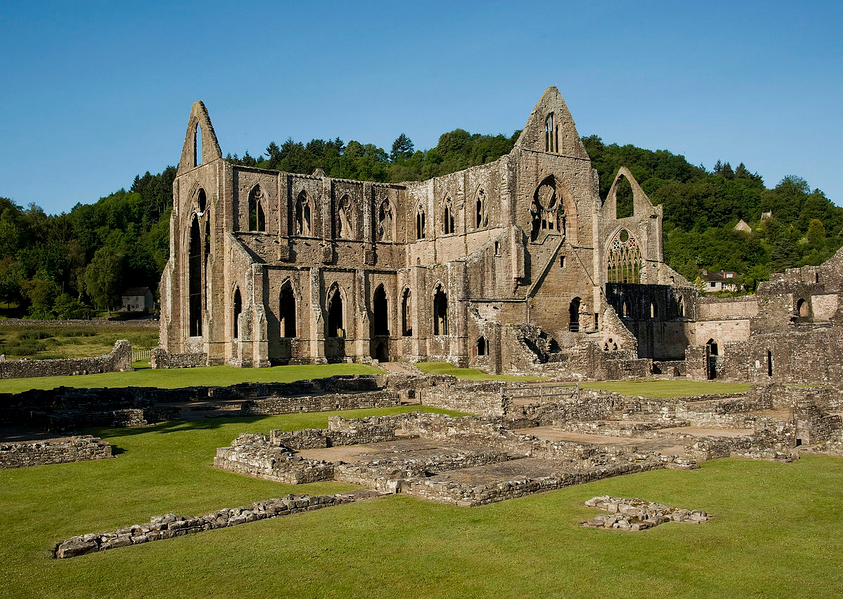
Tintern Abbey and Courtyard*
Frankly, her idea didn't sound like "one of the answers" until this morning, when I reread Wordsworth's "Lines Composed a Few Miles above Tintern Abbey, On Revisiting the Banks of the Wye during a Tour, July 13,1798." Why--or Wye--did it suddenly resonate, you ask? For three reasons. Because I hadn't expected to be as deeply moved as I was by this poem that I hadn't read in the last forty years. Because I hadn't expected to come upon certain lines and phrases that for a long time have been helping me speak to myself about the world: "The still sad music of humanity" is one of those phrases. Finally, because I was sitting in the library with my laptop computer inches from my copy of the poem.

But why read "Lines Composed a Few Miles above Tintern Abbey" again at this moment? At the beginning of December, when the Scituate Town Library poetry discussion group read some Wordsworth, I felt a certain unexpected but reassuring sense of homecoming. The leader of that group, Joyce Wilson, and I decided to read some more Wordsworth. Joyce was interested in Harold Bloom's characterization of Wordsworth as a poet writing in the tradition of biblical prophecy; and since I'd taken a graduate school course on visionary poets, I had just the right book on my shelf--Milton and the Line of Vision, edited by my professor, Joseph Anthony Wittreich--to help us explore this idea together. As Wittreich puts it, visionary poets understand that their readers need to learn "to see not with but through the eye."**

Poetry--especially other people's poetry--has been much on my mind of late, particularly because the two choirs I sing in--the Unicorn Singers and the Broad Cove Chorale--are learning Craig Hella Johnson's Considering Matthew Shepard. The oratorio draws much of its text from Leslea Newman's poetry cycle entitled October Mourning. It's my contention that Johnson, Newman, and their collaborators were also writing in the prophetic tradition. 

A fellow Unicorn Singer and I are preparing a talk to be given before our late March performances, so we've been listening to interviews with Craig Hella Johnson. Johnson's motivations for writing his passion oratorio are multiple, but one of them is to create a better world in which we act better, understand one another better, and love more. Prophets are always about creating or restoring the moral order and getting people to act right. But one of the ways to the heart--perhaps always, but especially in this era of proliferating hate crimes--may be through the ear and eye.

So if you've read Wordsworth in the past, and you know this poem has something to do with returning to a beautiful natural place of one's youth and grappling with one's changed relationship with Nature over time, you're probably thinking, what can this possibly have to do with an oratorio about Matthew Shepard?

Simply put, Wordsworth's poem is also much about seeing differently, about developing a new perspective, and even holding multiple perspectives in one's head--in this case, the person I was and still am on some level, and the person I am right now who well understands that younger person and doesn't quite know where all this change will lead.

Wordsworth's youthful self wanted nothing more than to perceive, delight in, and romp among Nature's various elements that, for him, "had no need of a remoter charm,/ . . ., not any interest/ Unborrowed from the eye." Wordsworth's older self, in contrast, sees something more in Nature, senses in it "A presence that disturbs me with the joy/ Of elevated thoughts." He welcomes those thoughts, though they "chasten and subdue" the "dizzy raptures" and "aching joys" of his childhood.

Nature is no longer purely surface and sensory for Wordsworth; neither is he himself. On returning to Tintern Abbey five years later, he recognizes and values his own depth and potential for spirit, even if he isn't totally easy with every aspect of the change he's undergone:
Nor less, I trust,
To . . . ["these beauteous forms"] I may have owed another gift,
Of aspect more sublime; that blessed mood,
In which the burthen of the mystery,
In which the heavy and the weary weight
Of all this unintelligible world,
Is lightened:—that serene and blessed mood,
In which the affections gently lead us on,—
Until, the breath of this corporeal frame
And even the motion of our human blood
Almost suspended, we are laid asleep
In body, and become a living soul:
While with an eye made quiet by the power
Of harmony, and the deep power of joy,
We see into the life of things.***
While Wordsworth has many pleasant memories of a favorite childhood spot, he's now interested in writing about the existence of and his relationship to "the burthen of mystery," and then about the much desired experience of transcending one's own physical body to exist as "a living soul." When we're in that calm but profoundly happy soul state, we don't just see what's around us; "We see into the life of things." And that Wordsworth wants to do.

Wordsworth is grappling. And so must we. And I say "we" not just because I'm talking to "All of Us," as one section of Considering Matthew Shepard is entitled. Actually, I'm thinking about Wordsworth and his sister Dorothy, to whom he speaks. Seeing and hearing anew, always a challenge, often goes better when there's a trusted companion to share the experience with along the road. I'm looking forward to heading back to Orono in a few minutes, and telling Margo all about my latest blog, written in a few hours at the Bangor Public Library. 

* Blaze, Saffron. “Tintern Abbey and Courtyard.” Wikimedia Commons, 31 May 2011, commons.wikimedia.org/wiki/File:Tintern_Abbey_and_Courtyard.jpg.
** Wittreich, Joseph Anthony, editor. Milton and the Line of Vision. The University of Wisconsin Press, 1975.
*** Wordsworth, William. “Lines Composed a Few Miles above Tintern Abbey,...” Poetry Foundation, Poetry Foundation, www.poetryfoundation.org/poems/45527/lines-composed-a-few-miles-above-tintern-abbey-on-revisiting-the-banks-of-the-wye-during-a-tour-july-13-1798.

Tuesday, December 24, 2019

For This Dark, Bright, Mysterious Season

So already, I love Bruce Crane's "Snow Scene."* It could easily have been painted looking south from Fenno Street in the Wollaston section of Quincy, MA, where I often walk.

I especially love the salt marsh at Black's Creek--Black's Creek runs through Quincy's Merrymount Park--at dawn and dusk. Especially in winter, the sweep of its wide, clean barrenness agrees with me. It's one of the first places that the increase in light--be it in the early morning or the late afternoon--can be readily discerned once the first dark weeks of January are over.

January--soon to be upon us--offers a blank, slow endlessness to our imaginations; December, in contrast, glitters, dazzles, expects, distracts, and demands. There's often little to no time in December for walking, for writing, for reading. So much doing and driving. So much stirring and stacking and baking and bringing. Even so much singing. And in the December 2019 season of impeachment, so much shouting and squaring off. 

If ever there has been a December that has needed art and poetry, this one is it. Darkness sends us home both wired and exhausted from the ride home's traffic and the latest news, but with many busy hours to go before we sleep.

When I finally stop doing--because I'm finally "ready," finally "done" with singing concerts, with writing cards, with cooking and baking, with wrapping gifts, with catching up on the latest grandstanding--I can often feel myself still churning, thinking and moving at the frantic, productive pace that has gotten me to "done" and "informed." At those moments, the silence and stillness for which I've claimed to be hankering sit on me like a scratchy, ill-fitting coat.


There's a transition that needs to happen, and sitting still with music, visual art, and poetry helps. Poetry reminds us--or at least me--that my heart beats with something more than the day's push, rush, and rage. So this morning I pushed back against "doing," sat down, and began reading. Okay, I admit I got to "doing" again when I began writing this post, but transitions happen in increments.

Luckily, blogs are great places for sharing other people's art. So as December 2019 winds down and the lights of Hanukkah and Christmas brighten the darkness, I share two favorite seasonal poems from Art & Nature: An Illustrated Anthology of Nature Poetry, a publication from the Metropolitan Museum of Art that pairs visual art and poetry--and to which I often turn when poetry and I have become temporarily estranged.

If you're reading this in late December's sunlight, I offer you first Ludwig Michaelek's "The Way Home."** The sight of home after we've been trudging at day's end through cold and snow: we who live in wintry climes all crave that.

It's a great picture to accompany "Good Night Near Christmas" by Robert Francis:
And now good night. Good night to this old house
Whose breathing fires are banked for their night's rest.
Good night to lighted windows in the west.
Good night to neighbors and to neighbors' cows

Whose morning milk will be beside my door.
Good night to one star shining in. Good night
To earth, poor earth with its uncertain light,
Our little wandering planet still at war.

Good night to one unstarved and gnawing mouse
Between the inner and the outer wall.
He has a paper nest in which to crawl.
Good night to men who have no bed, no house. 
And finally, another poem that recognizes the importance of stars: "The Evening Star" by Rainer Maria Rilke:
One star in the dark pass of the houses,
Shines as if it were a sign
Set there to point the way to –
But more beautiful, somehow, than what it points to,
So that no one has ever gone on beyond
Except those who could not see it, and went on
To what it pointed to, and could not see that either.
The star far off separates yet how could I see it
If there were not inside me the same star?
We wish on the star because the star itself is a wish,
An unwilling halting place, so far and no farther.
Everything is its own sigh at being what it is
And no more, an unanswered yearning
Toward what will be, or was once perhaps,
Or might be, might have been, or – – –


And so soon after the sun goes, and night comes,
The star has set.

I'm still thinking about those last two lines, still wondering what to make of them. But it's a good season for wonder and wondering.


Wishing you a holiday season in which you feel the star within you. And may you soar in 2020, powered by the love, beauty, and the stillness within and around you. There really is no reason all can't be calm and bright, at least for a little while.

* Crane, Bruce. "Snow Scene" (watercolor and gouache on blue-gray wove paper). Art & Nature: An Illustrated Anthology of Nature Poetry, edited by Kate Farrell, Metropolitan Museum of Art, 1992, p. 142. 
** Michaelek, Ludwig. "The Way Home" (Color etching and aquatint). Art & Nature: An Illustrated Anthology of Nature Poetry, edited by Kate Farrell, Metropolitan Museum of Art, 1992, p. 130. 
*** Francis, Robert. “‘Good Night Near Christmas.’” Art & Nature: An Illustrated Anthology of Nature Poetry, edited by Kate Farrell, Metropolitan Museum of Art, 1992, p. 125. 
**** Rilke, Rainer Maria. “‘The Evening Star.’” Art & Nature: An Illustrated Anthology of Nature Poetry, edited by Kate Farrell, Metropolitan Museum of Art, 1992, p. 130. 
***** Thank you, Kathleen FitzGerald, for the beautiful greeting card you sent me that I photographed and included here!

Sunday, November 10, 2019

Besodded by Scott Ketcham's Recent Paintings

"Winged Sod" by Scott Ketcham*
So already, whenever I encounter Scott Ketcham's most recent works, I almost always respond in strong, often contradictory ways. I love, I admire, I long to look longer, I long to look away, I wonder what it means that I'm married to the man who painted them. This year, among Scott's varied new works is one painting I immediately fell in love with, even though it has so much in common with some other paintings that creep me out.

To my eye and imagination, "Winged Sod" presents a voluptuous figure who's in strenuous flight, her head bowed, her wings--or is it wing?--extended back, her meaty, muscular legs--the thighs of a committed athlete--contracted in energized suspension above a field of crinkled white nothingness. Bowed and triumphant both. First impressions.

Of whom or what did she remind me--besides a number of professional basketball players whom sports photographers often capture in mid-air beneath the hoop, their arched and twisted bodies conveying their committed intensity and staggering athleticism? 

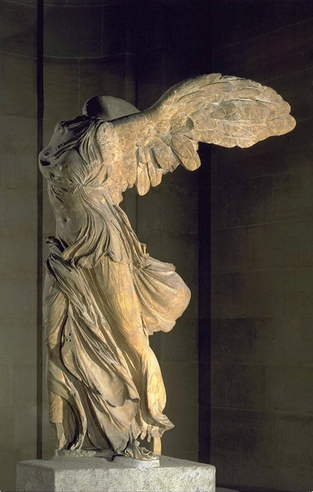
"Winged Victory"**
I took my first cue from the first word of her title--and did an online search for "Winged Victory."* Blogger saltgirlspeaks, like myself, was curious about the goddess Nike's missing arms and head; her reflection that "there’s a certain melancholy beauty to destroyed victory…"** got me thinking about the themes and overall mood of Scott's work: even in Scott's strongest, most nearly triumphant athletic figures, male and female, there's a feeling of tireless, unbowed resignation to perpetual struggle. I'm guessing that when Nike still had her head and arms, she exuded the joy of safe landing following a mission accomplished. Scott's "Winged Sod," in contrast, is still in motion, still striving, still flying--more in a state of ongoing intention than fulfilled achievement.


Missing body parts, athletic figures stretched more horizontal than vertical captured in action. Suddenly it was Rodin's "Iris, Messenger of the Gods" that "Winged Sod" had me thinking about. I had to laugh remembering the field trip one of my classes took to Harvard's Fogg Art Museum  on which our enthusiastic elderly-woman docent had asked my students, much to their teenage chagrin****, to look long and carefully at Rodin's anatomically graphic statue in preparation for comparing and contrasting it with a Degas ballerina that stood nearby.

"Call"
More importantly, my association to Rodin's sculptures reminded me of two things that sometimes disturb me about Scott's paintings: that the figures often lack parts of their bodies; and that, when their faces can be seen, their eyes are often blank or closed, suggesting torpor, death, profound disconnection from the viewer or anyone else, for that matter. Iris is a mythological figure; how individual and grounded in the "real world" are Scott's figures, or do they represent universal aspects of human experience--at least as Scott understands them?

"Scout"
Clearly, it was time to talk to Scott about all of this. As far as "Winged Victory" was concerned, Scott told me that antiquities not even that long ago were often vandalized by collectors who were happy to lop off and carry home a part of them if having and transporting the whole was not possible: why not break off the head of the goddess Nike and smuggle it home in a steamer trunk? 

In explaining Rodin's many "incomplete" statues, Scott, who admits to Rodin's influence on his work and consciousness, explained that Rodin's work was metonymic, and then said that though the statue did not depict the whole body, it stood for and evoked the whole body. The more he explained, the more I understood that he was talking about that subcategory of metonymy known as synecdoche: the whole is suggested or implied by the parts or the partial, in this case, by the partial body.

Kensington Lawns Sod
It's always good to be reassured that your husband has no interest in beheading, abbreviating, or dismembering people, especially women. And that wasn't a problem with "Winged Sod" anyway: she has a head. Her thick hair obscures the face--so we can't tell if her eyes are closed. But wait: is that hair, and can one be sure she has a head? "Or is what I'm interpreting as being hair actually sod, "a section cut or torn from the surface of grassland, containing the matted roots of grass," that's taking the place of a human head? Of course, it is possible that's Scott's title is simply conveying an association that Scott is making. Whatever is the case, I'm willing to replace the goddess Nike in my imagination with the Greek goddess Gaia, who's often understood as Earth itself, the source of all.

"Head in the Sand (2)"
The problem is that, despite my comforting mythological associations, Scott has several other paintings that place women in relationship to sod and other earth surfaces that really trouble me. Chief among them is "Head in the Sand (2)": frankly, it terrifies and therefore repels me: the body seems butchered or at least completely vulnerable; from my perspective, the form can't breathe, let alone see. That said, I wonder what I would see if I didn't know this painting's title: a darker object at the bottom of the painting with a strong, dark upper edge, and a very geometric something above it that's cinched in the middle? This painting could easily be looked at abstractly. That thought made me understand Scott's general preference not to give names to his paintings.

"Edged Sod"
Not horrifying but still troubling to me is "Edged Sod." Its crouched figure may be the most Gaia-esque of Scott's sod-connected females: she hosts the living world, carries it on her back. But is she a willing and eager hostess? Observing her taut, compact, energy-demanding position, I surmise that she might be oppressed by the sod she carries, especially given the painting's title's suggestion that she's merely the edge of the dominant sod, thus more its servant than its source.


"Persephone Prepared"
In fact, there seem to be three distinct relationships between the figures and "the sod" in Scott's paintings:
  • In one group, figures actually merge with the sod/earth, as is the case in "Edged Sod"; 
  • In another group, the figures move in, out, and through the sod--but remain separate, intact, and fully human, as is the case in "Persephone Prepared" (I blogged about Persephone connections in Scott's paintings a few years back); and 
  • In yet another group, as in the case of "Uprooted," the figures are attenuated or otherwise "restructured" so that they have roots--or are roots, suggesting they've been plucked from the sod.

"Uprooted"
Whether that separation from the sod represents liberation or forced exile from the life source, I can't tell. Whenever I'm baffled by motifs and patterns that I observe in Scott's work, I invariably pay attention to the literary associations I make to them. In this case, it's T.S. Eliot's lines from "The Wasteland" that keep coming to me: "What are the roots that clutch, what branches grow/ Out of the stony rubbish?" But I suspect I'm quoting Eliot to myself only because he's articulating my own question. I'm hard-pressed to equate sod with stony rubbish. Dark as Scott's work is, there's a fertility to it: the darkness he portrays births things.

Recently, Scott messaged me a drawing that moved me--it was simultaneously sweet and strange. In this drawing, the two figures of indeterminate gender are joined, connected, intimate, encircling, and they seem to share common roots--unless perhaps they are sharing kind of charged connection emanating from something not on the paper.

Yes, there's so much that's mystifying in Scott's paintings for sure, but I would feel remiss if I did not mention that's Scott's artistic output this year also includes portraits and life studies very much concerned with conveying the appearance and essence of the individual person posing for him. My purpose here, however, has been to talk about some of his work that's most challenged me as a viewer.


"Portrait"
So I end this post with two invitations for you to come see Scott's work large and up close:
  • If you wish to see Scott's most recent work, please come to his studio during the 4th Floor Artists Association's annual open studios on Saturday, November 23 and/or Sunday, November 24. Scott's studio is on the Fourth Floor of the Sandpaper Factory. 
  • If you wish to see more of a retrospective of Scott's work, please come to his show in the ET Wright Building that will run from Friday, January 10 through Friday, January 17; the opening is on Friday, January 10.  
Hoping to see you in Rockland!

* On Scott Ketcham's website: https://www.scottketcham.com
** Saltgirlspeaks. “Invisible Ink.” The Salt Girl Speaks, WordPress, 16 July 2007, saltgirlspeaks. wordpress.com/2007/07/16/invisible-ink/.
*** Rodin. (1880-1881). Iris, Messenger of the Gods. [Scuplture, bronze]. Fogg Museum, Cambridge, MA. Harvard Art Museums (web site).
**** When, after the observation period, our docent used the word "labia" and then pointed at the statue's female private parts, most of my students stared at the floor.

Monday, October 21, 2019

Holding On to Sweetness

So already, this morning was one of those get-moving Monday mornings. On the agenda was a visit from the plumber: my new washing machine was working well if and when the water flowed into it--which happened if and when the old valves, turn-offs, and associated pipes worked as and when they should--a circumstance that had ceased to be certain. I was going to be the plumber's first appointment, so I was up and at 'em. Not the day for an early morning walk along the beach!

Relieved as I was that my pipe dreams were about to fulfilled, I was also a little resentful of the timing of all this (and yes, I was the one who had jumped at this plumber appointment time for a number of dull reasons). Today is a Jewish holiday that I didn't understand at all until last year, even though as a child, I stayed home from school on this day in order to observe it. Back then, though, it never occurred to me to question anything that meant not going to school.

It turns out I'm not the only Jew whose understanding of Shemini Atzeret has been partial or non-existent. As Abigail Pogrebin says in My Jewish Year: 18 Holidays, One Wondering Jew, though she admits to "a bit of exaggeration*," 
  What's the easiest way to stump a Reform Jew? Ask him to explain Shemini Atzeret. 
   What's the easiest way to stump an Orthodox Jew? Ask him to explain Shemini Atzeret. (90)*
During her research/journey through the Jewish calendar, Pogrebin learned that "after the unceasing intensity of Elul, Rosh Hashanah, Yom Kippur, and Sukkot, God is asking us to stay just a bit longer"* (91). God as yearning for us--all of us, each of us? It's still such a new idea for me. But given the centrality of covenant in Judaism, what more would I expect, even if I can't respond to it with a completely faithful, resounding "Yes"?

Among those to whom Pogrebin spoke was Modern Orthodox Rabbi Asher Lopatin. Her book reports on their conversation and her reactions to it.
He . . . sees Shemini Atzeret as a tender, bonus moment with the Almighty, in contrast to God's severe evaluation during the Days of Awe.
'This is the intimate holiday,' he tells me. 'Atzeret means detaining. We're ending this period of holidays and pulling everything together. . . . The term atzeret means stop and come in,' . . .. I [Pogrebin is speaking here] could use a breath to pull everything together; I'm feeling buffeted by the marathon that started in August. 'As busy as God is with the whole world, God is also interested in what I'm doing. There are no special customs. No special foods. No crying. No shofar. The message is, "Just sit there and be there."' (92)*
I so relate to Pogrebin's sense of having been part of so many experiences of communal and individual intensity since Tisha B'Av. But now as I sit here knowing the Jewish calendar is about to pitch me out into ordinary time after these weeks of heightened spiritual purpose, of study, of going here and there, and then going here and there again, I'm feeling resistant to letting them go.

Not that it's been a smooth ride. While these weeks have held me, they've challenged me. Sometimes I've longed for ordinary time. But interestingly, my sense of belonging and engagement didn't waver even in those many moments I wasn't feeling what I'd hoped I'd be feeling--and that was really something for me. I admit it: I still struggle to think of God as being "interested in what I'm doing." But I no longer have trouble thinking of Him as being interested in what we're doing. 

So as I sat in my dining room waiting for my plumber to arrive and fix my "ordinary time" problems, I was thinking about not wanting to let go of the serious sweetness of these last two months. But ordinary time was encroaching, and I needed to decide what to serve for dessert to several old friends who are coming to lunch next week. What would go with a bowl of clementines--or maybe with maple-walnut ice cream? I opened up Maida Heatter's Book of Great Cookies--given to me about thirty years ago by one of my anticipated lunch guests--and out fell a photocopy of Heatter's recipe for hermit bars: whenever I've brought these cookies somewhere, I've invariably been asked for the recipe***--so now I always bring photocopies along with the cookies themselves.


I didn't bake this hermit bar!**
Oh! Perfect, I thought. Ordinary time was looking to have great sweetness potential. Two kinds of sugar, and molasses. Currants, plumped by a brief soaking in boiling water. Cinnamon, cloves, nutmeg, mace, and allspice. Ordinary time would have some spice, too--first, wafting on the kitchen air warmed by the 350-degree oven required to transform cookie dough to cookie bars.

Julia Cameron would probably call this synchronicity--this immediate stumbling on the right cookie. No, I didn't make it to synagogue today. But as I sit at my dining room typing this, I am feeling distinctly present and deliberately seated--and much aware of the possibility of the sweet continuities between the sacred and the ordinary.

P.S. My plumber came and went!--and all's well with my washing machine and all those places that water needs to flow and not flow.


* Pogrebin, A. (2017). My Jewish Year: 18 holidays, one wondering Jew. Bedford, NY: Fig Tree Books.
** C. (2006, January 2). Mondays with Maida - Hermit Bars [Web log post]. Retrieved October 21, 2019, from https://mylittlekitchen.blogspot.com/2006/01/mondays-with-maida-hermit-bars.html
*** This link suggests raisins as the fruit to include. The book version of the recipe says one can use currants or raisins, and suggests golden raisins in particular.