Friday, March 11, 2022

Remembering The Millions, The Thousands, & The One


So already, I'm sure it's because I'm Jewish. But whenever I hear or see the number 6,000,000, I think dead Jews.

Immediately, my mind leaps across the Atlantic Ocean and imagines places like Germany's Auschwitz, Bergen-Belsen, and Dachau concentration camps and Soviet Ukraine's Babyn Yar ravine.* 
 
The convenient thing about killing people at the edge of a ravine is that their bullet-ridden bodies either slip into the ravine--or can be easily pushed into it.

So this past week, when The Boston Globe reported that the number of people worldwide who'd died of COVID-19 had reached 6,000,000, my first thoughts were of the Holocaust. In truth, though, I'd already been thinking about it because of another article I'd read a couple of days earlier. "Putin’s attack on memory at Babyn Yar"** explores the Russian habit of eradicating, or at least trying to eradicate, inconvenient truths from the official historical record. 
 
In that article, Jeremy Eichlen explains that Russian officials had first tried to erase Babyn Yar's murderous history by erasing--literally filling in--the ravine itself. Later, in an attempt to conceal their complicity in the murder of 33,000 Jews, they'd installed a marker that provided no information about what groups had been killed at the site. Not that Jews hadn't been killed in Russia before. 
 
But people frequently don't cooperate with government efforts to alter history; often, they refuse, publicly or privately, to forget what they know. For that reason, since then, multiple memorials, some designated for specific groups murdered at the site, have been erected at Babyn Yahr. In times of peace, people visit them and remember events past.

But as you well know, these are not peaceful times, and Russian attempts to prevent memory seem to be persisting, according to Eichlen. Russian attacks in recent days in the Babyn Yar area have significantly damaged a building that had been designated to become a Holocaust museum.

Eichlen then goes on to say that peacetime and wartime efforts to rewrite history have a formidable opponent: art, which often not only preserves and draws attention to history, but conveys its human toll and significance . He speaks in particular of how Yevgeny Yevtushenko's poem "Babi Yar" permanently engraved on the collective human memory the facts and legacy of the mass murder of so many Jews at Babyn Yar. "The story of Babyn Yar," Eichlen asserts, "also reminds us of why art can be such a threat to totalitarian regimes: It remembers."**
 
I agree: art does remember, and other important collective and individual human needs depend on remembering. I think about Suzanne Brennan's "In America: Remember," an installation on the National Mall consisting initially of 600,000 flags for the Americans who had succumbed to COVID-19 by the autumn of 2021.*** One of those flags was for my father. 
 
Such works of art create the physical and temporal space in which we can remember, can ruminate on the present moment, can feel, can speak to ourselves, can speak to the dead if we want to, can think about mortality and meaning, can seek healing and hope. I believe that even just knowing that these works exist can create important psycho-spiritual space for those of us who can't visit them.
 
I write these words thinking about a book on my shelf that I've yet to read. I bought The Phone Booth at the Edge of the World because, like its author, I'd heard the news story about a phone booth in a man's garden on Japan's northeast coast that was attracting visitors. They wanted to use its disconnected phone to speak to loved ones they'd lost in the post-earthquake tsunami of 2011. I have to imagine that making the pilgrimage to this spot so close to where their loved ones had perished must have been as important as speaking to them on that disconnected phone.

I'm thinking a lot about the stories that we must remember to tell and hear as my choral group prepares--again--to sing Craig Hella Johnson's passion oratorio, Considering Matthew Shepard, on April 9 and 10.**** It tells the story of the gay college student who was brutally murdered in Wyoming in 1998.

It's not that Matthew Shepard, the "ordinary boy" who became known around the world, is in danger of being forgotten--his name, and by extension his story, are forever enshrined in the Matthew Shepard and James Byrd Jr. Hate Crime Prevention Act***** and on a commemorative plaque in the National Cathedral. It's that hate crimes like the one that killed him continue to be committed and have in fact increased in number in the past decade.****** That tragic and disturbing fact brings to mind the lines from "Where Have All the Flowers Gone": "when will they ever learn, when will they ever learn."

Yes, we need to be better and do better. But there's another important reason for telling these stories, specifically in art, music, and poetry. "We tell each other stories so that we will remember/ Try to find the meaning in the living of our days," explains the final of the three pieces in the oratorio's Prologue section. We have to find ways to mourn and to cope, and then to move forward with hope and active purpose. For Jewish people, this is about tikkun olam, or repairing the world.*******

One of the prominent voices in the musical story of Matthew Shepard belongs to the fence on which Matthew Shepard was hung and left to die by his murderers. Its monologues come from Lesléa Newman's poem cycle October Mourning: A Song for Matthew Shepard.********
 
The fence is a destination site for the bereft in the weeks and months after Matthew's death. In "The Fence (one week later),"it opines that "being a shrine/ is better than being/ the scene of a crime"(45). But eventually the fence is taken down, perhaps because of people's conflicting feelings about it. "The Fence (after)," in which the fence is spoken about, captures these tensions in its internally contradictory couplets:
 
prayed upon
frowned upon

adored 
abhorred

despised
idolized . . .

gone
but not forgotten (82)

When the new owner of the land on which the original fence had stood erected a new fence, people began coming again "to pay their respects," according to a friend of Matthew Shepard's (Newman, 85). As chronicled in"Pilgrimage," in the Epilogue section of the oratorio, people "walk to the fence" and eventually "leave the fence surrounded by beauty" (Newman, 85).

But as much as the fence matters and helps many needing to come to terms with the events it symbolizes, it's really only a tool, or a way station on the human journey. In the next section of the piece--the section that makes me cry every time--the speaker and the music reach out to us to help us move beyond the fence, toward healing and wholeness:
 
Meet me here,
Won't you meet me here
Where the old fence ends and the horizon begins
There's a balm in the silence
Like an understanding air
Where the old fence ends and the horizon begins.
 
If you're able to come to one of our concerts or otherwise to hear the complete Considering Matthew Shepard,  I hope you'll experience it as something that delivers "All of Us" from the despair that it both recognizes and understands, and then propels us forward and upward toward a new and better day. That's why I ended a talk I gave about this piece couple of years ago by showing the adjacent slide. 

Eichlen is right: Art remembers--and does so much more. That's one of the things we'll be talking about when I moderate a Zoom conversation with Craig Hella Johnson, Michael Dennis Browne, and
Lesléa Newman on April 6. 
 
It's not that art completely transforms tragic, senseless death-- be it of the millions, the thousands, or the one--into something meaningful and positive. But it does make it less in vain--because it either captures and gives form to what should not be forgotten; raises consciousness and begins a change process, as in the cases of George Floyd and Matthew Shepard; or offers hope and peace to those sadly lacking it. Whatever art does, we should never cease to remember.

*Ukraine marks Babi Yar massacre’s 75th anniversary. (2016, September 29). AP. Retrieved March 10, 2022. from https://apnews.com/article/6114f23279e84691808739c35706f2b7 [Note: the phot was accompanied by this information: "FILE - This is a 1942 file photo of a photo found on the body of the Nazi officer killed in Russia, shows a Nazi firing squad shooting Soviet civilians in the back as they sit beside their own mass grave, in Babi Yar, Kiev. Kiev prepares to mark the 75th anniversary of the Nazi massacre of Jews at the Babi Yar ravine, where at least 33,000 Jews were killed over a 48-hour period on Sept. 29, 1941.(AP Photo, file)"] 
** Eichler, J. (2022, March 5). Putin’s attack on memory at Babyn Yar. Boston Globe. https://www.bostonglobe.com/2022/03/05/world/putins-attack-memory-babyn-yar/ 
*** Franklin, J.  (2021, September 21). More than 600,000 thousand white flags on the National Mall honor lives lost to COVID. NPR. https://www.npr.org/sections/coronavirus-live-updates/2021/09/17/1037011493/covid-national-mall-white-flags-art-exhibit-memorial-pandemic-dead
**** Two years ago, the mid-March lock-down precipitated by the terrifying advent of the pandemic upended our plans to perform the piece in late March. At the time, we hoped we were postponing rather than cancelling altogether those performances rather than cancelling them altogether; two years later, we can report we merely postponed these performances. 
***** signed into law by President Obama signed into law in 2009
*(6) So report the Southern Poverty Law Center and other groups that track hate crime.
*(7) Don't think that Jews all agree on what it means to do this.
*(8) Newman, L. (2012). October Mourning: A Song for Matthew Shepard.  Candlewick Press.

Saturday, February 19, 2022

Monsters All Around . . .

So already, a week into 2022, I opened The Boston Globe and saw the capitalized word “MONSTER.” It was in the middle of a half-page ad thanking contributors to the paper’s annual Globe Santa fundraising drive. Globe Santa provides gifts for many Greater Boston children who might otherwise receive no presents at Christmas. Monster, a global job application business and platform, was among the corporate contributors being thanked.

Had I not just finished Tiphanie Yanique’s novel Monster in the Middle, and were I not partway through Joy Harjo’s memoir Poet Warrior, I probably wouldn’t have paid any attention to “MONSTER.” But both books contain powerful “monsters” that must be reckoned with, so monsters were on my mind.

In Poet Warrior, the “monster” designation carries with it a sense of threat. Harjo uses it in relation to her stepfather, explaining that she “can’t sleep because I was trying to keep away from the monster now married to mother,” and also to people and forces that drove people, including her own Muscogee people, from their homelands (68). As she explains in “Sunrise,” the poem that opens “A Postcolonial Tale,” the third section of the book,


We struggled with a monster and lost. 
Our bodies were tossed in a pile of kill. 
We were ashamed, and we told ourselves for a thousand years, 
We didn’t deserve any of this— (99)
 
The encounter with the violent-displacement monster didn’t just shame and kill the vanquished “We” who speaks in this poem; it dominated its thought and conversation for “a thousand years.” We’s shame and anger had to have begun being passed from generation to generation long before the European colonizers and settlers arrived in the Americas. 
 
Was there always a monster? Is there always a monster?
 

For the father of Stela, the female main character in Yanique’s novel, there is always a monster. Or rather, there are always monsters. Some of them are human—“For even [my mother, your grandmother] . . . is a monster—and her mother, too,” he tells Stela (134). And some aren’t: winter is a “Cold monster” (134).
More importantly, they are everywhere at every moment. 
 

The story of the monster on my back, the monster on your back, is not just one of fathers and daughters but also mothers and sons and mothers and daughters and even grandparents and aunties and first loves and second and third loves and who knows what else. It’s all there. Meeting you in the middle, . . . Where you always are. This is how the whole of history works, sweet girl. And you and me and the whole of us, we aren’t anything separate from history. (138)


Harjo would concur with Stela’s father’s thoughts about history and people’s need to live in connection to it. 
 
But if monsters run rampant through Stela’s father’s remarks to his daughter, so too does gratitude. Sometimes, the two are linked, as they are in his recollection of his first night in the military: “That night, I shivered. So loudly that a bunk mate threw his blanket on me. Thank you, mate monster. Generous monster. Thank God” (135).
 
 
Harjo also expresses some monster gratitude. Monsters are not as ubiquitous in her world view as they are in Stela’s father’s, but stories are always important to her, as are dreams and spiritual life:
 
. . . Jo Jette says, writing about Medusa
I did not ask for this stepfather. . . . I do not want his story here with mine even now. Yet he is probably one of my greatest teachers. Because of him I learned to find myself in the spiritual world. To escape him I grew an immense house of imagination. . . . I found the ability to construct dreams with many kinds of materials. I saw the future; I saw the past. I battled monsters, then sat with them at the table to hear their stories. Everyone has a story. Even the monster has a story. (92-3)
 
“Sunrise” also takes a restorative, life-affirming future-oriented turn, but without going so far as to give thanks to the monster. 
 
And one day, in relentless eternity, our spirits discerned movement of 
      prayers 
Carried toward the sun. 
And this morning we were able to stand with all the rest 
And welcome you here. 
We move with the lightness of being, and we will go 
Where there’s a place for us. (99)
 
After centuries of pain and anger, a day arrives on which We experiences a shift in perception and purpose; soon thereafter, on “this morning,” We acts in new ways, even foresees and plans. The same could be said for Harjo's Native American artistic community:
As we discussed among ourselves, we began to consider ourselves to be a king of hybrid: not the confused, worn-out trope of Indians caught between two worlds, but committed artists rooted in our individual tribal nations who created with a dynamic process of cultural, conceptual interchange of provocative ideas, images, and movements. (104)
The monster has ceased to be in control, a wonderful development, but hardly an easy one. We’s ruminations during “relentless eternity”--or the years of feeling the pulls of tradition and change, in the case of Harjo and her fellow artists--must have seemed arduous and endless, a steep, necessary price to pay for deliverance.
 
Are monsters just one more example of those things that, if they don’t kill us, will only make us stronger? Would we be lesser human beings if we didn’t encounter monsters and somehow manage to defang or otherwise handle them? After some thought about heroes and monsters in mythology, I wondered if the origins of the word “monster” might help answer my two questions. 
 

The Online Etymological Dictionary provided the following information:

From the Urban Dictionary
early 14c., monstre, "malformed animal or human, creature afflicted with a birth defect," from Old French monstre, mostre "monster, monstrosity" (12c.), and directly from Latin monstrum "divine omen (especially one indicating misfortune), portent, sign; abnormal shape; monster, monstrosity," figuratively "repulsive character, object of dread, awful deed, abomination," a derivative of monere "to remind, bring to (one's) recollection, tell (of); admonish, advise, warn, instruct, teach," from PIE *moneie- "to make think of, remind," suffixed (causative) form of root *men . . . "to think."

   
The information about the Old French and Latin origins of “monster” didn’t contribute much new to my thinking. I’d already understood from ancient literature that a monster’s physical malformation, cast upon it at or before birth, marked it as the harbinger, if not the agent, of god-anticipated and even god-sanctioned suffering and adversity. Poor monster, as Stela’s father might have said. 

"Landed Like Icarus" by Scott Ketcham
 
But the information about the PIE (Proto-Indo-European) roots of “monster” did offer me something new—the idea of monsters being more for us than against us. Could our encounters with them serve to “admonish, advise, warn, instruct, teach” us?  Could their function be “to remind” us of what we already know somewhere deep inside but have managed to forget?  
 
The notions that we humans easily become estranged from what know and that it takes either effort or crisis to return us to that knowing is at the heart of several religious traditions. A monster can be or can precipitate the crisis that leads us back to knowing and, in so doing, leads us forward. Clever, helpful monster, Stela’s father might have said. 
 
And Harjo would probably have agreed. But she also would have reminded him of how terrifying, prolonged, destructive, and sometimes fatal struggles with monsters can be. Monster encounters might yield wisdom, but we’d crazy to seek out monsters. If anything, we should feel relieved and fortunate when they don’t set their sights on us.
 
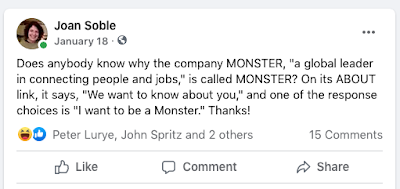
Still curious about Monster, I called the company to ask about its name. While there are imagined evil creatures of all shapes and sizes, monsters are often envisioned as the largest. Was the name "Monster" simply meant to convey that the company was global and huge? 

When no one at Monster answered the phone at the number given on the company website, I turned to Facebook and Twitter; perhaps of my friends or contacts could explain its name.
 
First to respond on Facebook, my businesswoman cousin theorized that Monster was so named because, like the Sesame Street cookie monster, it had aimed to gobble up all the cookies—the smaller job application companies—in the cookie jar. 
 
But a little later one of my former students posted the real answer:
 

"Yes. . . . when [Monster] came out (and of course, I was there at the time), it was a hip and suitably wacky and irreverent name. Like Yahoo! or Google (then known as a play on googol). It had that fun Pixar-style mascot. Looking for work is fun and wacky! The idea didn’t age well. On the other hand, it outlasted thousands of contemporaries, so… "
 

So Monster’s founders weren’t trying to stress the advice-related aspects of the PIE roots of “monster”; they were just being unbelievably hip and trendy.


A few comments later, a Facebook friend thirty years my junior reminded me that people raised on Sesame Street were more apt to find monsters “cute or funny” than to fear them. Shades of all those Brothers Grimm fairy tales that were purged of their most gruesome, fear-inducing original elements. Meanwhile, my cousin’s cookie monster analogy was even more apt than she knew. 

 A couple of weeks after I saw MONSTER in the newspaper, the word “monster” appeared again--on Wednesday, January 19, this time on the front page. The governor of New Hampshire had used it to refer to the father of missing seven-year-old Harmony Montgomery (Say her name). Adam Montgomery, currently in jail, has “a violent history” and “previous convictions including [for] shooting someone in the head and a separate attack in two women.” Montgomery sounds like a far more deadly monster than Harjo’s stepfather. 

 
The January 19 Boston Globe reminds us again there are always monsters. In the adult world, they vary from “wacky and irreverent” to the last thing you’d ever wish on a fellow human being. They’re not always people, though it’s usually people who create them. And it’s usually people whom they afflict. They exist in the eye of the beholder, sometimes the eyes of multiple beholders, and they are real. 
 
The unwelcome ones that show up complicate our lives, knocking us off course. Sometimes they challenge us to survive or evade or defang them, as Joy Harjo’s did; other times, they challenge us to acknowledge or even integrate them into our selves and worlds, as Stela’s do. When we’re lucky, we learn from monsters, but the learning is always hard—often too hard, too exacting.
 

We’re better off not seeking monsters. Besides, they will find us anyway. If we’re lucky, they’ll be the kinds that are more interested in our cookie jars than in us.


Arnett, D., & Koh, E. “Sununu Points to Mass. in Girl's Case.” (2022, January 19). The Boston Globe, 19 Jan. 2022, pp. 1, 8. 
Harjo, J. (2021). Poet warrior: a Memoir. W. W. Norton & Company. 
Monster. Online Etymology Dictionary. Retrieved January 18, 2022, from https://www.etymonline.com/search?q=monster. 
Monster.com. In Wikipedia. https://www.immagic.com/eLibrary/ARCHIVES/GENERAL/WIKIPEDI/W110114M.pdf 
Soble, J. (2022, January 18). Does anybody know why the company MONSTER, "a global leader in connecting people and jobs," is called MONSTER? On its [Comments on status update]. https://www.facebook.com/joan.soble.1. 
Yanique, T. (2021). Monster in the middle. Riverhead Books. 

Friday, January 14, 2022

Fred Rogers and Joy Harjo On My Sofa

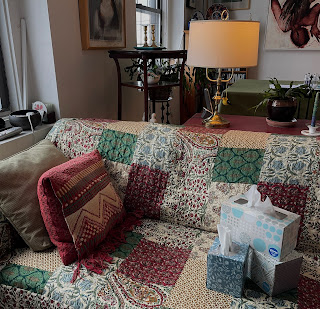
So already, the meeting between Joy Harjo and Mister Rogers happened last week on my living room sofa. All afternoon I'd been sitting there reading Joy Harjo's Poet Warrior. But after dinner, wanting something lighter, I'd turned on the television.

After no small amount of scanning, skimming, and clicking, I discerned that A Beautiful Day in the Neighborhood, the film starring Tom Hanks as Fred Rogers, might be my only viable “entertainment” option. Though I'd never watched Mister Rogers as a kid, I'd heard from so many people say that A Beautiful Day was a really good movie that I decided to give it a try.

Within the first five minutes of my watching it, the movie glued me to my sofa and continued to command my full attention for the next two-plus hours, except when I had to get up to get more Kleenex because I was weeping again. I was used to exhausting tissue supplies during Call the Midwife, but I hadn't cried over a televised movie in a while.

When it was just about over, I blew my nose for the final time and texted my husband, who was still in his studio. “I’m just finishing watching the Mister Rogers movie—it’s so good,” I texted.

“It’s good? Mr. Rogers? When I was a kid, I wanted to punch him.”

I wasn’t surprised by his response; he always questions the authenticity of overt kindness.

The next morning when I asked my younger sister why we’d never watched Mister Rogers as kids, she said, “Well, I always thought he was kind of creepy.” He definitely was different: he spoke very slowly, he was never sarcastic, he spoke to puppets like they were people, and he seemed to have only children and animals as friends.

But while my sister and I avoided Mister Rogers’ Neighborhood, clearly so many other kids did not. And that’s what sent me to YouTube, where I watched a video called “The Best of Mr. Rogers,” a Charlie Rose interview of Fred Rogers that included various clips, including Rogers’ 1969 testimony to the U.S. Senate Commerce Committee* that helped secure funding for national public television. I didn’t make it through that interview without running to get more Kleenex.

Later that same day when I sat down on the sofa and continued reading Poet Warrior**, I realized that Joy Harjo was partly responsible for the many tears I’d shed in the last day. She and Fred Rogers had so much in common.

Testifying to Commerce Committee, Rogers had explained,

We made a hundred programs for EEN, the Eastern Educational Network, and then when the money ran out, people in Boston and Pittsburgh and Chicago all came to the fore and said we've got to have more of this neighborhood expression of care. And this is what -- This is what I give. I give an expression of care every day to each child, to help him realize that he is unique. I end the program by saying, "You've made this day a special day, by just your being you. There's no person in the whole world like you, and I like you, just the way you are."*

Rogers’ brief statement referred to both the collective and the individual: the neighborhood was needed to express care of children, and the individual child was to be cherished as “unique,” and therefore uniquely contributing to “this . . . special day, by just being you.”

Similarly, in Poet Warrior, Harjo emphasizes both the uniqueness of each child and the critical role of the surrounding, supporting community. The book opens with a poem that asserts "all children are deemed as ours” (5). But while each child belongs to all of the adults, each also needs and deserves a smaller, more personalized “circle of belonging,” like the one Harjo experienced when she spent time with a beloved aunt who discerned and nurtured her uniqueness (11). That circle could also be at a kitchen table, such as the one described in Harjo’s poem “Perhaps the World Ends Here” where “we sing with joy, with sorrow” (25).

In the book's final poem, as an adult, and particularly as a grandmother, Harjo explicitly pays forward her aunt’s gifts of instinct, inclusion, and expressed ascertainment of a particular child’s unique nature:

Poet Warrior [Harjo’s poetic avatar] stood at the doorway of time. 
She held the child of the seventh generation in her arms 
Adjusted the soft blanket to see her face 
To glimpse what this one was bringing with her to share, 
In the way she took every child, grandchild, and great-grandchild 
Into her arms to welcome them, to bless them 
During her time walking on the earth. (218)

Like Rogers, Harjo understands each of us as a distinctive “this one” whose uniqueness is to be discovered, acknowledged, and treasured—and who will, consequently, have something distinctive “to share.” But more than Rogers does, she emphasizes that the neighborhood needs the child as much as the child needs the neighborhood: in the final lines of both the book and the poem, Poet Warrior walks “into time/ To deliver the baby to the earth story that needed her” (218).

Yet another important thing Harjo and Rogers have in common is trust in ritual’s capacity to foster children’s happiness and healthy development. Mr. Rogers’ daily rituals of putting on and taking off of the cardigan and sneakers bookend the time during which he’s happily, completely available to each unique child. Harjo muses on how different the lives of her mother and other female forbears might have been had they participated in rituals marking their transitions into womanhood:

I wonder what would have happened had my mother been given a coming-of-age ceremony, or her mother or hers—a ritual in which they were welcomed and given spiritual and physical gifts to help them navigate their lives as young women who would grown to become matriarchs, to become loved leaders in their families and communities. (87)

Finally, in addition to trusting ritual, both Harjo and Rogers trust song. The ancestors present Girl Warrior with “a song that will keep her in the right direction” (77) And Rogers*** told the Senate subcommittee the story of a particular song that “has to do with that good feeling of control . . . that children need to know is there”—and that begins with a line that “came straight from a child” who’d been part of a small-group puppet-centered therapeutic session:

What do you do with the mad that you feel? When you feel so mad you could bite. When the whole wide world seems oh so wrong, and nothing you do seems very right. What do you do? Do you punch a bag? Do you pound some clay or some dough? Do you round up friends for a game of tag or see how fast you go? It's great to be able to stop when you've planned a thing that's wrong. And be able to do something else instead, and think this song –

'I can stop when I want to. Can stop when I wish. Can stop, stop, stop anytime. . . . And what a good feeling to feel like this! And know that the feeling is really mine. Know that there's something deep inside that helps us become what we can. For a girl can be someday a lady, and a boy can be someday a man.

 
I know; an updated version of this song might make its last line a little less binary. But the idea of being able to “stop when you’ve planned a thing that’s wrong” and the sense of reassurance that results from knowing a feeling “is really mine” make me want to send this song to every American politician today.

I wonder if Joy Harjo watched Mister Rogers’ Neighborhood, and, if she did, whether she thought Fred Rogers was talking to her, and what she thought about what he was saying. Even if her childhood self reacted more the way my husband and sister did, I’m still of the mind her adult self would have appreciated him for creating place, story, song, and ritual. 

 
A final comment about all those tears shed and all that Kleenex used. Having come from both a nuclear and an extended family that emphasized how much and how equally all of us “kids” were loved, but that didn’t much articulate or acknowledge how we differed from one another, I found myself envious of the inquiring, discerning attention Harjo and Rogers focused on individual children.

In my life, it was teachers who saw me as an individual, who put into words what they saw or thought they were seeing in terms of my personal strengths and interests, and who encouraged to explore and develop them. Given this, it doesn’t surprise me that I knew early in my life that I wanted to be a teacher. I came to poetry early, too, because, as Harjo put it, “with poetry, doors would open inside even as I heard them slamming outside” (38).  

 
But when it comes to Mr. Rogers, I am definitely a latecomer. I’m glad I finally made it to the neighborhood, though; it's a beautiful day here.
 
*Rogers, F. (1969, May 1). Senate statement on PBS funding. American Rhetoric Online Speech Bank. https://www.americanrhetoric.com/speeches/fredrogerssenatetestimonypbs.htm   
**Harjo, J. (2021). Poet warrior. W.W. Norton & Company.
*** Fred Rogers Statue Photograph Credit: