Saturday, July 5, 2025

As Far (and Near) as the Eye Can Sze

So already, as many of you already know, I have moved my blog from Blogger to Substack so that those who want to receive emails letting them know I've posted can do so. 
 
Recently, I've been musing on time, age, and some recent experiences of writing poetry. The year 2025 has entered its second half, and time is marching  forward for us all. My most recent Substack blog post/newsletter also includes my thoughts about  Arthur Sze's poem  "Under a Supermoon" in the July issue of The Atlantic.
 
If you'd like to read "As Far (and Near) as the Eye Can Sze," here's the link--https://joansowhat.substack.com/p/as-far-and-near-as-the-eye-can-sze
 
Thank you for reading, if you do. And feel free to subscribe for free.

Tuesday, June 24, 2025

Revelation, Inspiration . . . & Then . . .

So already, as many of you already know, I have moved my blog from Blogger to Substack so that those who want to receive emails letting them know I've posted can do so. 

Recently, I've been musing on the connections among revelation, inspiration, and action.

If you'd like to read "Revelation, Inspiration . . . & Then . . .," here's the link--https://joansowhat.substack.com/p/revelation-inspiration-and-then 

Thank you for reading, if you do. And feel free to subscribe for free.

Painting by Karin Foreman: “Counting of the Omer” by Karin Foreman: https://karinforeman.com/counting-of-the-omer-sfirat-haomer-%D7%A1%D7%A4%D7%99%D7%A8%D7%AA-%D7%94%D7%A2%D7%95%D7%9E%D7%A8/counting-of-the-omer/

Wednesday, May 28, 2025

Of Horses, Peaches, Pears, and Poems

So already, as many of you already know, I have moved my blog to Substack so that those who want to receive emails letting them know I've posted can do so. 

Recently, I've been musing on the kinds of language we need to have in our lives in order to live healthily and happily enough.

If you'd like to read "Of Horses, Peaches, Pears, and Poems," here's the link--https://joansowhat.substack.com/p/of-horses-peaches-pears-and-poems --and thank you.

Tuesday, May 6, 2025

Saying Hello and Good-Bye as So Already Moves On

So already, it's with a somewhat heavy heart that I write to say I will now be blogging on Substack. I've loved the aesthetic capabilities of Blogger, but I've been frustrated by its lack of capacity to help old readers and potential new ones find my posts: when Blogger ceased to have an RSS feed, those who wanted to read my blog regretted not being notified when I posted something new.


Blogger has felt like home to me. As I say on the "About" page of So Already by Joan Soble  on Substack, 
When I started So Already [on Blogger], I didn’t realize how much I needed a space where I could explore topics and feelings that resonated in the core of me, especially when I wasn’t sure why. Conversation with others often expands and refines my thinking and provides me with insight into the intensity of my feelings. But what I often need even more, especially at first, is to be in conversation with myself. So Already provides the time and space for that. That’s why it says on Blogger, “In So Already, I always get to be me.”*
Thus far, Substack has respected my Blogger blogging experience
: it let me import all 257 of my posts. When all is said and done, to compare blogging on Blogger and blogging on Substack is like comparing apples and apples from any perspective having to do with meaning.
 
So if you like apples and think you'd like to keep reading my blog, I'd be honored if you'd check me out on Substack. As I explained in an email to some friends and relatives, 
should you want to subscribe, there will be a subscribe button somewhere within each of my posts, which can be found at this address: https://joansowhat.substack.com. Please know I personally won’t ask you to pay to subscribe, but Substack will no doubt encourage you to pay or pledge. 
Thanks to those of you who've been reading my blog on Blogger over the years--sometimes often, sometimes sometimes. I've really appreciated your interest in what I've had to say. I wish you inspiration and enjoyment as you continue on your virtual and "real world" journeys.

Sunday, April 27, 2025

The Worlds Beyond Our Windows in Life and Verse

So already, I love looking out of my apartment's windows. Since they're large, east-facing, and high up, I can see beyond my neighbors' rooftops to the patchwork of adjacent and farther streets, the tops of trees, the bell towers of two churches, and up into the broad expanse of unfettered sky above them all. 
 
All day long, my view bustles with human, mechanical, and natural motion. And often, I feel connected to it, even part of it, as I do what I do, such as sitting at my keyboard opposite my dining room window, as I am this afternoon, composing a blog while a stiff breeze keeps the just-leafed-out branches of my view's tallest tree vigorously bobbing and bending.
 
I also like to look out of my windows at night. Sometimes when I wake up in the wee hours, I walk into the living room, with its always-raised window shades, and take stock of what is and isn't happening outside. If night is wearing on me, I'll hope to see the first signs of dawn at the easternmost edge of my view. Always, I check on the customarily lamp-lit windows I expect to see in certain houses, and re-experience the companionship I feel with those I imagine beyond them. When there's movement--a figure walking alone, an ambulance's blinking lights--I wonder what story, routine or life-changing, is being written. 
 

Given all of this, it won't surprise you that I love poems about views from windows. Recently, I've been rereading three of my favorites: David Ferry's "Backyard Dog" from his book Ellery Street, Grace Shulman's "Gone: Washington Square, 2020," and Mary Jo Salter's "White Petals, 3 A.M." Both Shulman's and Salter's poems appear in the anthology Tree Lines: 21st Century American Poems.*
 
Today, I'm writing about Mary Jo Salter's "White Petals, 3 A.M." because in just a few weeks, the dogwoods will be in bloom in my part of the world.
 
Salter's poem first appeared in the Sewanee Review, and Project Muse provides an image of five of its six stanzas. So you're able to read the whole poem before I start talking about it, I've screen-shot that image and am providing the final four-line stanza in black:
 
one falls, the sun comes up, the green
leaves take over the length of summer,
so long you forget you live in time.
Don't blink. Don't. Not again.
 
Salter's musing is stimulated by the unworldly light of the white dogwood blossoms beyond the window and window seat at the foot of her bed. The "wide-eyed whiteness" of the "white-petaled cloud" seems familiar to Salter, who recalls a similar winter experience of whiteness. What had mystified in that earlier instance was the source of the glow of the snow-covered branches: had the snow somehow managed to capture and hold day's light? That whiteness recalled seems to have some agency: it is "wide-eyed," as if it's looking back at the speaker, participating in an interchange with her.
 
By the third stanza, the speaker assumes the presence of a moon, though there is none to be seen, and, attributes the blossoms' unearthly glow to it, metaphorically transforming the blossoms into constellations. With that comparison, the view from the window expands to fill the universe, which in turn becomes filled with blossoms and their individual petals. As readers, we're surrounded and buoyed upward.

But Salter knows what she knows about nature: moons wax and wane, and blossoms on spring trees are short-lived forerunners of leaves that will endure for a much longer season. The question "should people sleep/in April?" is poignant, since to sleep would mean to miss the breath-taking, fleeting spectacle beyond her window, this particular 3:00 A.M., this intense experience of "bounty" that lights up the brain's "circuitry." 
 
By now, this initial imaginative puzzling about the source of light in these night-time experiences of light has become a meditation on the brevity of enchanting, soul-stopping moments--the surprise of them, the gift of them, the consciousness-transforming power of them. The final stanza expresses the speaker's insight and resolve, which she conveys to us in the imperative voice so that we won't miss out on what fleeting magical moments may come our way: "Don't blink. Don't. Not again." 

The poem doesn't tell us whether the beholder of those dogwood blossoms has lain awake long before 3 A.M., or has awakened suddenly and observed the flowers first in a semi-dream state. Regardless there's something about a canopy of dogwood blossoms, a corridor of dogwood blossoms, an abundance of dogwood blossoms anywhere. Annually, I experience such an abundance when I visit a local historical house  that has an associated arboretum filled with dogwood varieties. Especially when I visit it by myself, I feel as if I've walked into the setting of a fairy tale.

There are photographs of such places and flowers. There are newsletters describing them and encouraging people to visit them.
There are radio interviews that promise such places and flowers will inspire "oohs" and "ahs." But poems say and share something different and more about the experience of them. The gift of poetry is that it brings to life such moments and the insights associated with them, even for those of us who are merely reading about them. Happy National Poetry Month, and may the worlds outside of your windows make you feel humbled, connected, profoundly alive, and blessed.

* Salter, M.J. (2022). White petals, 3 a.m. In J. Barber, J. Greenbaum, F. Marchant (Ed.), Tree lines: 21st century American poems (p. 110). Grayson Books.

Monday, March 10, 2025

On God Avoidance and Other Activities in the Garden

So already, the other night as I was getting ready for bed, I realized I had no interest in reading other people's stories, fictional or not. That surprised me, because the week before I'd finished reading Daniel Mason's North Woods, which I loved--so much so that I'd
gone to the library a couple of days later to borrow an earlier Mason book. And two weeks before that, I'd finished reading Omo Moses' The White Peril: A Family Memoir, which I also loved, so much so that I blogged about in February.

It's my habit to read a little before I go to sleep, and I wanted to take in some words, but not the kinds of words I'd been taking in during the weeks before. As I climbed into bed wondering, "What words, what words?" I
realized I hadn't given God much thought or attention in the last few months. 

Why that thought at that moment? Probably for three reasons.
 
The first was that a couple of days earlier, I'd recalled how last fall, after my mother died, I'd gone to synagogue a couple of times and felt very disconnected spiritually. Despite the kindness of so many in my congregation, I knew I was not connecting with God through the services' formulaic prayer and familiar language, nor did I feel like making the effort to do so. My feelings were in no way a criticism of God, my fellow congregants, or liturgical prayer; they were simply an expression of my orbiting in this strange new mother-less galaxy.*

The second was that twice quite recently, God had entered my mind. But He'd stayed there only briefly, as if in passing.
 
The first time was while I was walking--something I hadn't done much recently because of February's stubborn ice, low temperatures, and gusty winds. As if to say "enough" to winter's persistent harshness, I headed out to my usual salt marsh on the last day of February when the potentially lethal ice had finally vanished from the trails. Being there reminded me that Donald Trump and Elon Musk don't have dominion over everything--certainly not over the salt marsh and the ducks' seasonal rhythms.
 
The second time was while I was reading Peter Beinart's Being Jewish After the Destruction of Gaza: A Reckoning. The book explores the assumptions and priorities of various Jewish individuals and groups as Beinart understands them politically, culturally, and historically; offers his opinions about their practical and moral costs and benefits; and asserts that a consideration of Jewish values and teachings can and must guide Israel's
way forward. In particular, I appreciated his discussion of Jewish chosen-ness, which is all about relationship to God and the obligations associated with that, and its implications for the future of Israelis, Palestinians, and American Jews.
 
The other night as I sat in my room, I found myself missing having some kind of an ongoing connection to God. But I also still wondered what part of my "what words, what words" conundrum was a response to Donald Trump's degrading treatment of Volodymir Zelenskyy  in the White House on a recent Friday, and what part of it was the latest expression of my experience of the loss of my mother--which is more akin to emptiness and disorientation than to sadness. 
 
Next to my bed was a book of daily meditations called Healing After Loss, a gift of a good friend, that I hadn't been reading regularly--only because I was feeling more weird than bereft. But seeing it there did remind me that I had a couple of other books written by rabbis that offered daily meditations, or short enough "chapters" to lend themselves to bedtime reflection. So I pulled out both Floating Takes Faith: Ancient Wisdom for a Modern World by Rabbi David Wolpe and Restful Reflections: Nighttime Inspiration to Calm the Soul, Based on Jewish Wisdom, written and edited by Rabbis Kerry M. Olitzky and Lori Forman. 
 
I read the first entry in the former and the March 3 entry in the latter. Remarkably, they both spoke to me, tempering my profound sense of puzzling absence.

The March 3 meditation in Restful Reflections, entitled "The Voice of God Has Never Stopped," talks about the Shema, translated as "Hear, O Israel"--the prayer that's known by heart in both Hebrew and English by virtually every American Jewish person, regardless of how they feel about being Jewish and how observant they are. The meditation's author, Rabbi Levi Meier, explains,
The 'Hear, O Israel' is a statement of faith, love and commitment to listen to God's voice. And to live that belief means bringing oneness and wholeness into the world. It means bringing people together, bringing unity and peace into the lives we touch. (51)**
For the last months, I've been wondering why I do what I do--literally, why I fill my hours with what I fill them with. Rabbi Meier reminded me that lots of what I routinely do, whether I'm an organizer or simply a member of the group, brings people together to do something meaningful and even pleasurable together. If that "meaningful" has peaceful aspects, my glass is half full, despite my nagging sense of absence.
 
A paragraph later, Rabbi Meier reassures that if one opens one's ear and heart sufficiently, "then the voice of God will enter your mind and your heart, and your actions will testify to the fact that God dwells here, now, in your room." Those words spoke directly to the possibility of lessening the distance between God and me, put there by me: what could be more distance-diminishing than having God come into my own room? It was as if I'd pressed "pause" on my personal spiritual CD player in late October, but the music had kept playing in the cosmos, ready always for me to press the button that would make the divine music "resume."

Next, I turned my attention to Floating Takes Faith. Actually I'd met Rabbi Wolpe once when he'd attended Shabbat services at my synagogue several weeks after October 7, 2023; he was the rabbi who had resigned from Harvard's antisemitism task force because he felt the group lacked a sense of urgency about the work it was doing. His column entitled "The First Question"--for some time, he'd published a column regularly in The Jewish Week--dealt with the first question God asks in the Hebrew Bible--to Adam, in the Garden of Eden, in Genesis 3.

"'Where are you?'" God asks, no doubt knowing that Adam is in the Garden of Eden--where else could he be? That was the part of the story I remembered. What I didn't remember was Adam's answer. As Wolpe explains, "Instead, it is a question of spiritual geography. Adam, understanding the import of God's question, answers that he was frightened, so he has been hiding."***

"Spiritual geography" immediately spoke to me since I've long been fascinated with inner landscapes. But Wolpe's reminder that Adam was hiding out of fear practically took my breath away. Just the week before, during my voice lesson, during a part of a Fauré song **** when I should have been singing out a beautiful ascending line, my voice teacher had said to me, "You sound like you're hiding."

I told her I probably was. My sisters had always hated my singing, so I had always felt I needed to conceal it around the house--and right now, I was singing in the house, my house. So my habit pulling back when I ought to be letting it rip was a well-established one. It won't surprise you to know that part of what I'm learning to do in my voice lessons is to let it rip--at least within the bounds of good vocal practice.
 
Letting it rip musically depends on a number of vocal factors, and one of them is having enough air, enough breath--and I often count on the experience of breathing deeply--whether I do so intentionally or suddenly realize I am doing it--to tell me that God is with me, or that there's the chance that God is with me.  
 
Wolpe's column comments, after talking specifically about Adam, that "Where are you"
. . . is not only the first question: it is also the eternal question. At each moment in our lives, this question is addressed to us: Where are you? Where are you spiritually? Where are you morally? What have you done with life, and what are you doing with it now? Are you proud of your conduct in the garden?"
Frankly, I don't want to deal with the question of what I'm proud of or not. I think there are any number of things I could be proud of, but an emphasis on being proud of how morally or ethically good I'm being (or striving to be) would too easily foreground judgment, put and keep myself at the center, and apply constant pressure.
 
But I like the other questions well enough, and I'd like to think more deliberately about what I'd like to do with my life going forward, should I be lucky enough to remain of sound mind and body. For sure I'd like to listen and hear. And I'd also like to get really comfortable with letting it rip, vocally and otherwise: the idea of not hiding out of fear appeals on every level.

So here I am, standing in the Garden. Except right now, for me, it looks a whole lot like my dining room, where I've been sitting for the length of this Sunday afternoon alternating between writing this blog and listening--to Ned Rorem songs (The Prince Consort's On an Echoing Road CD is beyond beautiful), to Paul Moravec songs (specifically to Jennifer Cano singing "A New America"--magnificent), to Gabriel Fauré songs. I am sure God is in these songs, and therefore He is in my dining room. Maybe it's the beginning of something--like less avoidance, or the renewal of something, or something altogether new. Time will tell.

* Screen Shot of Oort Cloud Formation Metal Print by Science Photo Library: https://fineartamerica.com/featured/oort-cloud-formation-claus-lunau.html?product=metal-print
** Olitzky, K.M. & Forman, L. (2001). Restful reflections: Nighttime inspirartion to calm the soul, based on Jewish wisdom. JEWISH LIGHTS Publishing.
*** Wolpe, D. (2004). Floating takes faith: Ancient wisdom for a modern world. Behrmann House, Inc.
**** Screen shot of "The Effect of Moonlight "(also known as "St. Valery Canal"), a painting by Eugène-Louis Boudin (1891), in the following blog: JDB. (2017, March 20). Clair de Lune redux. Wordpress. https://augenblickblog.com/2017/03/20/clair-de-lune-redux/


Tuesday, February 25, 2025

A Read for Our Times: Omo Moses' The White Peril

So already, late last Saturday afternoon when I turned on my television and began channel-surfing, I happened upon the Freedom Summer episode of Eyes on the Prize. I'd seen it before, but I kept watching because I had recently finished reading
Omo Moses' The White Peril: A Family Memoir. The book quotes Bob Moses, Omo's father, at length, and I was definitely feeling immersed in Bob Moses' philosophy of change, his metaphors for empowered and empowering activists, and his ideas about leading and organizing.

That Bob Moses* was the first person I saw when I came upon that episode had clinched my decision to watch it: I wanted to hear the voice of the man who wasn't yet Omo's father, whose ideas about supporting groups to self-determine as Americans, to organize, to insist, and to persist are alive and well.

I first met Omo when he was a teenager in an English language arts class I taught at Cambridge Rindge and Latin School. In January, as the release date for his book drew near, I marveled at its timeliness--one day after Donald Trump's inauguration. Since then, Trump has been confirming that we stand at another moment in our country's history requiring "we the people" to act for the sake of freedom and justice for all. Members of Omo's family have long known how to do this.

And at the same time, despite its place in American history, the nuclear family of Omo's formative years was also "just a family"--in his case, composed of four children and their two parents who were intent on raising them to thrive and realize their dreams in a world too often structured and inclined to obstruct their paths. 

The White Peril  captures Omo's experience of navigating the relationship between the public-political and private-familial aspects of his formative years. Presenting his journey from childhood to young adulthood, it offers the beginning chapters of the story of how Omo came to carve out his place in and in relationship to his family's public legacy as it continues in the present moment.**

The extended Moses family in front of a mural featuring Bob and Janet; Omo and his kids are on far left.

 
Consequently, The White Peril can be accurately described as a personal and political coming-of-age story. But it's not a conventional linear one representing just one life journey. It's multi-generic, multi-generational, multi-voiced, and multi-faceted, weaving together others' stories with Omo's own--as its subtitle, A Family Memoir implies. Essentially, it offers a mosaic of defining events, life-shaping ideas, and influential people that float in the non-chronological narrative of Omo's first decades.
 
It can be described accurately in other ways, too. It's a migration story: Omo and his family move from Tanzania to New York City to Cambridge. It's an exploration of masculinity and being male, especially as relates to black males growing from boyhood to manhood in the city. It's a portrait of a "progressive" city and its broken and kept promises over time. It's the story of the birth and first steps of a new youth-lifting educational initiative. 
 
It's also a tribute to rock-solid familial love in all its complexity. It's an exploration of what it's like to live not only with one's own vivid memories of stories lived and heard, but with other people's vivid memories of them--and the hopes and expectations that often accompany them. It's a tribute to ancestors whose voices and wisdom are not only presented in this book, but meditated upon, internalized for present and future reference (not to be confused with swallowed whole), and, above all, appreciated for their contributions to the spiritual, communal, and deeply considered intellectual place in which Omo's life is firmly rooted--and from which it draws so much strength and inspiration.***

So how does this book hold together, given its many facets? I believe the answer lies in Omo's own writing, so often poetic and dramatic, even when its aim is simply to lay out the contexts that surround particular events and situations that Omo recalls and recounts so vividly. Omo's capacity to create mood, character, and place through the physical details he chooses to share, the diction and imagery he uses to render them, and the metaphors he creates and sometimes repeats makes the world of his youth physically and emotionally immediate.

Take for example, his description of his family's trip from Tanzania to America: the almost staccato presentation of the political/historical context in which it occurred--certainly what Omo learned much later--is followed by his account of the nearly endless trip itself, as experienced by his four-year-old self.

    We were torn from the road. From the red dirt**** that stretched to the base of Mount Kilimanjaro, transplanted onto America's glacial concrete.
    We would learn that our home in Same, like most of the homes of African American expatriates in Tanzania, had been searched by soldiers and police. That it had been reported that blacks from America had arrived by boat with guns and were headed to President Nyerere's village in the build-up to the Pan-African Conference to be held in Dar es Salaam in 1974.
    We would learn that in 1975 President Jimmy Carter was offering amnesty to the citizens who had refused to fight in the Vietnam War.
    We would learn that we'd been denied Tanzanian citizenship, that the political climate had shifted, that we couldn't become Tanzania's children.
    'We're going to visit Bibi,' Mama said.
    It was 1976. We were six, four, and two, and Malaika was getting ripe in Mama's belly, when the plane left the surface of the earth, its wheels folding into its guts. The engines roared like a pride of lions. We took off down the runway like a tortoise at first, and then a cheetah and then an albatross, wings abruptly rejecting gravity. Taking off felt like the car trips we'd made to the Indian Ocean, five, six, or seven of us in a vehicle yo-yoing on dirt and rocks until we reached the paved road, black and smooth. And then the plane was floating. On our way to forty thousand feet like on our way to the beach, . . .. We treated the plane like the road. Inspected the arms of each chair as if a bush or an anthill, ran up and down the aisle unaware that an umbilical cord had been severed, that we were being delivered to the other side of the planet.
    We landed in Nairobi and took off again.
    We landed in Paris and took off again. Remained between the surface of the earth and the sun and the moon for twenty hours. 
    We landed in the South Bronx, unaware that we had reached the shores of hip-hop. (35-36)*****
The very first sentence telegraphs that this move to America will be traumatic, even though the next sentences convey the excitement of the multiple plane rides, the pleasure with which the first plane ride recalls the movement of various animals, and the ease with which the children transfer their exploratory skills from the road in Tanzania to the airplane's aisles. In the last sentence, the language of landing shifts to mean "finally ended up." Africa is destined for memory, and the safety of the "we" whose experience is reported in this series of paragraphs that begin with "we," many only one sentence long, cannot erase or protect against the pain of the loss soon to be comprehended by Omo and his older sister. 

I particularly like Omo's evocation much later in the book of time spent with an influential friend after days spent working with students at the Brinkley Middle School in Mississippi.
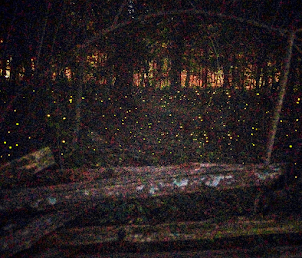
     I spend evenings on Mr. Figgers's porch, just talking about things. I enjoy listening to how his words run a marathon around a point, stuff time with his hopes and provocations. I enjoy time passing, with no apparent destination, along the tenor of his voice. If there are fireflies, I enjoy witnessing the call and response. (201)
Again, the reader encounters the sensuous, imaginative quality of Omo's writing, a direct reflection of his strong response to the actual places and moments in which he finds himself. In this case, it's the slow moment--always suitable for deep listening and deep thinking.
In Omo's imagination, words can run marathons, and time is a hollowed sacred space capable of being filled not only with hopes, but with unanswered questions and speculations deserving further consideration during future evenings on the porch. The fireflies******, if present, contribute to the warm night's natural rhythms, recapitulated by the repetitions of "I enjoy."
 
It was in a similar spirit of unrushed listening that I read The White Peril's many excerpts from interviews, sermons, and books that are also an important part of the book. For those who want to read only the action parts of Omo's own journey from childhood to manhood, these excerpts might seem like an intrusion, but to know Omo is to know that he is and always has been a quiet observer, absorber, listener, and thinker. By providing these other voices, he shares those viewpoints and personalities that were critical to his development "back then" and "since then." The White Peril is a family memoir, and Omo does family--nuclear, extended, and writ beyond DNA--the courtesy of letting them speak for themselves.
 
There's a lot of water in The White Peril--next to the beach in Tanzania where Omo and his siblings play, in the Harvard swimming pool where they swim and compete, beneath the frozen surface******* of the Charles River that Omo 's mother cautions him and his brother not to trust, in the ocean and waves to which his father compares the civil rights movement and those active in it. 
 
At a moment when many of us feel like we might drown in our country's deliberately churned-up rough seas, this book reminds us we can swim if we swim together. Simultaneously, it tells the moving story of a young man growing up with dreams that he adjusts over time in response to new realities and understandings. Fortunately, those dreams are good for other people, too, especially young people. I highly recommend The White Peril.

* Images screen-shot from PBS website. https://www.pbs.org/video/eyes-on-the-prize-mississippi-is-this-america-freedom-summer/
** Screenshot of photo by Nick Surette/Central Square BID accompanying Levy, M. (2021, July 25). Bob Moses, educator and icon of civil rights, 86; he inspired generations to both learn and lead. https://www.cambridgeday.com/2021/07/25/bob-moses-educator-and-icon-of-civil-rights-86-he-inspired-generations-to-both-learn-and-lead/
*** The title of Omo's book is proof of the Omo's strong connection to the ancestors: Omo's great-grandfather's book has the same title.
**** Screen shot of photo on Flickr by Anna & Jorge--C@jig@ https://www.flickr.com/photos/spartan_puma/781637442/in/photostream/lightbox/
***** Moses, O. (2025). The white peril: A family memoir. Beacon Press.
*(6) Screenshot of photo posted on the following: Mississippi Firefly Tours. (2023, May 20). Photo credit: Louisa Simmons. Facebook. https://www.facebook.com/photo/?fbid=212214484891558&set=pb.100083090241019.-2207520000
*(7) Screenshot of photo on Reddit: https://www.reddit.com/r/boston/comments/1i64pld/people_walking_on_frozen_charles_river_again/#lightbox