Wednesday, November 12, 2014

Bird Watching in Scott Ketcham's Art

"Blue Departure"
So already, a few days ago, when I asked my husband, Scott Ketcham, if he liked the painting he had been working on all day, he said he did. "Take a picture of it on your smartphone so I can see it," I said. The newly finished painting I got to see is the one you're seeing to the right. Scott's been even busier than usual in the last few weeks because Open Studios are less than two weeks away.* 

Recently, Scott's been giving titles to his paintings on the advice of the man who designed his new web site, <scottketcham.com>. Scott, who has generally had no interest in naming his paintings, has taken to creating titles as a marketing necessity. When asked about his title choices, he explains that his sole intent is to give the viewer a foothold in his work without usurping any of his/her right to see and interpret as s/he sees fit. He also admits it's never bad for a prospective collector to be able to refer to the painting in which s/he's interested by its name.

But though the titles he's assigning mean very little to Scott, they are meaningful to me. I'm endlessly curious--and baffled--by the source from which Scott's vision and imagination spring--or maybe I should say climb, or rise, or erupt, or limp, because all of these words seem apt for some painting or other. So his titles, not completely arbitrary despite Scott's casual attitude toward them, provide me with some clues. Take "Blue Departure" above: to my eye, a man, a woman, and a giant bird seem entangled, not departing--and "entangled" always connotes tension and struggle. Are they struggling to free themselves from being forged and frozen, or is it inescapable Dionysian frenzy from which they seek liberation? ? But wait--the the face of the female figure defies either interpretation: I see a benign smile on her face--as if she's in the midst of a sleeping or waking dream. And so I'm left to accept that the painting itself somehow reconciles struggle and peace. But I really don't know how and why it does that. 

For a while, Scott's work has sent me wandering the literary and mythological backwaters of my education, formal and informal. It happens in flashes: 
  • a conviction that I need to reread Louise Glück's poem collection Averno because I'm wondering how Persephone's semi-annual passage between the underworld and upper world, between death and life, connects to what Scott's expressing; 
  • an urge to research the significance of the phoenix, to weigh in my own mind the counter-forces of destruction and rebirth; 
  • a desire to immerse myself both in the William Blake poems populated by Zoas and emanations, and in Jewish writings about the Shechinah, the feminine aspect of G-d that makes so many ardent Jewish monotheists uncomfortable.
  • a resolution to revisit The Subtle Knife, the second book of Philip Pullman's His Dark Materials trilogy in which the protagonist has a special knife that permits him to slice his way through both spirit and matter into other worlds--and that must be used with the utmost care.
My Persephone hunt led to Wikipedia, which explained the significance of Lake Avernus, and thus Averno:
Avernus was of major importance to the Romans, who considered it to be the entrance to Hades. It gained its name from the Greek word αορνος (originally αϝορνος) meaning "birdless", referring to the belief that birds flying over the lake would drop dead from the poisonous fumes that it emitted. The name Avernus was often used by Roman writers as a synonym for the underworld.**
A portal to the underworld with the power to kill birds? Given the significant role birds often play in Greek prophecy, what did the birdlessness of this important place signify?

In Averno, I came upon "Persephone the Wanderer," in which Glück says,
They say 
there is a rift in the human soul
which was not constructed to belong entirely to life. Earth

asks us to deny this rift, a threat
disguised as  suggestion--
as we have seen 
in the tale of Persephone
which should be read

as an argument between the mother and the lover--
the daughter is just meat. 
In Scott's paintings in which the male and the female sometimes blend, sometimes mate and bear, sometimes make the abstract and conceptual palpable and visible, the rift that Glück identifies is everywhere manifest and hardly pretty.

And then there's the question of the relationship between this boundary-straddling soul and the perception and pursuit of beauty.  In "October," the long poem just before "Persephone the Wanderer," she asserts, 
It is true there is not enough beauty in the world.
It is also true that I am not competent to restore it.
Neither is there candor, and here I may be of some use.
I believe that Scott goes everyday into his study looking, trying to restore that beauty, seeking it inside and outside of us all. I suspect he spends little to no time assessing his competence "to restore it." Somehow it calls to him, elusive but real, and he responds to its call, pursuing it, eschewing doubts and distractions as best he can, and looking to find it and render it--the truthful beauty that must reflect the "rift in the human soul/ which was not constructed to belong entirely to the earth." As if that's all he can do.

Which brings us back to "Blue Departure." Are the two human figures lovers, or male and female aspects of "something" separating or uniting, creating or destroying? Is the bird, having mastered them, fading and depleted? Which one or two have birthed the other(s)? Should we be thinking of them as a trinity, and toward what end? But that's just it: there doesn't seem to an end: the three seem linked eternally. But where are they?

"The Gold is Within"
So many questions --and also so many  Scott Ketcham paintings that include or suggest birds in their content. Even as I sit at my dining room table writing this post, I'm looking at the painting you see on the left, entitled "The Ancient Inside."  Here the bird is inside of a figure who's probably female--but perhaps not. This painting represents an instance when the title Scott gave the painting helped me to interpret, or to begin to: does that bird inspire or lift up, or does it burden, control, overmaster the figure whose feelings remain mysterious to us? And does "Ancient" mean very old in the sense of antiquated, or of eternal? I think the latter. "The Gold Within," a later painting to the above right, suggests by its name that this inner "being"--here detectable as a human face--is positive and welcome. I'm intrigued by the feathery, wing-like quality of the figure's right side. The title provides another hint and potential puzzle: "Gold" and "God" are just one letter apart. Is that inner gold the divine spark that Jewish and other religious thought places within each one of us, or is it a more personalized essential self?


"Blue Annunciation"
"Bird Call"
And there are other bird paintings from earlier years. Does the figure in "Blue Annunciation" announce herself, or is she the Gabriel figure who comes to announce another's message? And in "Bird Call," is the figure calling the birds, or being called upon by them? Despite the birds' swirling flight and their shadowy translucence that recalls the murderous birds in Hitchcock's "The Birds," the flgure appears calm, deferential, and engaged--a partner in whatever is transpiring.


"Landed Like Icarus"
I was already thinking of Icarus when I came upon a painting on Scott's web site that I didn't remember ever having seen before. "Landed LIke Icarus" captures the violence of Icarus' plunge. Were Scott's painting literal, Icarus would have been depicted without wings because the sun would have melted the wax that held them fast. But Scott's Icarus remains winged--and now that I look closely at it again, I begin to wonder if this is in fact a painting of a dead bird that has simply reminded Scott of Icarus. In all the years I've been with Scott, he's often photographed dead animals we've come upon in natural settings. (Doesn't everybody?)  Regardless of how human his subject is in this painting, Scott has blended the human and avian and suggested that efforts to soar and to fly are always fraught with risk. Death is brutal and beautiful here: feathered yet final, intense yet soft. And birds must fly: that's what they do.

Thoughts of Icarus led me to thoughts of Daedalus--first, Icarus' father who designed the labyrinth on Crete, and then James Joyce's protagonist in A Portrait of the Artist as a Young Man. The girl in one of Stephen Dedalus' well-known epiphanies is distinctly birdlike: 
 "A girl stood before him in midstream, alone and still, gazing out to sea. She seemed like one whom magic had changed into the likeness of a strange and beautiful seabird. . . .
     . . .
    -- Heavenly God! cried Stephen's soul, in an outburst of profane joy. (pg 171-172)**
"Profane joy"--I feel that in much of what Scott paints. But I also feel sacred joy. And in addition to that, something far darker, something far more elusive, both threatening and comforting, that refuses to recuse itself, even when joy, sacred or profane, reveals itself and dominates.

"Soaring While Earthbound"
"Apotheosis"
Last year, there was a metamorphosis in form in Scott's work: the inner bird became the container for the figure, ultimately spawning the figure, perhaps the emerging artist, who sometimes had his/her own wings, even if he/she hadn't yet spread them. Always, always, struggle accompanied this emergence: not so much a sudden "young man artist" Stephen Dedalus-style epiphany, but a hard-won product of tormented exertion willingly embraced. Passion. Apotheosis requires no less, and neither does a world crying for profound beauty and its potentially transformative effects on the human spirit. 

But since birth and death are often companions, we must be prepared for destruction, too. In Hermann Hesse's Demian, the title character embraces the god Abraxas, in reference to whom he shares the following with the novel's narrator: “The bird fights its way out of the egg. The egg is the world. Who would be born must first destroy a world. The bird flies to God. That God's name is Abraxas.”****

Reading Demian made Scott curious about Abraxas, a god, considered Egyptian in origin by some, in whom were combined spiritual opposites often embodied in different gods or beings in other traditions.***** "The Birth of Abraxas," the largest painting in this photo of Scott's Johnson State College winter 2014 exhibition, was one result of this fascination.  Interestingly, though, there is neither an egg nor a bird to be seen: just two distinctly human figures.

"Sulfuric Getaway"
While the human form dominates in much of his recent work, Scott hasn't stopped painting birds. "Sulfuric Getaway," which I shared in another blog post, balances the human and bird figures (which may actually be separate aspects of a single figure) and suggests that the bird has been sacrificed in the process of birthing the man whose "sulfuric" quality raises its own set of questions. And "Blue Departure" stays on my mind with its tripartite ring of figures. In the word "Departure," I hear more than an announcement of the new: I hear the active setting forth of a newly realized self that has meaningfully integrated the "ancient inside" with important, not ancient aspects of the self.

Still, the act of setting forth doesn't ensure progress. Vague boundaries appear everywhere in these paintings: between death and life, birth and death, male and female, mother and child, man and woman, human and avian, inner and outer, above and below, here and beyond, dark and light, intensity and release, struggle and peace, physical and spiritual. Perceiving where they are, let alone crossing them, is difficult. That's why Persephone, that expert boundary-crosser who is swallowed up annually by what's beyond and below, stays on my mind. Her coming and going literally destroy and restore the world. Among the animals symbolically associated with Persphone: talking birds.******

I don't know where Scott's work is headed, but I feel it moving, sometimes slouching towards Bethlehem, sometimes stretching upward though still much tethered, sometimes soaring. So I intend to keep up my bird watching and bird wondering. And if these paintings intrigue you, please head down to Scott's Open Studios on November 22 or November 23.

* This flyer contains all the information about Scott's Open Studios:


** http://en.wikipedia.org/wiki/Lake_Avernus
*** Hermann Hesse, Demian: Die Geschichte von Emil Sinclairs Jugend <http://www.goodreads.com/quotes/225268-the-bird-fights-its-way-out-of-the-egg-the>  
**** <http://aportraitoftheartistasayoungman.weebly.com/meaningful-passages.html>
***** <http://en.wikipedia.org/wiki/Abraxas>****** <http://www.goddessgift.com/goddess-myths/goddess_symbols_persephone.htm>

Friday, November 7, 2014

Precious Life, and the Surrender to Adventure

So already, ever since I've stopped working at Cambridge Rindge and Latin School, I've been thinking about how precious and fragile life is.

Hardly an original thought, I know. But too many of my colleagues who ended long careers in the same school district and who looked forward to discovering and embracing the blend of productivity and ease that suited them personally didn't live much beyond their official retirement dates. In the last two months, cancer has claimed two of them, one of whom, a really nice, always optimistic woman with whom I worked closely for a number of years on Cambridge's new teachers' program, received her diagnosis less than a month after her last day of work. And the Kimbrough Scholars Project* does its social justice-related educational work to extend the legacy of Les Kimbrough, who died not far into his post-retirement years. 

Even when death hasn't snatched my fellow retirees, it's spectre has often been lurking nearby. The retirement party of another member of the Kimbrough Memorial Committee had to be postponed because she suddenly needed--I'm pleased to say, very successful--bypass surgery. Others spent much of their respective first years of "freedom" mourning departed spouses or sitting at the bedsides of gravely ill or gravely injured loved ones.


CARLOS A. THOMAS

Obituary Condolences


CARLOS A. THOMAS Obituary


Thomas, Carlos A. 1/14/1979 to 11/1/2014. A life tells a story, and that of Carlos A. Thomas, in spite of ending too soon, tells one of connection and service. Carlos had passionate interests in art, music, and community, which he embraced throughout his young life. Carlos developed significant skills as a web developer and designer, starting his own company "Dynamic Data Design" (www.dynamic-data.net) to provide technical support specifically to nonprofits, as he was aware they are often inexperienced at technology and strapped for cash. A strong believer in building community, Carlos sought out connections that later became friendships, due to his low key yet enthusiastic personality and his wide variety of interests. Carlos and his family moved to Fitchburg in 2006, where he and his wife LaNeia had two children (ages 12 and 4) and worked on a number of community issues. Carlos has also been active in Fitchburg Youth Soccer, including coaching (and photographing) both local and traveling teams. In 2012 this powerhouse of a young man was diagnosed with Stage IV kidney cancer, which eventually stopped him in his tracks: likely the only thing that could. In "Being Mortal", Atul Gawande writes: The only way death is not meaningless is to see yourself as part of something greater: a family, a community, a society". Carlos saw himself as part of all these things. Following cremation by Keefe Funeral Homes (www.keefefuneralhomes.com), his life will be celebrated at the Fitchburg Art Museum, 5 PM on Saturday, November 8th. In lieu of flowers, donations to support Carlos's children can be made at http://climbingforcarlos.wordpress.com or to Applewild School (www.applewild.org ) "In memory of Carlos A. Thomas".

Published in The Boston Globe from Nov. 5 to Nov. 6, 2014
- See more at: http://www.legacy.com/obituaries/bostonglobe/obituary.aspx?n=carlos-a-thomas&pid=173054102&from=fb_npapp_obitread#sthash.9g1bN4q3.dpuf
The death of a former student just days after I attended Frances Cooper-Berry's funeral reinforced all of my recent feelings about the arbitrariness of life and death. Carlos Thomas was never a student in my classroom; he was one of those kids I got to know because he was a good friend of another student who actually was in one of my classes. The nature of the Pilot School was that teachers got to know their students' friends because the "friend clusters" in which the kids so often traveled were generally inseparable. I always found the constancy of these little groups sweetly, beautifully teenage.

Carlos was smart and mysterious, always ready with a wry smile and a philosophical comment. I can't say that I knew him well, but my memories of him are vivid. I always felt that he was assessing my sincerity and my values. And that despite his reservations about me, he appreciated our back-and-forth. I liked him.

Carlos' obituary** in today's Boston Globe fits perfectly with the Carlos I thought I knew--it refers to his vigor and commitment that only death could stop, and quotes from Atul Gawande's "Being Mortal" to assert that his was a life with meaning. Still, I find myself thinking of his two children, not even yet teenagers, and imagining how their worlds have been completely upended by his illness and passing. And I find myself wondering how Carlos' life might have unfolded in the years ahead had it not been ended by rampaging disease.

As for me, to date I'm one of the lucky ones. At the moment, all I have to fear is fear itself. The problem is that I've never known if I agree with Franklin Delano Roosevelt's first inaugural address pronouncement, though I've always wanted to. Some fear is justified--though probably not as much as I've been feeling as I've anticipated my upcoming trip to Singapore and Malaysia. 

I know. This is the moment when you're thinking that I should be excited, that I should be feeling as lucky as I am--to be healthy, to have such an opportunity to work (in Singapore) and play (in Malaysia) in places I've never laid eyes on before and that are reputed to be great places to visit. Some of the fear, probably better characterized as anxiety, is professional--and more natural: my educator colleagues and I are hoping that the ways we've planned to engage several large educator groups in exploring and embracing Making Learning Visible practices and principles are relevant, compelling, culturally responsive, and downright inspiring.

I've generally been good at handling professional anxiety--accepting it as the companion to the kind of stretching that professional growth requires. But I've never been good at distance travel or adventure. Anticipating adventure and distance travel, for me, is always about imagining the bad things that can happen, not the fascinating things I hope to experience. It's only when I get to my destination that I begin to feel the wonder, and the privilege of feeling the wonder.

Probability suggests that I won't perish in an ISIS attack, won't contract Ebola, won't experience the aftermath of an eruption of Krakatoa, won't perish in an airplane-related accident (even though Malaysia has been associated with more than its share of these in the past year). But probability always merely suggests and never insures. 


At any rate, I've been insured--and registered, vaccinated, passworded, and documented, too. At the moment I'm as legally and medically protected as one could be. Still, I think it's my quest for solace, certainty, rootedness, and protection that made me spend part of yesterday afternoon polishing silver and brass--the Sabbath candlesticks that belonged to my maternal grandmother, the Kiddush cup that belonged to my paternal grandmother. As if somehow I could channel the protection of my grandmothers through those objects that were part of how they blessed and kept those they loved, including me.


Meanwhile, everywhere life is shaking and moving, even though it's November and all is cold, dark, and damp. But the gold of the late fall trees flames against the sky's slate gray and dares the darkness. And the day's news is all life: my cousins Eli and Annita--I shared some of Annita's art in this blog in April and some of Eli's thoughts in May--have a new baby boy. Scott's in major production mode, gearing up for his Open Studios the weekend before Thanksgiving.*** Even my Christmas cactuses are getting into the act with their new, tiny, tender buds.

Years ago, when I went to my first World Music/CRASH Arts-produced concert at the Somerville Theater, I came across a familiar name among the donors listed in the program: Frances Cooper-Berry. When I next saw Frances, we talked about World Music and its commitment to "Music and Dance from the Far and Near Corners of the Globe." I remember how excited she was as we talked about the events planned for the rest of the season and the organization's mission. Frances was all about letting the world in, and going out to meet it whenever she could.

Yes, there's sadness this week. Irony and arbitrariness, too. But the big lesson of the week--the lesson that gets taught too frequently, and that we forget until we're taught it again--is that time is the precious commodity, because so often, time is life. And fear, like time, can limit life. I can't think of a single one of those who has passed who wouldn't have thought I was truly fortunate to have this travel opportunity--and who wouldn't have encouraged me to focus less on the fear and more on the opportunity.

So in their honor, I'm dedicating myself to welcoming my fast-approaching adventure as the positive thing that it is. Yes, some fear and anxiety are probably reasonable. But to place them front and center isn't, even though it's so natural for me. Yesterday's timely Writer's Almanac poem has me acknowledging the relationship between fear and guilt--my guilt, because I really don't have the kind of "heavy heart" at the moment that others I know do, because I have been so lucky so long. At the back of this connection is a robust, counterproductive fatalism--an inescapable belief that "there are rules that cannot be broken," a nagging, superstitious fear that too much good fortune puts a target on one's back, tempts fate. It lunges like a chained attack dog whenever I suspect that things are going well, perhaps too well.

Sometimes, the only way to solve a problem is to give thanks for having the problem--especially if it's luck or it's privilege that gives us the problem. Regardless, life is precious, much too precious to squander through fear that relegates us to routine, even beloved, satisfying routine, because of its certainty. So I've begun to do it, or at least to try to do it: to surrender to adventure, to relish its imminence, to stop wondering if I deserve it, to stop fearing as if fear itself could ward off disaster. And even yesterday, on the first day of trying, I felt real glimmers of excitement. Which doesn't mean that I'm not keeping my fingers crossed and praying--really praying--that in a few weeks, in a room filled with sunlight and the strains of "music from a confident age," I'll be able to acknowledge to myself that what I feared would happen "in my story did not happen." It's all about loving to be alive. Life is good.

Thomas, Carlos A. 1/14/1979 to 11/1/2014. A life tells a story, and that of Carlos A. Thomas, in spite of ending too soon, tells one of connection and service. Carlos had passionate interests in art, music, and community, which he embraced throughout his young life. Carlos developed significant skills as a web developer and designer, starting his own company "Dynamic Data Design" (www.dynamic-data.net) to provide technical support specifically to nonprofits, as he was aware they are often inexperienced at technology and strapped for cash. A strong believer in building community, Carlos sought out connections that later became friendships, due to his low key yet enthusiastic personality and his wide variety of interests. Carlos and his family moved to Fitchburg in 2006, where he and his wife LaNeia had two children (ages 12 and 4) and worked on a number of community issues. Carlos has also been active in Fitchburg Youth Soccer, including coaching (and photographing) both local and traveling teams. In 2012 this powerhouse of a young man was diagnosed with Stage IV kidney cancer, which eventually stopped him in his tracks: likely the only thing that could. In "Being Mortal", Atul Gawande writes: The only way death is not meaningless is to see yourself as part of something greater: a family, a community, a society". Carlos saw himself as part of all these things. - See more at: http://www.legacy.com/obituaries/bostonglobe/obituary.aspx?n=carlos-a-thomas&pid=173054102&from=fb_npapp_obitread#sthash.c332wQXe.dpu


* I talked about the Kimbrough Scholars Project in my June 30, 2014 post entitled "Watching Freedom Summer" twice.
** <http://www.legacy.com/obituaries/bostonglobe/obituary.aspx?n=carlos-a-thomas&pid=173054102&from=fb_npapp_obitread>
*** "Sulfuric Getaway" by Scott Ketcham: <http://www.scottketcham.com/post/97321402092/215-sulfuric-getaway-2014-48x32-oil-on> 
**** "In November" by Lisel Mueller: <http://writersalmanac.publicradio.org/index.php?date=2014/11/06>

Sunday, September 28, 2014

Tangled in Reflection's Web

So already, outside of one of my living room windows, a large, industrious garden spider has woven a huge web. During the night hours and just after sunrise (where does he go when evening is spread across the sky, I wonder), he's not out there at the center of it; but by mid-morning, he's resumed his customary place, spinning, repairing, doing whatever it is spiders do when they've established themselves in a particular location. Just as nature intended, his web isn't easy to see; it took me multiple photograph attempts, along with the cooperation of the sun and the shadows, to capture Sammy Jr.* and his web through the window screen. 

But don't be deceived by the neatly bounded rectangle of the above close-up: Sammy's web is wide, extending across the width of window from the left side to the right side of its outermost frame, the track that's reserved for one of the storm windows. The web is far enough away from the window screen that when the wind blows, it billows and waves. It's strong and delicate both--but not so strong as to have ensnared my neighbor's car, as the picture on the right might lead you to believe.

So much is about perspective and purpose. Knowing from where you're looking in time and space. Knowing why you're looking, what you're so keen on seeing. What's interesting to me is when focus and purpose actually limit seeing. It happens all the time in television crime dramas** when a robust but incorrect theory of "who done it" blinds detectives to elements of the crime scene photos that point toward the real perpetrator. Until there is someone to charge with the crime, the job of the investigators is to zoom in while never losing sight of the periphery, just in case.

As a longtime teacher, I think about this a lot, especially given the current passion for criterion-referenced assessment of both students and teachers. In my educational book, tunnel vision is never a good thing, even when the tunnel is built out of very thoughtful performance criteria. As educators, we need to move deftly between our zoom lenses and our wide-angle lenses if our intent is not only to judge what our students have learned and how well they've learned it (always important), but to support them in furthering their learning, and in constructing the authentic individual and group identities that can help them realize their potentials as learners and people. 

That's why the Reggio Emilia notion of "a pedagogy of listening,"*** which bids teachers to listen and see both widely and deeply for the sake of learners and learning, resonates so strongly with me: it makes students visible to themselves during the processes of learning and helps them determine and execute their next steps. Experiences of successfully directing and redirecting their own learning propel them towards agency in their lives both in and beyond school. 

But as Reggio Emilia educator Carla Rinaldi cautions, 

       Listening is not easy. It requires a deep awareness and at the 
       same time a suspension of our judgments and above all our 
       prejudices; it requires openness to change. It demands that we 
       have clearly in mind the value of the unknown and that we are 
       able to overcome the sense of emptiness and precariousness 
       that we experience whenever our certainties are questioned (81). 
 
Recently, I've been thinking how hard it is to see what is there to see, even when I'm actively striving to see. And with that sense of failed but intentional seeing come the feelings of "emptiness and precariousness" that Rinaldi mentions. 

Photography has helped me to understand the fragility of my perceptions of what is certain and there. For a while, I've been conscious that my camera often sees what my mind's eye doesn't register--namely reflections in the water of objects or scenes near the water that have caught my attention. For example, recently, I took several photographs of the rays of the sun shining through broken cloud-cover. 


But only when I looked at the photos a couple of weeks later did I realize that one of them captured not only the sun's commanding rays but the reflection of whole variegated gray yet sun-splintered sky in the waters of Black's Creek. I would have thought that by now, I would have noticed the almost-symmetry of the scene I was beholding and would have taken the photo because of the bonus mirror image of the sky's spectacular arrangement. But I think I know what blinded me: I had begun playing with the exposure because I so wanted my photo to capture the drama of the light-dark contrast above me. In retrospect, my determination to "see" and capture one arresting aspect of the scene before me prevented me from registering that other arresting aspect.


All of this interest in seeing, widely and deeply, into and beyond, has me wondering about the relationship between reflection and realities of all kinds. Over the last five weeks, I've been purposefully reflecting, especially in conjunction with Simon Jacobson's 60 Days: A Spiritual Guide to the High Holidays.**** But it's been difficult; I've felt haunted and disconnected as often as I've felt encouraged and connected. It's as if the more I look, the less certain I am of who I am and what I see. Frankly, it's not an easy place for a Jew to be right in the middle of the 10 Days of Awe. According to the book, the King is no longer in the field; He's entered the palace. For some reason, though, I'm still standing in the field. And it feels like the only place I can authentically be. Maybe next year, something will be different. Meanwhile, out here in the field, I am watching the changing season, and I'm terribly grateful for it.

I'm also incredibly grateful to my husband Scott, who gives great advice that I generally don't follow.  While he totally respects my 60 Days process, he's been encouraging the "out in the world" me to to stop trying to figure out my future and to get busy doing anything that appeals to me without worrying about whether it's "the thing I should be doing"--essentially to come to know by doing, not thinking. And he doesn't get angry at me when I keep thinking and not doing. Because on my most unsettling days he somehow manages to remind me of who I am, I asked him if he was doing that intentionally. No, he said; he wouldn't deliberately try to reflect me back to me because he doesn't feel he knows me better than I know myself. He then offered the possibility that the affirmation that I was experiencing was less about who he knows me to be, and more about how much he feels for me as I struggle genuinely--and how much he believes that I'll get to where I should be going. 


I've been thinking about things that one can't see or experience directly, that one can only apprehend somehow reflected. I began thinking about this because early in 60 Days, Simon Jacobson retells the story of Moses' being allowed to see G-d's shadow rather than G-d himself. Soon thereafter, Andrea Barrett's short story, "Servants of the Map," part of a story collection by the same name, came to my mind and sent me to my bedroom bookshelf. First of all, the story's main character has an unusual talent for perspective-taking: when he recognizes that he is evolving importantly through his experiences in a fascinating, beautiful, dangerous unknown part of the world, he almost immediately recognizes the likelihood that his wife and children are on their own courses of change and might be also be worrying about how their changes will affect the family's collective life once he returns. Second of all, the story is about using what we know to know what we don't know: the men executing the Grand Trigonomentrical Survey of India use triangulation to measure the heights of towering Himalayan peaks that they can see but never scale. It's arduous, excruciatingly lonely, and often exhilarating work.

As the surveyors' triangulation method suggests, it may be that triangles of vision are more useful than lines of vision for helping us to see, to understand, to know. If reflection is attached to one angle of a triangle that one might use to know the unknown, to apprehend truth and reality, either within us and beyond us, then what ideas or entities might be attached to the other angles? I began drawing triangles, experimenting with assigning various knowns and unknowns to the vertices of an array of triangles. I imagined the lines of sight heading in two directions, and in so doing, defining a field of vision, upon which perhaps, I or someone else could gain some footing. 

I don't know if this drawing helped me at all to see more clearly or to feel more connected, but it did give me something to do. Now as I look at the triangles, having had that conversation with Scott, I am wondering if a genuinely useful triangle needs "love" or "compassion" as one of its vertices. Scott's constant, attentive presence allows me to tolerate--and sometimes even confront--my sadness and fear as I'm struggling to see. Reflection is different--in my case, far more intimidating--in the absence of love and compassion.


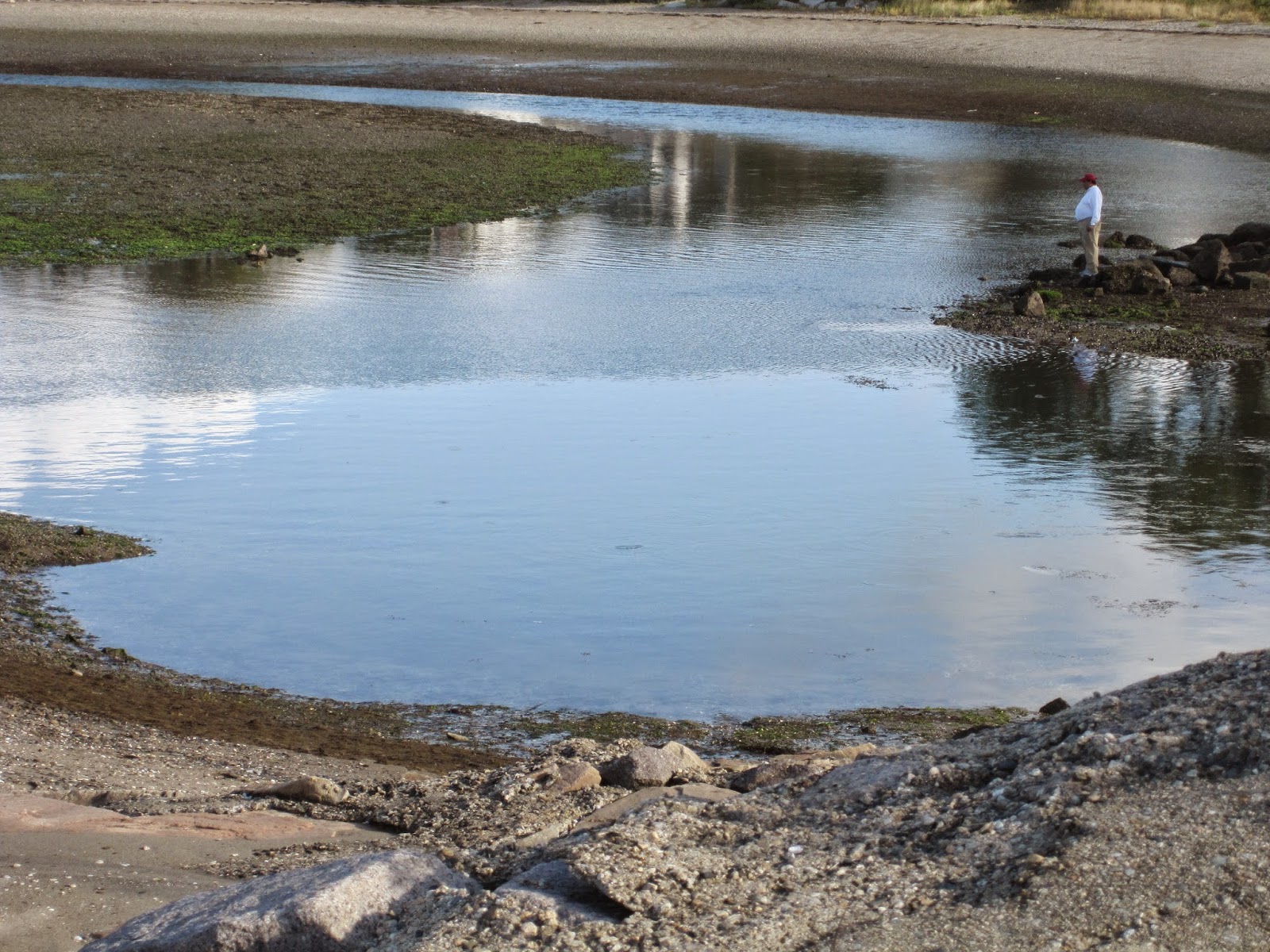
Recently, I took the picture at the right not just because the sky's reflection in the tidal channel was so beautiful, but because the man in the white shirt and red hat seemed to be so thoroughly enjoying this vast, beautiful reflection, and the sea beyond it, as if they belonged to him. I can almost hear him exhaling. I envy his calm contentment. I think I also envy his red hat.


During the last two weeks, my personal reflection experiences have left me feeling more like an insect caught in Sammy Jr.'s voluminous web than like that red-hatted man. But that spider web is an amazing, beautiful thing as long as you're not an insect ensnared in it. Which I'm not. Here******, it's sunlight-reflecting dew-drops that make visible another spider's magnificent handiwork. Yes, sometimes, it really is all about perspective and reflection. But other times, looking and doing, moving and hoping, are just what's needed for knowing and seeing. So I end this blog post determined to keep up my 60 Days reflecting--and to follow Scott's advice. I'll need a zoom lens and wide-angle lens for both, I think.

* Sammy Sr. and his web blockaded the path to a seldom-used bench overlooking the stream on our property in Berlin, New York.
** Screen shot from <http://thebacklot.mtvnimages.com/uploads/images/svu0304b.img_assist_custom.jpg?quality=0.7>
*** Carla Rinaldi’s definition of this can be found in the chapter entitled “Documentation and Assessment: What is the Relationship?” in Project Zero and Reggio Children (2001): Making learning visible: Children as individual and group learners. Reggio Emilia, Italy: Reggio Children. 
****Jacobson, Simon. 60 Days: A Spiritual Guide to the High Holidays. 2nd Revised ed. New York: Kiyum, 2008. Print. 
***** Screen shot of <http://www.pestproducts.com/images/orb-spider-web.JPG>. 

Monday, September 1, 2014

The King is in the Color Field

So already, this morning, I enthusiastically turned the pages of all of my calendars* to September, part of my ritual reorientation of myself to the end of summer as someone who has generally spent a lifetime going to school the day after Labor Day. It's very strange not to be going to school tomorrow. It doesn't feel wonderful, as I hoped it would. I've simply replaced a familiar anxious feeling with an unfamiliar one. The good news is that both varieties of anxiety share elements of hope and possibility. The bad news is that "hope and possibility" keep alternating with little jabs of "terror of the unknown."

But the other good news is that another new month has just recently begun: 1 Elul on the Jewish calendar was last Wednesday, August 27. And so, as I did last year, I am beginning to prepare for the Jewish High Holidays with the guidance of 60 Days: A Spiritual Guide to the High Holidays by Simon Jacobson.**

Some Background
All of that said, the real purpose of this blog post is to share a spiritual experience I had the other night while my husband Scott and I were out in Berlin, New York at our cabin. So my more immediate reason for talking about 60 Days is some of its content is significant for my night-time tale. So is the fact that on the day of that night-time experience, Scott and I visited the renovated Clark Art Institute. A word about each of these official contexts.

In 60 Days' introductory materials, I came across an idea that comforted me much last year: Elul is "the month when the 'King is in the field and receives all people pleasantly and with a smiling countenance'" (Jacobson, 5). Since I continue to struggle with how to talk to G-d, the fact that G-d is especially inclined to listen helps me continue to try. As the Chabad web site explains,
"In Likkutei Torah [footnote #5], the Alter Rebbe describes the tightening of the bond between G‑d and the Jewish people in the month of Elul with the following parable:

Before a king enters his city, its inhabitants go out to greet him and receive him in the field. At that time, anyone who so desires is granted permission [and can] [footnote #6] approach him and greet him. He receives them all pleasantly, and shows a smiling countenance to all . . .
". . . In going out to the field, the king makes himself accessible to his people. It is the people, however, who take the step of turning to him."***
The Clark Art Institute has been redesigned to take advantage of the museum's setting on its hilly, beautiful natural "campus" that offers a large reflecting pool adjacent to the new building and a number of walking trails that, for all intents and purposes, leave the museum behind. The two "special exhibits" we saw, one in the brand new Clark Center and one in the slightly older Lunder Center at Stone Hill, were especially moving and memorable because of the way they take advantage of the museum's natural setting, offering exterior views and supplementing artificial light with natural light when doing so "does right" by the works so lit.


In fact, Scott and I saw many of the paintings in the Clark Center exhibit, "Make It New: Abstract Painting from the National Gallery of Art 1950-1975," in Washington D.C. two years ago, but they didn't speak to me then as they did last week. Why I felt personal narrative crying out this time when last time all I saw was passionate technique and experimentation, I just don't know. The adjacent Frank Stella painting, "Delta,"**** which
wasn't at the National Gallery, especially called out to me: perhaps because its repeated shapes seemed to form a candelabra, even a menorah, a symbol of liberation from darkness; perhaps because its repeated shapes also seemed to form a corrugated iron fence, a dark image of oppression, and I've been feeling in a dark place; perhaps because "Delta" often symbolizes change, and this year has been about desired but uneasy change. 

All of that said, if I'd seen this painting at another time, I suspect I would have wondered silently, "Why did the artist want to do this?" That's the question I always seemed to ask about paintings that seemed to be just about pattern or just about color. But this time I saw nuances in both color and pattern and felt engaged rather than put off.

And now, my night-time experience
Last Friday night, I woke up in the middle of the night, and knew immediately that I was wide awake and was going to be up for a while. 

Despite Scott's and my having had such an inspiring visit to the Clark Art Institute, I was feeling uneasy, strangely homeless, alienated from my usual comforts and purposes. As a result, I couldn't conjure the images and fantasies that sometimes get me through at least some part of a "dark night of the soul": my usual images and fantasies seemed to belong to someone else's life, not mine. 

The problem was that once I jettisoned those images and fantasies, I was left with nothing but blankness--not so much the stark whiteness of a page, but a kind of floating neutral not-light, not-dark grayness. Confronted by that grayness, not threatening but not inviting, not cold but not warm, just there in all its nondescript neutrality, I just felt flatly, powerlessly sad, incapable of any kind of escape, incapable of generating anything that might distract me from that matter-of-fact, steady grayness.*****

Then I heard the owl--maybe it was the orange-headed owl that had startled me that afternoon when it took flight from the tree closest to our cabin's front door. It was somewhere in the valley: maybe at the far end of our field, maybe across the brook, maybe perched in any one of the trees across the road and up the hill. It floated its "hoo-oo" five or six times across the faintly humming darkness that is Berlin, making me newly happy with each calm, measured repetition. Scott moved, and I became aware that was he had heard the owl and had enjoyed hearing it, too. I also understood that my sadness could vanish in an instant.


I stayed up for a long time after that. With my eyes open, not my usual sleepless practice. I looked up at the open window in the wall above our bed and could see night--from my perspective, a smoky gray-brown trapezoid, framed by an darker, more opaque gray-brown window frame and wall. The two distinct gray-browns, the soft edges of the lighter trapezoid and its frame, the faint luminosity of the window, and the slight variations in the dark gray-brown of the wall reminded me of the "color field" paintings I'd seen at the Clark earlier that morning. So I just kept staring at the gray-brown-against-gray-brown above me.******


Suddenly, I saw the Helen Frankenthaler purple- and yellow-dominated painting******* that I'd seen that morning hanging on a wall in the Clark as an exemplar of "Color Field" painting. In my mind's eye, the painting was hanging on a white wall next to a large floor-to-ceiling window with a view of trees--like the windows in the sculpture building in which David Smith's circle sculptures, some or them placed as he had placed them on his Adirondack farm, were on display. At the Clark, these sculptures were inside, but everything about the exhibition space itself--its plentiful natural light, large windows, and wooded views--and the arrangement of the sculpture and paintings in it suggested that we were outside. 

But it wasn't a painting and a window alone that I was seeing in my mind's eye. In addition to those Clark-inspired elements, my imagination conjured a long, bare wooden table, resting on which were a pad of paper and the forearm of someone poised to write on it.

In its sparse harmony, its orientation outward, its pristine quiet, my image felt expressive of me. The person to whom the forearm belonged was alone, and view, or views, from the window pointed toward the expansive and infinite, not toward the centered, the drawn-in and finite, that's often associated with "hearth and home." 

Curious about this "looking out" propensity I often feel, I remembered how much I had liked several Sylvia Plimouth Mangold paintings that I saw at the Boston Museum of Fine Arts many years ago, so much so that I bought a book so I could keep looking at "5 A.M. in January, 1979" and "Untitled, 1979" (pictured here********). My favorite Mangold paintings evoked dawn on winter's coldest, stillest mornings and reminded me of how much I liked waking up early in Cambridge and looking at the apartment building across the street where one illuminated window told me a fellow early-riser was already beginning the ritual of the day, though the sky was still blue-black. So many of my homiest images are of the individual, alert and awake and purposeful, while the rest of the world does what it does somewhere else. Such comfort in the cold, alone stillness; hardly a Hallmark moment!


I thought again about the owl, who'd been silent for a while. Or maybe he'd gone elsewhere. In my mind was the field in the still night and the owl somewhere, alert and watching. Like the King in the Field, watching, listening. In the beautiful sunlight of late August, I easily think of our Berlin field as a place G-d could be standing, waiting, listening, crowned in the gold of all the goldenrod, cooled in the lengthening shadows of the trees. But I wasn't used to thinking of the King being in the field at night--and there wasn't any reason that He shouldn't be. And maybe the King was in the color field.

So I began looking at the muted gray-brown of the open window, imagining  the owl somewhere at the edge of the field or the valley, and G-d out there, the King in the darkened field, the King in any field and every field, all day and all night. 

I thought to myself, "Well, if he's out there, I should try to pray." But I'm not good at praying. And I was struggling to remember all three things 60 Days directed regarding prayer.********* I could remember that I needed to have courage, and I could remember that I needed to express my feelings, which could mean asking for what I really needed, really wanted. So I kept my eyes open, looking at the open window, and I found myself saying that I needed to know where to direct my heart. I was surprised I asked about my heart, but I knew immediately I'd actually asked the right question. This was about the heart, about the inclination of my heart. I had moved away from asking "what should I do with my time?" to asking "what should I do with my heart?"

The minute I said it, I began to think more about Learning to Walk in the Dark by Barbara Brown Taylor. Actually, I had already been thinking about it because I had made a deliberate decision to keep my eyes open and see the dark, but I now focused on Taylor's discussion of James Fowler's ideas about belief, faith, and trust in Stages of Faith: The Psychology of Human Development and the Quest for Meaning. The inclinations of the heart are so important. The Talmud calls prayer "service of the heart."********** But knowing and speaking our hearts isn't easy.


The saying goes that "home is where the heart is." But homes are only places if people don't bring their hearts into them. Which doesn't mean that homes can't help to cultivate hearts or to restore them when they're injured or broken. Perhaps home is that toward which the heart yearns, or maybe home is the yearning heart itself if all it can do is wander the world. Given that I come from a religious background in which exile and wandering are chronic experiences, I believe that on some level, home and heart can be portable. The world has too many highways, paths, dark corridors, and darker streets***********; and is too filled with refugees, wanderers, homeless people, exiles, and other displaced and marginalized persons and peoples for it to be otherwise. That said, we all do better when we have someplace that's home, even if we spend more time looking out of the windows than immersed in a perfect sense of belonging around the hearth.


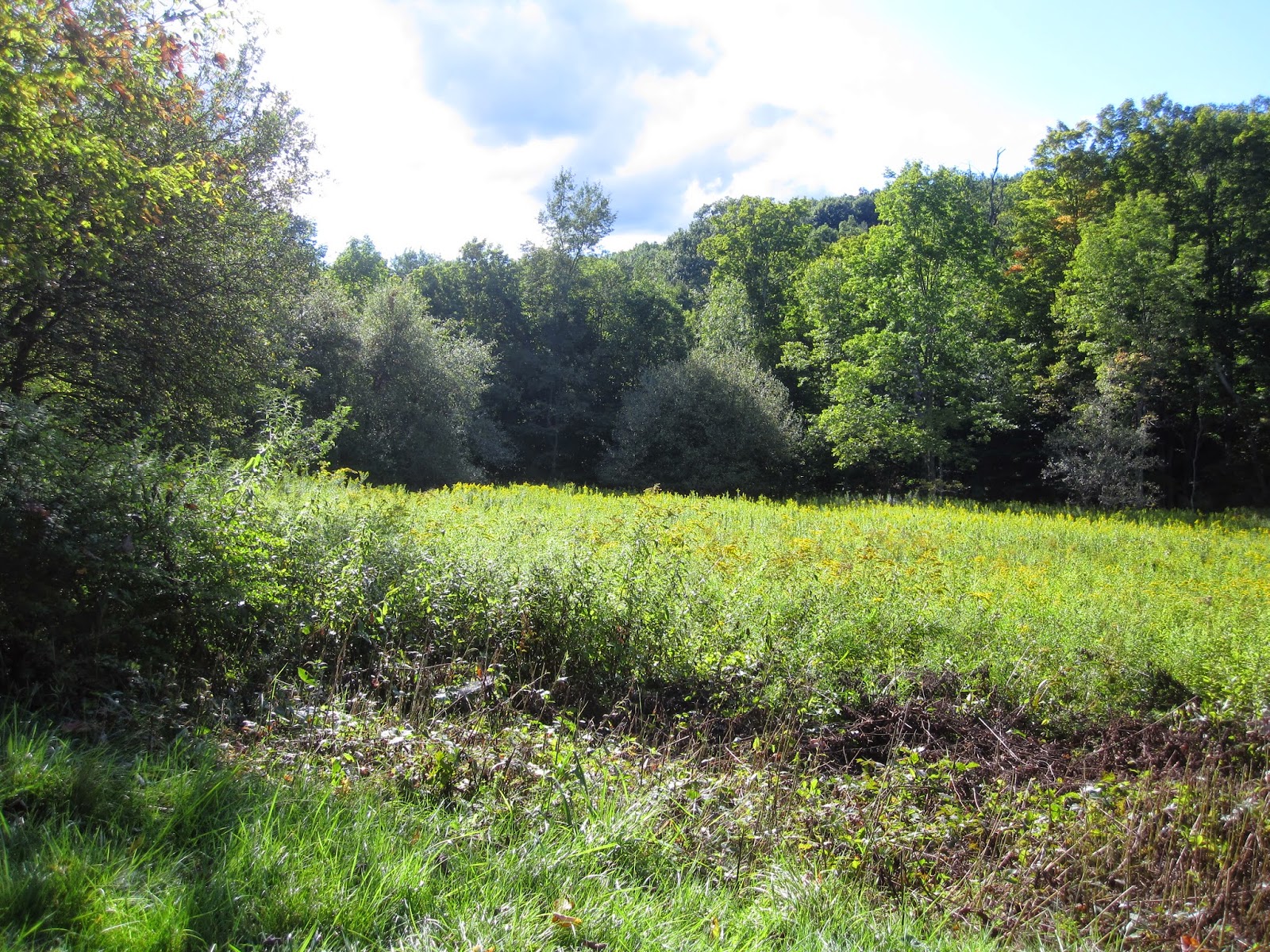
Since Friday, I've been keeping my eye on fields--color fields, natural fields. The one at the right, photographed last Saturday, borders Route 2 in Williamstown, and proclaims in every season that Creation is spectacular. But after my experience of watching darkness deliberately and having the courage to pray, versus almost pray, I'm reminding myself that the King is in the field. Still feels funny to hear myself say that, but I'm saying it, and I'm getting more used to saying it.


And one more thing: I've promised myself to remember how, on that night of flat, calmly expanding grayness, when I felt sad but not scared, the call of the owl banished my sadness completely and filled me with joy. I know owls are nocturnal hunters, but given my experiences of last Friday night, I'm now thinking of the Berlin owl as my "bird of pray," a reminder that some kinds of sadness may be habits rather than unshakable feelings. Luckily, I rediscovered in my cupboard a small ceramic owl and positioned him in my bedroom window for future sleepless nights. There will be some!

* Screen shot of <http://www.amazon.com/Appalachian-Trail-2014-Wall-Calendar/dp/0789326264>
**Jacobson, Simon. 60 Days: A Spiritual Guide to the High Holidays. 2nd Revised ed. New York: Kiyum, 2008. Print.
*** From the Chabad web site:<http://www.chabad.org/library/article_cdo/aid/155856/jewish/The-King-in-the-Field.htm>
*(4) Screen shot of blog post: <http://mattmignanelli.tumblr.com/post/23481863018/frank-stella-delta-l-m-arts-nyc>
*(5) Screen shot of <http://d2085470.u310.surftown.se/images/gray04.jpeg> 
*(6) Screen shot of <http://www.burningsmile.com/wp-content/uploads/2009/03/jodyeyes1.jpg?w=300
>
*(7) Screen shot of Helen Frankenthaler's "Wales": <http://cdn.artsnapper.com/wp-content/uploads/2012/05/helen-frankenthaler-wales-1966-national-gallery-of-art-washington-dc.jpg>
*(8) Screen shot of "Untitled, 1979": <http://weatherspoon.uncg.edu/images/full/1985.3682.jpg>
*(9) Jacobson,161-163.
*(10) <http://iyyun.com/teachings/prayer-service-of-the-heart>
*(11) Screen shot "Heart of Darkness" by Scott Ketcham from <http://www.scottketcham.com/post/96305011977/44-heart-of-darkness-2000-2009-40x46-oil>