Friday, March 26, 2021

Warble for Crocus-Time

So already, as some of you know, I often walk the trails around the salt marshes near my home in Quincy, Massachusetts. Everywhere in Quincy, timeless nature, urban sprawl, and suburban order are juxtaposed, so I experience them all on my trips to the marshes. 

Usually, I revel in springtime. Daily walks invariably reveal new indications of rebirth: crocuses cropping up on lawns and in not-yet-tended gardens; thorn bushes' slim, tangled branches greening along the marsh trails; birdsong proliferating along sidewalks and trails; leaf blowers noisily ridding envisioned flower beds of fall and winter detritus; front doors sporting wreaths that weave forsythia and marsh grass.

But this year, I've been simultaneously loving the evidence of returning life and feeling saddened by it, no doubt because this is the first spring in my life that my father has not been alive--he who relished the annual return of warmth and light. I'm finding myself caught in an inverse proportionality situation: the more I feel elated by spring "firsts" and customary evolutions, the more I feel sad because I can't pick up the phone to call my dad to report them to him. The last line of Louise Glück's "Vita Nova" is what's getting me through my mixed emotions: when Glück says, "it is still spring; it is still meant tenderly," I can feel her sharing my sadness (2).*

But really, I've known all along I'm not alone in this. If it's one thing I'm aware of this spring, it's how many other people--people I know well--are also grieving. In some ways, that nature of winter itself made it easier for those of us grieving simply to hide in darkness, to hunker down, to feel and stay separate, as if all that separateness was required by COVID-19 safety protocols. But spring is pushing all of us out of our front doors, practically requiring us to reconnect cheerfully with our now-vaccinated friends, many of whom we weren't in very much touch with when our grief was new and even breathing felt difficult.

As I've been walking near the marshes in the last couple of weeks, I've been reminded of three people in particular, in addition to my father. Two are grieving colleague-friends, both of whom lost children in late 2020. The other is the poet Walt Whitman, whose"When Lilacs Last in the Dooryard Bloom'd," one of the ultimate poems about the power of springtime to evoke remembrance, I so often taught.

In one of the late sections of  the poem, the poet/speaker links arms with two companions--"knowledge of death" and "thought of death"--in whose company he listens to the hermit thrush's "carol of death" before he has his transformative vision of the dead in several later sections of the poem**:

Then with the knowledge of death as walking one side of me,
And the thought of death close-walking the other side of me,
And I in the middle as with companions, and as holding the hands of companions,
I fled forth to the hiding receiving night that talks not,
Down to the shores of the water, the path by the swamp in the dimness,
To the solemn shadowy cedars and ghostly pines so still.
"Attendants" by Scott Ketcham

Whitman's description of that walking trio has had me imagining walking arm-in-arm with my two friends, even though they are grieving as parents of young children and I'm grieving as the adult daughter of an elderly parent who lived a wonderfully happy, long life. I might not have felt that I deserved to walk with them in grief had each of them not invited me to: in the case of one of them, the invitation came in the form of a simple text message she sent upon her learning of my dad's death from my blog: "we are both missing people right now."  Neither of my two friends who've suffered truly tragic losses has ever minimized my loss as compared to their own, and both continue to walk with me in mourning fellowship.
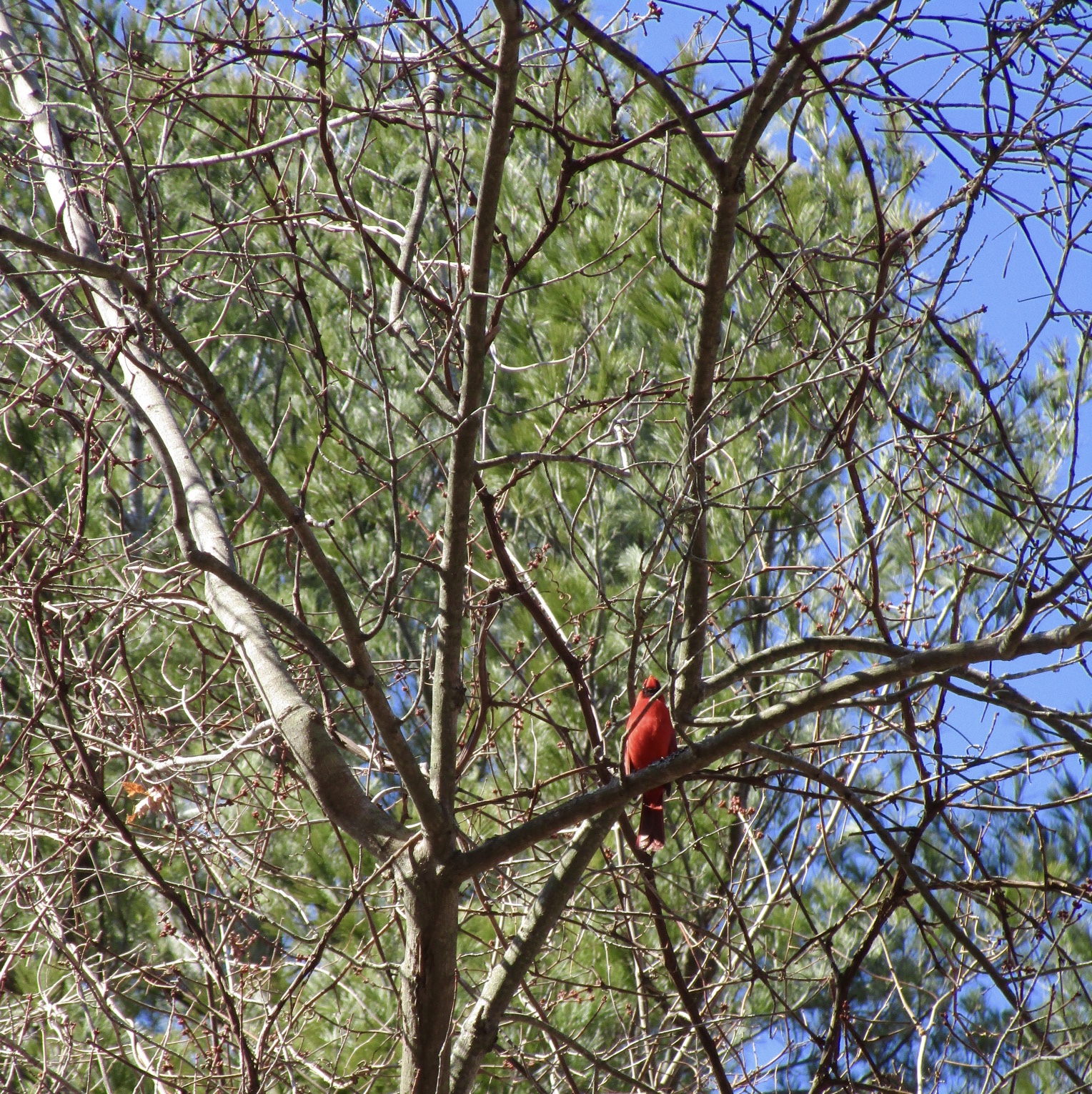
Whitman's also been on my mind for the much more superficial reason that I'm so regularly in a swampy place where birdsong is the only sound I hear. I'm hearing cardinals, robins, and a few other kinds of birds rather than Whitman's hermit thrush offering carols of death. But their singing constantly reminds me of the critical role the song of the "the gray-brown bird" plays in the transformation of the poet's relationship with death. Please note that I said "relationship," not "understanding." The change is more embodied, more fundamental, than that.

"Embodied," you ask? I'm a little bit surprised to be using that word, too. But yesterday, at the encouragement of an old college friend and fellow English major, I listened to an EconTalk* called Dana Gioia on Learning, Poetry, and Studying with Miss Bishop.**** A few times, he used the word "embody" in conjunction with literature, and I began to contemplate the implications of thinking about the connection of literature and visceral experience.***** 

That got me thinking back to how my students and I initially made our ways through "Lilacs"--by walking alongside the speaker through the story told by the poem. Reading closely, we journeyed section by section through the poem, keeping track of where he was; what he was doing, seeing, hearing, and paying attention to; how he seemed to be feeling. We didn't worry about what the poem meant, though we couldn't help but notice the repetition of certain images, which made us wonder whether they might be symbols; we simply immersed ourselves in the physical and sometimes fantastic world created by Whitman's language and images. Essentially, we embodied the speaker.

It's weeks from lilac time in Quincy, and not even the forsythias are out screaming yellow along the chain link fences, but that teaching memory combined with my long history with "Lilacs" sent me back to Whitman's poetry in search of another experience of comfort and inspiration through embodiment. 

I decided to turn my attention to "Warble for Lilac-Time"--in part because its title mentioned lilacs. And also because two springs ago, when the women of the Broad Cove Chorale and Unicorn Singers--I sing in both groups--were learning Elliott Carter's "The Harmony of Morning," I often listened to Carter's "Warble for Lilac-Time" because it was the first track of my Carter CD.

It's turned out to be a good choice thus far. And since all of Whitman's poetry is in the public domain, here's the full text of it. I suggest that you simply welcome its abundant images to cascade over you if you're reading it for the first time.

Warble for Lilac-Time*

WARBLE me now, for joy of Lilac-time,
Sort me, O tongue and lips, for Nature’s sake, and sweet life’s sake—and
      death’s the same as life’s,
Souvenirs of earliest summer—birds’ eggs, and the first berries;
Gather the welcome signs, (as children, with pebbles, or stringing shells;)
Put in April and May—the hylas croaking in the ponds—the elastic air,
Bees, butterflies, the sparrow with its simple notes,
Blue-bird, and darting swallow—nor forget the high-hole flashing his golden wings,
The tranquil sunny haze, the clinging smoke, the vapor,
Spiritual, airy insects, humming on gossamer wings,
Shimmer of waters, with fish in them—the cerulean above;
All that is jocund and sparkling—the brooks running,
The maple woods, the crisp February days, and the sugar-making;
The robin, where he hops, bright-eyed, brown-breasted,
With musical clear call at sunrise, and again at sunset,
Or flitting among the trees of the apple-orchard, building the nest of his mate;
The melted snow of March—the willow sending forth its yellow-green sprouts;
—For spring-time is here! the summer is here! and what is this in it and from it?
Thou, Soul, unloosen’d—the restlessness after I know not what;
Come! let us lag here no longer—let us be up and away!
O for another world! O if one could but fly like a bird!
O to escape—to sail forth, as in a ship!
To glide with thee, O Soul, o’er all, in all, as a ship o’er the waters!
—Gathering these hints, these preludes—the blue sky, the grass, the morning
drops of dew;
(With additional songs—every spring will I now strike up additional songs,
Nor ever again forget, these tender days, the chants of Death as well as Life;)
The lilac-scent, the bushes, and the dark green, heart-shaped leaves,
Wood violets, the little delicate pale blossoms called innocence,
Samples and sorts not for themselves alone, but for their atmosphere,
To tally, drench’d with them, tested by them,
Cities and artificial life, and all their sights and scenes,
My mind henceforth, and all its meditations—my recitatives,
My land, my age, my race, for once to serve in songs,
(Sprouts, tokens ever of death indeed the same as life,)
To grace the bush I love—to sing with the birds,
A warble for joy of Lilac-time.

So what is it about this poem that is making it speak or sing to me at this moment? A few things.

  1. I love that the poem's images and aspirations remind me of "When Lilacs Last in the Dooryard Bloom'd." So it gives me an experience of literary reminiscence.
  2. I love that the poem unites sadness, delight, and yearning--and that it begins and ends with direct references to reminiscence. In general, I love that there's so much joy and sadness in this poem--but the poet's aspiration is joy.
  3. I love that the poet is asking his lips and tongue to make the accommodations that will enable him to warble, to embody bird-ness and birdsong. This desire to transcend humanness is made particularly explicit in the middle third of the poem. I believe the poet aims to transcend his humanness for the sake of humans.
  4. I love that the poet's springtime contains winter ("the crisp February days and the sugar-making") and summer ("souvenirs of earliest summer")--that all time, all seasons, become one. I also love that the poem's natural setting becomes joined to "Cities and artificial life"--all places join to become one place in the poet's soul and imagination.
  5. I love that the poet's own imaginings re-invigorate his desire "to serve in songs" the love he will re-experience in every season of lilac-inspired human reminiscence.

I don't understand every line of this poem, but I feel its energy and its conflicts, its moods and its hopes. They suit me right now. It's an emotionally zigzagging, energetic, messy yet positive collection of images, ideas, and feelings--which is often the way I experience myself these days.

I know that in the weeks ahead, I'll keep walking around the salt marshes with their soundtrack of birdsong. And I'll also keep reading "Warble for Lilac Time"; I already feel the embodying process beginning, and it's liberating me, connecting me, and enlarging me. A couple of weeks ago, for the first time since my father died, I sang something. Before then, I hadn't felt like I could sing. Maybe by the time crocus-time has become lilac-time, I'll be ready to warble. And whether I warble or not, I will not feel alone in the marshes or at home.

* Glück, L. (1999). "Vita Nova". In Vita nova (pp. 1-2). New York, NY: Ecco Press.
**  Whitman's poem is both existential and historical; he's wrestling with the reality and nature of death generally. The wasteful, violent deaths of Abraham Lincoln and so many Civil War soldiers have catapulted him into this wrestling match and the deep sadness that accompanies it.
***  Kristen Baraniak O'Brien recommended I listen to the talk: The Library of Economics and Liberty. (2021, February 15). Dana Gioia on Learning, Poetry, and Studying with Miss Bishop. Econlib. https://www.econtalk.org/dana-gioia-on-learning-poetry-and-studying-with-miss-bishop/. 
**** Frankly, I haven't read Gioia's poetry, and sometimes I found Gioia and his interviewer, Russ Roberts, too certain about whose and what kinds of lives matter. But what Gioia had to say about poetry really intrigued me.
*****  Gioia, who helped initiate a National Poetry Recitation Contest for high school students, explained that students in Russian schools are required to memorize poetic masterpieces so that they have "the opportunity to embody the greatest language available." He also said that myths embody truths.

Monday, March 15, 2021

How and Why I Wrote My Own Morning Prayer Service

So already, last month I created a prayer service for myself, something I could do every morning before I embarked on "the day" as prescribed by anticipated obligations and often unpredicted thoughts and feelings. I've been adhering to my ritual pretty regularly, speaking the words of the service out loud as I stand in my office facing the window. 

I was reminded of my daily practice this morning while reading Maria Popova's "Proximity: A Meditative Visual Poem for Those Reaching for Something They Can’t Quite Grasp, Inspired by Trees" in this week's" Brain Pickings newsletter--and, in particular, while watching the ten-minute film "Proximity" embedded within it. The film by Russell Dawson was inspired by David Whyte's "short lyrical essay"*  called "Close," which Popova quotes in her essay. Among other much more important things, it reminds us that being close to and comforted by trees, even embodying them, does not require fleeing the town.

Much but not all of the film is presented in two side-by-side frames, regularly creating two perspectives. Its many images of trees and its clips of Dawson moving with the grace and the apparent inner stillness of trees are simultaneously calming and captivating. 

Screen shot of video on Brain Pickings Page
I was immediately mesmerized by the film. But I did not begin thinking about my morning prayer service until I saw that Dawson was not "surrounded by nature": his chair was located near, and in fact was facing, a rather utilitarian, inhabited town-like place.

Similarly, my office window looks out on a relatively nondescript residential setting. And almost every morning when I look out at it during the first part of my prayer service, I laugh. That's because the view always reminds me of a story in Ben Birnbaum's essay "How to Pray: Reverence, Stories, and The Rebbe's Dream."** In telling the story, Birnbaum recounts*** a renowned Chasidic rabbi's answer to his son's question, "'With what are you praying?'": "'With the floor and with the bench'"  (24). Speaking of himself, Birnbaum explains that he learned to pray "with the sheet linoleum and the gunmetal folding chairs in the Young Israel Synagogue of New Lots and East New York" (24).

These mornings, as I look out my office window during the first part my morning prayer service, I always think to myself, "I'm praying with two trees and a dozen parked cars"--you can see them above. And then I laugh.

I love to laugh as part of my prayer service because I haven't laughed very much during these past months, and it's not just pandemic fatigue and worry that have gotten me down. Frankly, I probably wouldn't have created a prayer service had I not lost my dad in December and were my mother not living with Alzheimer's and the slow, steady decline associated with it.

When I first sensed that I was anxiously adrift in uncharted emotional waters, I purchased a book called The Jewish Book of Grief & Healing: A Spiritual Companion for Mourning to help me feel a little easier with my predictably difficult situation. (Only now that I am posting this picture of it do I realize that its cover also depicts a chair set on some kind of a field!) The book contains a variety of brief essays by rabbis and others, most of which are no more than four pages long: I suspect the book's wise editors and authors understood that those in the early months of mourning generally can't read more than four pages at a time.

In his essay entitled "Praying in Crisis," Rabbi Mike Comins begins with a long quotation from Rabbi Zoë Klein, which includes these sentences:

" . . . I have noticed a difference between people who try to muster some relationship with God in crises and those who have always been in relationship with God. Those who have always been in relationship can lean more easily on God, and can speak more freely, expressing their hope as well as their anger. I have seen prayer help people overcome loss, deal with grief, change their direction, and recover, but usually it is in people  who have become practiced in prayer through their own rituals and devotion to it. It is not usual that someone prays for the first time and their life is altered, although sometimes it can happen, rare as revelation" (38).****

Rabbi Klein's phrase "practiced in prayer" reminded me of a question that Rabbi Mona Strick posed last fall to those of us enrolled the adult education class she was teaching called "Service of the Heart: Wrestling with Prayer"*****: how might you change as a result of establishing and sustaining a prayer practice? As the course went along, a related question was added for our consideration: what (else) might change as a result of your establishing and sustaining a prayer practice? In one class, we even considered how God might change in response to people's prayers.******

I was glad that Rabbi Strick spoke about practice rather than discipline. For me, practice suggests repetition until something becomes more customary, natural, efficient, and/or better, whereas discipline suggests adherence for the sake of improvement or correction. Rabbi Strick's language was distinctly invitational, as opposed to judgmental: we weren't in trouble if we'd never been in the habit of praying.

When our class concluded on December 3, I had it in mind to go back through my course materials in order to choose some prayer translations Rabbi Strick had shared to cobble together into a personal prayer practice. But my dad took sick on the same day the course ended and died of COVID-19 a little bit more than a week later. For a number of weeks, there was no other focus except the passing of my dad.

But as I suspected, once more and more of the legal and financial ends related to my dad's death had been tied up, or at least organized, there was more time to feel. I was already in the habit of being kinder to myself, courtesy of Katherine May's Wintering: The Power of Rest and Retreat in Difficult Times:

"When I started feeling the drag of winter, I began treating myself like a favoured child: with kindness and love. I assumed my needs were reasonable and that my feelings were signals of something important. I kept myself well fed and made sure I was getting enough sleep. I took myself for walks in the fresh air and spent time doing things that soothed me. I asked myself: What is this winter all about? I asked myself: What change is coming?" (238)*******

But my attempts at self-care weren't seeming sufficient: this wasn't a time simply about darkness as a precursor to dawn. Slow cooker pot roast and long walks even in combination weren't going to do it, though they definitely helped. 

That's when I began reading parts of The Jewish Book of Grief and Healing more often. When I came upon Rabbi Comins' essay and its wisdom from Rabbi Klein, I knew it was time to come up with my own daily prayer practice that, if Rabbi Klein was right, might better enable me to feel comforted and less alone on those days when I really was praying in crisis.

         So I headed back to my Rabbi Strick materials and found a lot of what needed. From our class's discussions of fixed prayer (keva) and prayer practice, I borrowed some language from Abraham Joshua Heschel to remind me to pray even when I wasn't inclined--and to remind me that prayers in the words of others could help me to pray when I wasn't at all feeling inspired or inclined to pray--and that even that uninspired, "canned" prayer might lead me to more intentional or inspired prayer down the road.

Drawing by Scott Ketcham
From a class session focused on praying in love and awe, I borrowed an alternative translation of Ahava Rabah (from Siddur Sha'ar Zahav) that reminds me to think of God, others, the world, justice for all--and to express gratitude--in other words, to get me--my ego, my  sadness, my fear--from dominating, even becoming my world view. About the time I was pulling together my prayer service, my husband Scott was frequently drawing a model who often posed with a pilates balls of various sizes. Initially, I tended to think of the model as hugging something that comforted her, almost like a body, but the more I said this particular prayer, the more I also saw her as embracing and loving the world, which needs loving. I think the view outside of my office window has also helped with this: we often love what we laugh at.

Finally, I just had to have some of my prayer service be in my own words. So I wrote a very particular prayer and some contextualizing, even explanatory words for it and a few other parts of the service--just to remind me of the intention of my own choices. What I love about the sections I've written is that I don't have to think them up every day, even though they're original: like the rest of my prayer service, they're there waiting for me when I walk into my office in the morning.

As spring approaches, and wintering is on the verge of being literally and figuratively over, I've been sensing that my prayer service needs a little updating.
The Jewish fixed prayers I've chosen are keepers, but the original sections may need a little revising to better reflect my present state and needs: everything is always shifting and changing, including grief, including me. What won't change, though, is my heading into my office each morning for this five-minute practice that has made me feel connected, held, and much more peaceful if no less sad. I hope I'll keep feeling this way. But if I don't, I'll keep at it a good while longer in hopes that it will again come to sustain me.

Drawing by Scott Ketcham
* Popova, M. (2021, March 12). Proximity: A Meditative Visual Poem for Those Reaching for Something They Can't Quite Grasp, Inspired by Trees. Brain Pickings. https://www.brainpickings.org/2021/03/10/proximity/?mc_cid=a336f1f004&mc_eid=dbe9e53593.
 
** Birnbaum, B. (2001). How to Pray: Reverence, Stories, and the Rebbe's Dream. In The best American essays 2001 (pp. 22–41). essay, Houghton Mifflin. 
*** Here's the whole story:  "One day . . .  a Russian Chasidic rabbi known as Schneur Zalman of Ladi was praying alongside his son and, turning to the boy, asked what bit of scripture he was using to focus his prayers. The child answered that he was meditating on the phrase 'Whatsoever is lofty shall bow down before Thee.' Then he asked his father the same question: 'With what are you praying?' The rabbi answered, 'With the floor and with the bench'" (24).
**** Comins, M. (2016). Praying in Crisis. In The Jewish book of grief & healing: a spiritual companion for mourning (pp. 38–40). essay, Jewish Lights Publishing. 
***** The course was offered as part of Hebrew College's Open Circle Jewish Learning program, and most but not all of my classmates were fellow members of the Boston Synagogue
*(6) I remember being especially struck by two companion questions during our fourth session. The first was "What happens to us during prayer? How are we transformed?" I was intrigued that the question was not asking what happened to us after or as a result of prayer, but rather during it. The second was "How is God transformed?" Never had I thought of God as being transformable--as needing, wanting, even aspiring to any kind of transformation, through prayer or anything else.
*(7) May, K. (2020). Wintering: the power of rest and retreat in difficult times. Riverhead Books.

Sunday, February 28, 2021

Morning Musings Beneath a Struggling Sun

So already, on the last morning of February, I set out to walk between weekend rainstorms. The air was damp and clean; the sun kept seeming like it might break through the thin, blue-gray cloud cover, though I knew from the weather forecast that the clouds would prevail. But I was upbeat, cheered by both the persistence of the veiled sun and the birdsong emanating from every winter-bare tree and bush--a great Sunday morning soundtrack.

I'm not usually out this early on a Sunday morning, but my husband Scott was determined to draw with the Edinburgh crowd--that is, the international online group of figurative artists that's based in Scotland. That meant that the two of us were up and done with breakfast by 7:00, so that by 8:00, he could be in his studio ready to start drawing today's model, who was Zooming in from Copenhagen.

As I set out toward the salt marshes, I was thinking about my walk around Squantum two days ago. In particular, I was thinking about what I'd learned about Squaw Rock upon my return home. Mostly, what I'd learned raised more questions than it answered. 

  • I'd looked up "Squaw Rock," and learned that there was also such a thing as "Chapel Rock" and "the Chapel Rocks."
  • I'd learned something that the various sources agreed on--and that was about the presence of "a 200 million year old ancient glacial deposit known around the world as the Squantum Tillite"--whatever that is.*
  • I'd learned two stories about why the "big rock" is called Squaw Rock.

As I thought about these things, I was also noticing winter's retreat. The Old Sailors' Pond ice was melting, and the hope of ice hockey was disappearing with it.

So as the sun and I kept walking along, I thought  about how the sounds of scraping hockey sticks and yelling boys had been completely replaced by the trills, chirps, and whistles of so many birds. Or had they? Had I even heard those winter sports sounds this year? The more I thought about the course of this COVID-shaped, temperate winter, the more I was sure the ice on the pond had never become thick and sure enough for ice hockey to be played even by masked young athletes.
But then my mind was back to Squaw Rock. When I'd told Scott that there was such a thing as Squantum Tillite, he'd told me that when we'd visited Squaw Rock on New Year's Eve day, he'd thought it was made up of lots of rocks all set in some kind of clay--and therefore wondered if Squantum Tillite was the name of the conglomerate rock he'd noticed. He was right**: I'd been too busy looking at the graffiti to look at the rock on which it had been painted.***

"More geese than swans now live . . ."
But what was most on my mind as I got closer to the marsh was the lore about how Squaw Rock got its name. The same source that sent me researching Squantum Tillite also explained that "The legend states that an Indian Squaw threw herself to death at this site, but that has never been confirmed." What bothered me was where this story came from, if it wasn't true.

In fact, that naming story was the only one I knew until I came upon the following explanation last Friday afternoon in a Quincy Historical Society pdf***** about the naming of many Quincy landmarks: 

"A very early Algonquian-speaking Native American people who lived on Squantum told stories of a most awesome male/female spirit named Musquantum. It was said that the male named Musquot dropped the rocks that formed the dwelling place (the chapel) for his wife Squanit, as well as one rock which is said to be in her likeness. Tales of these two scary personages continue to be told to Indian children living in Southern New England."

Silence at the Starting Line
Still at the marsh, I thought back to what I'd learned when I checked out the etymology of "chapel" last Friday afternoon: in 17th century English, the word was used to refer to places where religious worship of any kind took place. So Squanit wouldn't have needed to be Christian to have the word associated with her dwelling place.  But what actually happened at her chapel? Since she was a spirit, did she inhabit the chapel to which others came to worship her--or was it she herself who worshiped other spirits in her dwelling place, perhaps joined by fellow worshipers?

So why the story of the suicide that I'd originally heard? Through my internet exploring, I discovered that there was at least one other Squaw Rock in the United States to which the story of the suicide of a despondent "Indian maiden" was attached. That reminded me of a similar story I'd heard many times about Lake Penneseewassee in Norway, Maine: allegedly another Native American maiden had thrown herself into its waters because of her broken heart. 

My mind went back to Louise Erdich's Love Medicine, as it often does when the topic is attitudes toward indigenous peoples--and how we like to imagine "other people" generally. In particular, I thought out the chapter called "The Plunge of the Brave," in which Nector Kashpaw finally accepts $200 to pose nude for an ambitious woman painter. He's shocked by the resulting painting, which bears the same name as the chapter and is later hung in the Bismarck, North Dakota capitol: she painted him leaping from a cliff to "Certain death" (125). That's when he understands that " the greater world was only interested in my doom" (125).

Do people like this kind of subject matter generally? Which people? And who are their choices for who should be plunging, jumping, or leaping to their deaths? I mean, do we think about Virginia Woolf walking into the river with her pockets full of rocks the same way we think of these nameless dead Indians whom we've been told, or shown, couldn't take it anymore?

I know: it was kind of a strange topic to be turning over in my head while walking the streets of Quincy on a temperate pre-spring morning. But it's interesting to think about a place like Quincy, with its various place names and their derivations, and its perpetual interest in writing and sharing its own history. The questions of what's "old" and what's "original" are perpetually raised by the very idea of Merrymount Park, where so much encounter between native and recently arrived people took place--and now where a whole other group of relative newcomers, many of Asian origin, are making themselves at home, but not always with the blessings of those who were here before them.

* Quincy, Mass. Historical and Architectural Survey. ARCHAEOLOGICAL OR HISTORICAL SIGNIFICANCE. Dorchester Street. http://thomascranelibrary.org/htm/439.htm.  
** I include this paragraph about Squantum Tillite, in part because it includes so many words I've never seen before in one paragraph. (Carto, S. L., & Eyles, N. (2012, March 16). Sedimentology of the Neoproterozoic (c. 580 Ma) Squantum 'Tillite', Boston Basin, USA: Mass flow deposition in a deep-water arc basin lacking direct glacial influence. Sedimentary Geology. https://www.sciencedirect.com/science/article/abs/pii/S0037073812000796.) 
             The Squantum ‘Tillite’ (c. 593–570 Ma) consists of thick (up to 215 m) massive and crudely-stratified diamictites conformably interbedded with subaqueously-deposited conglomerates and sandstones within a thick (~ 7 km) Boston Basin fill which is dominated by argillite turbidites. The Squantum Tillite was first interpreted as being glacigenic in origin in 1914 because of the presence of diamictites; argillites were interpreted as glaciolacustrine ‘varves’ with rare ice-rafted debris, and conglomerates as glaciofluvial outwash. More recently these have been shown to be the product of deep marine mass flow processes with no glacial influence, yet because of its age equivalence with the deep marine, glacially-influenced Gaskiers Formation, the Squantum Tillite is still seen by some as supporting evidence for a widespread ‘Snowball Earth’ event at c. 580 Ma. New sedimentological work confirms that conglomerate and sandstone facies are deep marine sediment gravity flows genetically related to massive (homogeneous) and crudely-stratified (heterogeneous) diamictites produced subaqueously by downslope mixing of gravel and cobbles with muddy facies. Rare horizons of ‘ice rafted debris’ in thin-bedded and laminated turbidite facies interbedded with thick debrites show a weak but positive correlation of lamina thickness with grain size, suggesting these facies are non-glacial co-genetic ‘debrite–turbidite’ couplets. A significant volcanic influence on sedimentation is identified from reworked lapilli tuff beds and reworked ash in turbidites. The depositional setting of the Squantum ‘Tillite’ appears to be that of a submarine slope/fan setting in an open marine volcanic arc basin receiving large volumes of poorly-sorted sediment on the mid-latitude active margin of Gondwana. No direct glacial influence is apparent. 
*** Ophis. (2019, June 21). Chapel Rocks. Flickr. https://www.flickr.com/photos/ophis/48102285483/.  
**** Douglas Harper. chapel: Search . Online Etymology Dictionary. https://www.etymonline.com/search?q=chapel.  
***** Quincy History pdf from the Thomas Crane Public Library: http://thomascranelibrary.org/sites/default/files/1989.3.pdf  
*(6) Erdrich, L. (2001). The Plunge of the Brave. In Love medicine: new and expanded version (pp. 122–145). short story, Perennial.