Thursday, January 4, 2018

Nothing Without Art: January 4, 2018--Joyce's "The Dead"

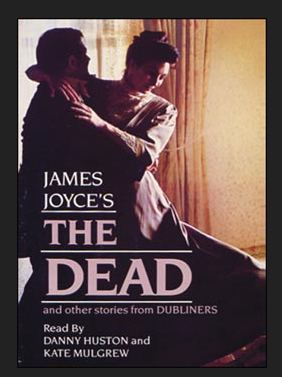
So already, the much forecast snow began this morning at 7:10. The winds picked up, and the blur of still-gentle snow began blunting the edges of dwellings, objects, and vegetation.* As often happens when snow begins to fall across a broad swath of place, uniting all who reside in it in a common experience seasonally ordinary but nonetheless serious, my mind intoned with these words from the last paragraph of James Joyce's "The Dead": "snow was general all over Ireland" (225)*.

Really there couldn't be a more apt time for resurrecting "The Dead": at the center of the story is a Twelfth Night dinner party given annually by the main character's maiden aunts and their devoted niece. And since Epiphany--Twelfth Night--is just two days from now, the time and the weather are both twisting my literary arm.

I often taught "The Dead" as a high school English teacher--always with some trepidation because of the story's scant physical action: people go to a dinner party; they talk, listen to music, dance, eat, and sing; and then they leave, one long-married guest couple for a local hotel. I warned my students that the story might seem more like a still-life than a film, though we would watch a film version of it. To emphasize its interpersonal activity, we read the central dinner scene out loud as if it were a play, with class members playing the parts of the story's various assembled guests. Every year, the whole class enthusiastically sang in appreciation of the party's three hostesses (206-207); later, they paid close attention to how the film's actors performed the lines they had read.


But what really saved the educational day was Joyce's language and choice of details, especially those that conveyed the state of mind of Gabriel, the story's main character. "Gabriel's eyes, irritated by the floor, which glittered with beeswax under the heavy chandelier, wandered to the wall above the piano" (186). A polished floor as a source of irritation? A chandelier providing light and heaviness? What was really going on with this Gabriel guy, the kids wondered.

As I look out my window, there's no question that the snow has intensified. It's time to share that final paragraph of "The Dead": 
      “A few light taps upon the pane made him turn to the window. It had begun to snow again. He watched sleepily the flakes, silver and dark, falling obliquely against the lamplight. The time had come for him to set out on his journey westward. Yes, the newspapers were right: snow was general all over Ireland. It was falling on every part of the dark central plain, on the treeless hills, falling softly upon the Bog of Allen and, farther westward, softly falling into the dark mutinous Shannon waves. It was falling, too, upon every part of the lonely churchyard on the hill where Michael Furey lay buried. It lay thickly drifted on the crooked crosses and headstones, on the spears of the little gate, on the barren thorns. His soul swooned slowly as he heard the snow falling faintly through the universe and faintly falling, like the descent of their last end, upon all the living and the dead" (225).
As I read this yet again, I can hear the "light taps," understand how "silver" can be "dark," easily envision "the treeless hills" and "the lonely churchyard." The assonance of "thickly drifted" and alliteration of "soul swooned slowly," "faintly falling," and "faintly falling"--oh, I love that near-repetition--almost lull me. But not quite. The gates have "spears," the monuments to the dead are "crooked," and the "barren thorns" can prick. The "journey westward" is never fully smooth; the waves themselves are "mutinous." 

Snow is contrary stuff. Peacefully, stiflingly, or dangerously blanketing, depending on any number of subjective and physical realities. Mostly I have every reason to love it, and I'm both loving it and taking it seriously today. If you've never seen the film version of "The Dead," be sure to watch to the very end: the final paragraph is read in its entirety, and the images*** that accompany it are near perfect companions to the text.

* This is not a photo of Ireland; it is a photo of the Princess Eve Salt Marsh in Quincy.
** Joyce, J. (1993). "The Dead". In Dubliners. New York, NY: Penguin Books. 
*** Photo from the film version of "The Dead" found in Phelan, B. (2010, December 7). Classic scene #25 [Web log post]. Retrieved January 4, 2018, from http://secretcinema1-accidentalbeauty.blogspot.com/2010/12/few-light-taps-upon-pane-made-him-turn.html (The whole blog is entitled "The Stuff Dreams Are Made Of.")

Wednesday, January 3, 2018

Nothing Without Art: January 3, 2018--"Winter Dog"

So already, one day before an impending snowstorm* that already has whipped local newscasters and meteorologists into a frenzy, I write to share an excerpt from a short story by Alistair MacLeod, a Canadian author who was unknown to me six weeks ago. Thus far, the stories I've read affirm the statement about him on the back cover of As Birds Bring Forth the Sun and Other Stories **: "In a voice at once elegiac and life-affirming, MacLeod describes a vital present inhabited by the unquiet spirits of a [Cape Breton] Highland past, invoking memory and myth to celebrate the continuity of the generations even in the midst of unremitting change."

"Winter Dog" is a story for winter-lovers, for dog-lovers, for people-lovers, and for anyone who's ever been waiting to hear the news of a loved one's death while the whole rest of the world--even the rest of one's own family--is caught up in gleeful anticipation of something else. 

In the case of this story, the children, "half crazed by the promise of Christmas," respond to the "unexpected giddy surprise" of an overnight snowfall by insisting on going outside to play at 4:30 in the morning (32). Their father gives in, warning the children against disturbing sleeping neighbors. So begins his journey into the past and perhaps the mystical:


     "Through the window and out on the white plane of the snow, the silent, laughing children now appear. They move in their muffled clothes like mummers on the whitest of stages. They dance and gesture noiselessly, flopping their arms in parodies of heavy, happy earthbound birds. They have been warned by the eldest to be aware of the sleeping neighbors so they cavort only in pantomime, sometimes raising mittened hands to their mouths to suppress their joyous laughter. They dance and prance in the moonlight, tossing snow in one another's direction, tracing out various shapes and initials, forming lines which snake across the previously unmarked whiteness. All of it in silence, unknown and unseen and unheard to the neighboring world. They seem unreal even to me, their father, standing at the darkened window. It is almost as if they have danced out of the world of folklore like happy elves who cavort and mimic and caper through the private hours of this whitened dark, only to vanish with the coming of the morning's light and leaving only the signs of their activities behind. I am tempted to check their recently vacated beds to confirm what perhaps I think I know.
      "Then out of the corner of my eye I see him. The golden collie-like dog. He appears almost as if from the wings of the stage or as figure newly noticed in the lower corner of a winter painting" (34-35).
"In the Studio" by Robert Motherwell
I leave it up to you read this short story if you want to watch that "golden collie-like dog" roughhouse with those children and set into motion interactions among the story's various levels. I leave it up to you to read the story if you wish to plunge with the narrator into his searing recollection of a near-death and salvation experience with another golden collie. At least as far as I've gotten, As Birds Bring Forth the Sun gently but firmly asserts that all of us are always making our ways in terrains shaped by inner and outer realities often simultaneously mystifying, comforting, and disturbing. Baffling as they may be, they are sure as stone, so we accept them, even embrace them, though they often make us lie awake at night.

* MacLeod, A. (2002). As birds bring forth the sun: And other stories. Toronto: McClelland & Stewart. 
** Photograph in Blog entitled Meditation Travelogue: Thoughts from the Mystical Road by Noelle Vignola: Vignola, N. (2014, December 28). Night walk: Part III [Web log post]. Retrieved January 3, 2018, from https://noellevignola.com/2014/12/   
*** In the Studio, 1984/1985. Courtesy of the artist in blog: Shaw, C. (2014, September 8). Form, gesture, feeling: Robert Motherwell retrospective opens at Pearl Lam [Web log post]. Retrieved January 3, 2018, from https://www.wallpaper.com/art/form-gesture-feeling-robert-motherwell-retrospective-opens-at-pearl-lam-hk

Tuesday, January 2, 2018

Nothing Without Art: January 2, 2018--Early Bird Singers

So already, the Peabody School Early Bird Singers* are the artistic inspiration that I report on today. Last evening, they performed at the Inauguration of the Cambridge (MA) School Committee, and they were just plain excellent! I woke up smiling because of them.

As the Peabody School page of the Cambridge Public Schools web site explains, "Our Early Bird Singers are a dedicated group of students in Grades 3 - 5 that meet before school two mornings a week. They learn very challenging music."

That dedication--and also their enthusiasm--were evident in last night's performance. The group performed two selections that required expressive unison singing, occasional polyphony, and lots of attention to well-tuned harmony. Diction is never easy, but I understood every word of "America, of Thee I Sing" (arraned by Mary Donnelly & George L.O. Strid) and "You Raise Me Up" (by Secret Garden). Adult choirs can struggle to achieve precision and expressiveness, but this group made it all happen at the same time. Their confidence, skill, and joy were just what was needed by those of us who'd come over to the CRLS Fitzgerald Theater on the first frigid night of the new year.

I wish I could recall who conducted the group last night--my web site browsing suggests it might have been Katie Bach or Megan Ankuda--just because she deserves so much credit and congratulations for guiding these students to create such a performance. And, of course, kudos to the kids: they really are the music-makers here. And let's face it, students in every school deserve such opportunities to be part of something that's truly excellent and really fun. Sing on, Early Bird Singers, all the days of your lives!

* Photo downloaded from Emily Dexter's Facebook page.

Monday, January 1, 2018

Nothing Without Art: January 1, 2018--Stories, Place, & Memory

So already, while I was looking back over 2017, I became keenly aware of how much the works of others' imaginations had kept me afloat during some of the year's darkest moments

Thus, my January 2018 writing resolution is to blog frequently (and therefore briefly!) about some example of artistic expression that got its hooks into me--or that currently has me in its grip. It's intensely pleasurable when some human being's expression of something, of anything, grabs hold of us and won't let us go, making us newly or truly see, feel, or understand. 

So today I share two paragraphs from Ann-Marie MacDonald's The Way the Crown Flies: A Novel. I am not very far into this book, but I love it already. And I've read enough to know what I believe this passage makes clear to you: that the family at the center of this novel moves often, which is something they have in common with many families in our present moment.
      "If you move around all your life, you can't find where you come from on a map. All those places where you lived are just that: places. You don't come from any of them; you come from a series of events. And those are mapped in memory. Contingent, precarious events, without the counterpane of place to muffle the knowledge of how unlikely we all are. Almost not born at every turn. Without a place, events slow-tumbling through time become your roots. Stories shading into one another. You come from a plane crash. From a war that brought your parents together.
     "Tell the story, gather the events, repeat them. Pattern is a matter of upkeep. Otherwise the weave relaxes back to threads picked up by birds to make their nests. Repeat, or the story will fall and all the king's horses and all the king's men. . . . Repeat, and cradle the pieces carefully, or events will scatter like marbles on a wooden floor (41).*
MacDonald has me thinking about being shaped by place versus events, and about how we--as individuals, and members of families and cultures--choose what patterns to enshrine in our stories. She also has me wondering how right she is when she says our human impulse is "to muffle the knowledge of how unlikely we all are." 

And yes, I love reading books where a philosophical digression like the one above fits so easily into the story of young family doing what it always does to make a new temporary place become "home."

* MacDonald, A. (2004). The way the crow flies: A novel. New York, NY: Harper Perennial.

Friday, December 29, 2017

Rounding Corners Into the New Year

A View of a Cambridge Public Library Corner from Within
So already, for the last month, I've been contemplating corners--the idioms and the spaces connected to them. People can cut corners or paint themselves into them. They can corner markets--or corner puppies that dash out front doors to temporary freedom and need to be brought back home. They can corner friends, colleagues, or acquaintances on occasions when they are bound and determined to say that important thing. And sometimes when they're feeling embattled or misunderstood, they can feel relieved to discover that others are in their corner. Depending on whether we're perceiving corners from inside or outside of them, we might round them, turn them, explore them, avoid them, or retreat to them. 

In 2017, I explored and reckoned with the contents of two corners and rounded two others. With each of these moves, I felt a little less cornered. By the end of the year, I felt beyond the thicket of corners I'd been navigating for the last twelve months: I could more comfortably contain the diverse directions, pulses, impulses, insights, and contradictions that are so often crammed into figurative corners. Our corners, ourselves, I say.

The First Corner: Explored
I wrote "Corner Bones" because I was struggling to feel less at the mercy of my chronic worries about a particular unchangeable reality. My strategy had been to embrace meaningful opportunities, but I soon learned that chronic worries--the bones in the corner--exert their pull even in moments we believe will be worry-proof. But to acknowledge the power of the bones in the corner of a room is not to empower them to rule the room. Before I wrote this poem, I'd been in the habit of bowing to the bones. Since writing the poem, I've come to understand the bones as a fixture. But the room definitely is mine, not theirs.

The Second Corner--Which Really Came First: Explored
Envisioning corners in conjunction with writing "Corner Bones" got me thinking about another corner: a fertile one I'd heard about a summer evening some years ago when my husband Scott Ketcham and I attended a presentation by a visiting artist at the Vermont Studio Center.*

"Large scale work on paper by Dawn Clements"*
In the early stages of her MFA studies, Dawn Clements had focused her official artistic energies on painting--and her unofficial ones on drawing. One day after she and her faculty advisor had conferred about the paintings she had assembled for their session, Clements' advisor pointed to a chaotic pile of papers and asked, "What's the stuff in the corner?" Together they looked at the drawings that were the art Clements really cared about. The stuff in the corner was the real stuff, the beginnings of the oeuvre for which Clements is known.  

Recalling Clements' story got me asking myself, "What's the stuff in the corner? What makes your heart say yes before your mind can muster the counter-arguments and say no?" To ignore the stuff in the corner is to betray one's true self for the kind of safety or approval that imperils the soul--and sometimes even the world. 

The Fourth Corner: Rounded
This fall, paying attention to the stuff in the corner made me say yes immediately to invitations to be on several panels-- even though I'd been telling people and myself that I wanted to do "less education." In all of these instances, my heart said yes right away, and I chose not to let my mind interfere. The most recent panel most challenged me because it required me to speak to an international audience on behalf of teachers around the globe. I knew I would be able to learn about the OECD***, the PISA**** exam, and the new global competence framework that the panel would be discussing. I knew my long experience as a teacher periodically called upon to reshape curriculum and instruction to reflect new frameworks would be valuable. I knew the experience I'd had both inside and outside the USA of working with teachers from other countries would be helpful. Still, would I be able to globalize my responses sufficiently to speak authentically for teachers in many different nations and types of schools?

The Roll-Out of the OECD Global Competence Framework
With the panel's moderator--Veronica Boix Mansilla, one of the designers of the global competence framework--in my corner, I determined to rise to the occasion and even to enjoy myself while I did it. In retrospect, I know I enjoyed myself. And I also think I rose to the occasion. Frankly, saying that so publicly makes me feel that I just rounded another corner.

The Third Corner: Rounded
I suspect, though, that had I not rounded a few blind corners in the months before those panel invitations, I might have declined one or more of them. Last August I blogged about how I'd turned the corner  and gone from paying respectful attention to others' participation in demonstrations and marches to showing up and marching myself. Of course, this kind of political activism represents a very different kind of risk than does participating on a panel, but both are collaborative acts of hope that benefit from confidence in one's ability to think, speak, and act in the unscripted moment.

On the first leg of the Boston march against white supremacy and other forms of hatred the weekend after last August's "Unite the Right" rally in Charlottesville, all of us rounded the corner from Malcolm X Boulevard onto Columbus Avenue. Police cruisers prevented cars from turning from side streets onto the march route so no marcher would meet Heather Heyer's fate. But as high-rise buildings replaced low-rise buildings along the route, Scott and I grew increasingly alert: having read that march opponents might hurl acid into the crowds, we kept glancing upward, looking for any window opened enough to permit the hurling or spraying of acid onto the crowd below. We'd both carried extra water just in case we or others needed to be rinsed down in such an event. 

Scott and I were both very glad when the trees of the Boston Common replaced the tall buildings; we were also glad to be numbered among the 40,000 who stood against hate. Some risks need to be taken. But taking precautions along with them can help. Good intentions and past good luck don't provide good cover. I'm particularly aware of this because last fall's Las Vegas shootings happened on my birthday through one open window in a high-rise. It's sobering to have one's birthday linked in the public's memory to a horrific event.

I believe that with practice, we get better at managing risk and worry--and we don't confuse that with being brave; we realize that though we may dread driving through snowstorms, we usually get to where we need to go without incident, and no amount of worry beforehand guarantees our safety. We calculate the risks, head out of driveways, and turn the corner, almost but not quite sure we'll make it back home. There is no such thing as no risk. So many corners are hard to see beyond.

The Corners in the Rearview Mirror  
An Annita Soble Hanukkah Card*****
And then there are those corners that we don't so much push ourselves to turn as realize we have turned. Only while I was writing holiday cards earlier this month did I recognize that I had adjusted to "retirement"-- my life post-Cambridge Rindge and Latin School and public school teaching. In the report that I wrote last spring for my approaching fortieth college reunion, I had described my blog, Facebook posts, and tweets, not with total comfort, as "being like me: all over the place." But somewhere in the process of writing those annual Hannukah and Christmas cards, I realized that I had to be all over the place in order to be true to the variegated, much alive, mysteriously arranged (or perhaps not at all arranged) "stuff in the corner." The "stuff in the corner" fails to obey the laws of linen-closet organization. It rearranges itself in the dead of night, usually for reasons I don't understand, so that what first catches my eye the next morning changes constantly. Sometimes it glows. 

When I realized that my retirement adjustment process had taken a full four years, I had to laugh: high school takes four years. So in honor of high school's enduring place in my consciousness, I offer this summary of my corner-related thoughts as a series of statements in the form prescribed by a thinking routine that will no doubt be familiar to many of my former students and colleagues:
Corners, Colors, & Coherent Randomness******
  • I used to think I needed to accept worry's dominant role in my daily life; now I think that worry's constant presence in a visible corner of my daily life does not mean that worry dominates my daily life.
  • I used to think the "stuff in the corner" was what I should pay attention to after I'd done what communicated to everyone--especially me--that I was taking proper advantage of being relatively young, still healthy, still professionally respected, and newly retired; now I think the "stuff in the corner" should be paid attention to first because it's critical not only to a good retirement, but to a good life.
  • I used to think that the phrase "being all over the place" was pejorative, synonymous with being superficial and confused; now I think it can mean having interests and commitments that range wide, run deep, and often combine--sometimes with our help--in unforeseen, enlightening ways. And yes, a corner filled with good, real stuff can be all over the place.
  • I used to think that my fears and worries would continue to deter and distract me from exploring and turning important corners; now I think I'm much more capable of not giving them the upper hand. (And I think my timing is good on this score, given the sad, dangerous state of our world.)
  • I used to think it was important to know what to say no to; now I think it's much more important to know what to say yes to.
Corner, Art, & Window, Museum of Russian Icons
Our lives are blessings, and many of us live with lots of freedom and choice in times that ask us to step up. There's something wonderful about being able to strive to be who and what we can be in such times. Our efforts often not only do some good for the world, but enhance our sense of belonging to it. Furthermore, if they reflect the "stuff in the corner," each of us comes into more harmonious, empowering relationship with her true self, an experience that may be not only important, but holy.

As we round the corner into 2018, may we be true to ourselves and the world. May we each have the courage, will, wisdom, and imagination we need to delve into some corners and round others. And may all of us round some important corners together. I believe that we can and will.

* Scott was at the Vermont Studio Center doing one of the summer residencies required by his MFA program.
** "Large scale work on paper by Dawn Clements" (photograph) in “Art Event: Dawn Clements in the Boiler.” JaquetteFITblog, Wordpress, 12 May 2010, jacquettefitblog.wordpress.com/2010/05/12/dawn-clements-in-the-boiler/. 
*** Organisation for Economic Co-operation and Development. 
**** Programme for International Student Assessment. 
***** Annita Soble's work may be viewed at http://www.annitasoble.com/new/. 
****** A painting on display at the Museum of Russian Icons in Clinton, MA. The exhibition is called "Migration and Memory: Jewish Artists of the Russian and Soviet Empires."
 

Tuesday, November 21, 2017

Corner Bones


"Corner Bones II"*

The tea was poured,
The chair set near the hearth,
The book opened to the next chapter.
All was ready.
In the firelight,
The bones winked and flashed.

They were always there now,
Crouched In the far corner of the room.

On soft May nights
When the scent of lilacs
Crossed the sill,
Spawning reverie,
Phantom moonlight
Washed them opalescent.

They were always there now,
Stirring when the phone rang,
Then resettling to the drone of daily talk.

At night, they migrated into dreams,
Settled in the shadowed nooks
Of unknown railway stations
Where frantic seekers
Of misplaced backpacks
Recognized them.

They were always there now,
Shifting just enough to catch the eye
Set on being elsewhere cast.

On summer days when sunlight
Honeyed hardwood floors,
Inviting bare feet to leap and dance,
They snared their share of gold
And tempered pleasure,
Grounding those who thought to soar.

They were always there now,
Hunkered, bent, and glinting,
Always leaching peace.
"Corner Bones"**

* Layering of Vitor Antunes Photograph and partial image from Scott Ketcham painting
      • Vitor Antunes "The Dark Corner" Flickr, May 28, 2011: https://www.flickr.com/photos/janeladeimagens
         /7558233640 
     • "Loam" by Scott Ketcham: http://www.scottketcham.com/post/155923357652/555-loam-2017-46-x-31-oil-
        on-denril 
 ** Layering of Sylvia Plimack Mangold painting and Scott Ketcham painting:
     • Brutvan, C. A. (1994). Floor with light at noon, 1972. In The paintings of Sylvia Plimack Mangold (p. 52).  
       New York: Hudson Hills Press, in association with the Albright-Knox Art Gallery. 
     • "Loam" by Scott Ketcham: http://www.scottketcham.com/post/155923357652/555-loam-2017-46-x-31-oil-
        on-denril

Tuesday, November 14, 2017

Questions, Answers, and Learning About The World


Pearl K. Wise Library Windows
It happened during an assembly in the Cambridge Rindge and Latin (CRLS) high school library. Approximately 150 students and many teachers were on hand to listen to a panel of three students who had recently immigrated to the United States. The panelists were going to share their experiences of life in a new school and country and their ideas about how their classmates and teachers, most American born and bred, might better support their ongoing adjustment.

The youngest panelist was a ninth-grade boy from Ghana. I remember admiring his poise: addressing “older kids” and teachers in a language I was still learning would have terrified me at his age. But there was Charles* sharing a prepared statement and fielding questions from the audience.

It was all going smoothly—lots of sharing about the challenges of navigating new cultures in the classroom and the lunchroom—and then, during the question-and-answer segment of the program, one of my colleagues who is passionate about the social and academic success of all our students spoke up. Since the Boston Marathon bombing—the Tsarnaev brothers graduated from CRLS—a number of us on the faculty had been feeling more intensely that we and our students who’d lived only in America needed to know more about the places from which our immigrant students and their families had come. I suspect this teacher’s question reflected both this concern and her desire to affirm Charles as a thoughtful individual. 

“Do you think people should learn about your country?” she asked.   

Charles shifted in his seat. Finally, he replied, “No, I don’t think they have to.”

I looked at another colleague who was also deeply committed to the thriving of all CRLS students. She was a native of Kenya who regularly helped students in her African literature course to recognize their often stereotypical assumptions about Africa and to replace them with informed understandings. What had she thought of Charles’s response? She seemed to be scanning the crowd. I wondered if she was hoping that some student in the audience would offer a contrasting opinion. 

Finally, she herself spoke up, gently but firmly. “You come from a country that’s very important for people to know about. Many enslaved Africans in the Americas came from the areas now known as Ghana, Togo, Nigeria, etc.—and many people of African descent are interested in learning more about where their ancestors came from.”** 

She didn’t speak for long. My impression was that she had felt an obligation to set the record straight about Ghana’s significant role in historical events that continue to reverberate in the present, but that she also was reluctant to “correct” Charles. After all, he’d been asked his opinion in the moment as part of a public event.  And after all, he was only fourteen years old: how many fourteen-year-olds would feel entitled to say to an authority figure, “I need some time to think about that” or “I think I need to learn more before I can answer that”? It was also possible that he hadn’t heard the question the same way his native-English-speaker peers had: as an English language learner, he might easily have understood “should they learn about Ghana” as “must they learn about Ghana,” instead of as “would it be good idea for them to learn about Ghana.”

Frankly, I can think of many other reasons that Charles might have answered as he did—some of which make me wonder how much Charles believed his own answer. 

There are several ways that we and our students become globally educated, especially when the goal is develop the global competence essential to our becoming active, engaged global citizens who can work together to create a better world for all.

  • We can learn from travel experiences that bring us to the places and people we want to understand more, learn with, and work with to solve problems.
  • We can learn at home or in school from the arts, from the media, from print resources—anything that brings the world beyond our national borders into our personal worlds.
  • We can learn through authentic interpersonal exchange—online and face-to-face--with those who live in, come from, or understand other places.


As NEA Foundation Global Learning Fellows in 2012, a group of us from all over the USA had the chance to develop a greater understanding of Chinese education, culture, and life in all three of these ways. One of the biggest lessons I took from the experience, however, is that authentic exchange between strangers is often not easily achieved, especially when the context is a designated question-and-answer period.

As travelers to China, we were advised to ask our most penetrating questions privately rather than publicly. It was advice we heeded generally. But one morning during a Q&A session in a school in Shanghai, a member of our group asked what must have felt like a penetrating question to the Chinese educators who were hosting us: “If there was something you could change about this school, what would it be?”


There was silence and shifting in seats; our Chinese colleagues looked furtively at one another, but not at the local government officials who were also present. 

Finally, one teacher spoke up: “We could not think of anything about this school that we would wish to change.”

Later in the day, the teacher who’d asked the question quipped, “Not even a different kind of chalk?” I don’t think any of us believed the answer we’d heard. We did understood, though, that deliberate inauthentic exchange—the sharing of "information" or "opinions" meant to obscure facts, conceal personal feelings, or satisfy one’s superiors—also produces understandings of other people and places.

Thanks to such tools as the Right Question Institute’s Question Formulation Technique and various Project Zero-developed Thinking Routines*** that require students to wonder and probe, many American students have become skilled at asking high quality questions that drive learning. Some have also become highly adept at asking follow-up questions. But that doesn’t mean that all of their well-considered questions should be asked directly. Nor does it mean that they should expect complete or truthful answers to their questions in the moment. In some settings and circumstances, answering such questions directly can be highly uncomfortable—or downright dangerous.

Imagine Charles for one minute more. Assuming he felt an obligation to answer the question he’d been asked, what else might have been going through his head? Perhaps he was wondering if there was a “right” answer and what it was. Perhaps he was wishing he knew more about Ghana; after all, what fourteen-year-old has had the chance to develop a critical knowledge of his own country or any other country? Perhaps he was frightened of giving the impression that he was critical of America, especially at a time when immigrants were being viewed with increasing suspicion. Perhaps he had been explicitly instructed by a family member to say little or nothing about Ghana to those who might misunderstand it or him.    

Interestingly, not one of us in the audience that day asked Charles what he wanted to ask us. When the principal of a new orphanage school in Kampala, Uganda asked the third-graders in one classroom what questions they had for two of us who were visiting from America, the first student to raise his hand asked a factual question that spoke volumes: “Do you have parents?” 

Reflections High Above Shanghai*****
Would Charles have offered a different answer to the question he was asked if a classmate—or even his own teacher—had asked him the same question in a classroom filled with other students whom he had come to know over time? Or if a fellow student had asked him the same question in a small group within the classroom? Maybe. Or maybe he would have given the same answer, but followed it with some explanation. Maybe eventually, all the students in the class would have shared what they thought “other people” needed to learn about their countries of origin. 

Authentic exchange, especially across national and cultural boundaries, is never just about good questions or sincere invitations to participate in it. It’s about relationships and trust. It’s about alertness to perspectives. It’s about access to language that can sufficiently express thinking and feeling. It doesn’t just happen: the relationships, expressive abilities, and classroom cultures that best support it—like the global understandings they seek to create—need time and strategic attention to develop.****

Welcome to CRLS, November 2013
By now, Charles has graduated from CRLS. As I think back to that panel discussion, I find myself wondering how the more mature, more educated Charles would answer the question he was asked that day (at least) four years ago: would he think that Americans should learn about Ghana? That still might depend on who was asking and why, who was listening, and how he was being asked.

* I am calling him “Charles”; actually, I can’t remember his name.
** I reached out to the teachers mentioned above to confirm my recollections of this event. My second colleague shared with me how Charles might have understood the word "should."
*** One set of thinking routines, called Global Thinking Routines, particularly support the development of global competence.
**** There could be a whole other blog post on this topic alone!
***** In 2012, the tallest building in Shanghai was The Shanghai World Financial Center.