Saturday, October 29, 2022

After the High Holidays 2022

So already, the Jewish High Holidays are now in the rear view mirror, and the road forward is into ordinary time--hopefully, infused with the energy, purpose, peace, and joy derived from observing the holidays.

In previous years, I've written about my efforts at teshuva, at preparing myself to take advantage of the opportunities for renewal, reconnection to G-d* and others, and refocused personal action and commitment particularly offered by Rosh Hashanah and Yom Kippur. 
 
In contrast, I've written much less about the holidays following Yom Kippur. Somehow the unfettered joy and celebration associated with these later holidays, the singing-and-dancing revelry, have always eluded me, even if a positive sense of a new beginning has not.

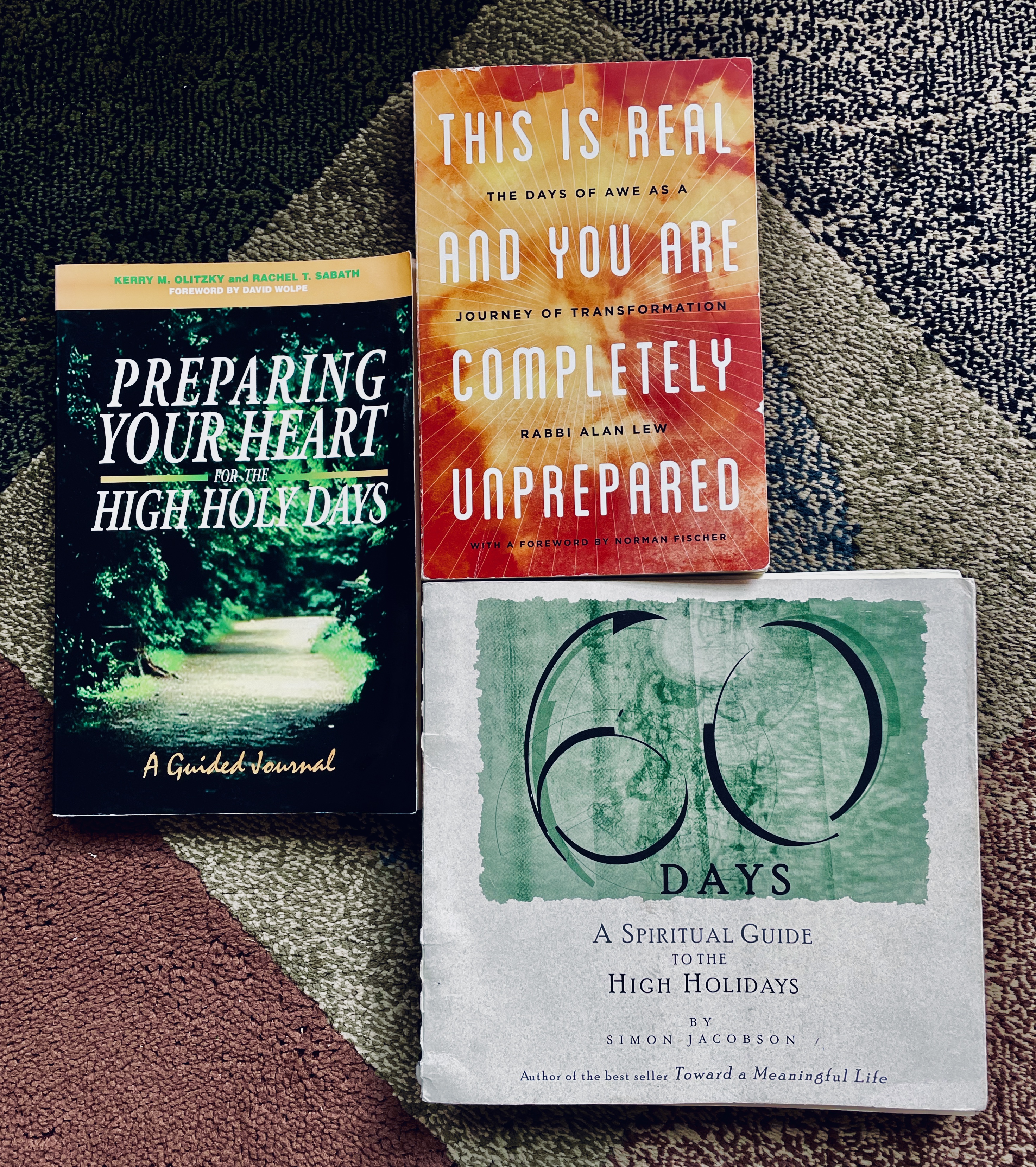
Because this year I went back to using Simon Jacobson's 60 Days: A Spiritual Guide to the High Holidays,** I was guided not only to prepare for the high holidays, but to pay attention to them while they were happening--and to continue to reflect on their effects during the week following them. 

So how did it go this time around? At the end of the sixty days, I can report that even though not once was I seen singing and dancing in the streets in these last weeks, I did feel some joy--best defined for me as feeling of lightness, freedom, optimism, and agency that knows what to do with itself. The following three "new" experiences attest to this.

The Sukkah at My Mother's Senior Living Community

Before I describe my first "new" experience, you should know that my birthday on the Jewish calendar is Tishrei 15, the first day of the post-Yom Kippur holiday of Sukkot. During the seven days of Sukkot, Jews allegedly spend as much as time as possible in the sukkot (plural of "sukkah") we build according to Torah-given specifications. Constructing and residing in these temporary habitations reminds us of the impermanence of human-made things and of life itself--and the permanence and eternity of G-d.

As an apartment dweller for my whole adult life, I've never built a sukkah in my yard. But being born on Sukkot always has always felt like a spiritual opportunity that I didn't know how to turn into a blessing.

Meanwhile, this year, though my sister, cousins, and I talked about getting together during the holidays, we never managed to do so. This lack of shared holiday festivity initially made me very sad: it seemed that the very different ways we live our lives as very secular Jewish people made gathering difficult. But my sadness dissipated when I read about the lulav (made of willow, cypress, and myrtle branches bound together in very specific way) and the etrog (citron) in 60 Days.** 

These objects symbolize four different kinds of people, all of whom are essential to the community, and none of whom--even those who study, pray, and do good deeds with real love in their hearts--matter more than others. The custom of Sukkot, both in and out of synagogue, is to shake the lulav and etrog*** together in six world directions--north, east, south, west, and toward the heavens and toward the ground. As Jacobson explains, "These movements manifest the unity of the 'four kinds'--and the Divine unity--in all the parameters of space in the entire universe, which it is our responsibility to elevate" (122).

Suddenly, I saw our family diversity as a microcosm of this world of diverse human types that can't always be knitted together well without real effort. I decided right then that I would host a family gathering on the first night of Hanukkah. To up the chances that everyone would be able to come, I sent "save-the-date" emails two days later.

On that same day--I'm finally getting to the experience that I've actually been preparing you to read about--as I was walking to my car after having visited my mother, I decided to walk into the sukkah that had been erected in the courtyard adjacent to where I had parked. No one else was there, but on a card table were a lulav, an etrog, and two laminated sets of instructions for how to shake them together. So I shook them. And in that moment, I felt joy--real connection to G-d; other people, past and present; and the natural world.

My second "new" experience happened about a week later when I was suddenly awakened very early one morning****  by an unfamiliar voice that said, "There's a good chance that G-d will strike you dead this year." Needless to say, I didn't feel joy.

At first, afraid, disturbed, taken aback, I wanted the facts. Who said it, I wondered. G-d speaking of himself in the third person? Some unknown person of much authority?  I myself, or a chorus of my inner demons? Given how much death has been in the foreground of my life in the last couple of years, it made sense that I might be wondering about the when and how of my own.

Quickly I went from fearful to coolly responsible. "Be careful," I told myself. "Be sure that Scott knows where all the financial stuff is and that he has the latest passwords. And do my sisters know where to find my mother's financial and medical stuff? I better remind them."

Untitled Recent Painting by Scott Ketcham
Next, my thoughts became more rational-theological. I reminded myself that I didn't believe that G-d would strike me dead--because I don't believe G-d strikes people dead. He wouldn't single me out and hurl a thunderbolt at me, force me off the road, make a tree branch fall on me, inject me with poison. But I also believed that he might let me die, that he probably would not intervene to protect me from a particular death at a certain time. I thought of a friend slightly younger than myself--someone loved and respected by many--who had died just days earlier of a protracted illness that everyone knew would be fatal. Dying happens all the time. So why not me this year?

Finally, with that possibility in mind, I thought of the holiday season's constant messages about the inevitability of death, the blessing of life, and the loving and eternal omnipresence of G-d. So five minutes after I heard this sobering pronouncement--which, thankfully, didn't decree that I would die this year--I was reminding myself to cherish my life and to live it fully and deliberately every day. 

Had I not been far into the process of doing the 60 Days book, I may not have gotten to this life-focused point at all, let alone quickly.

I am glad to be able to tell you that my third and final "new" experience was not in the least disturbing, though it too involved hearing words that felt more like they were coming through me than from me.

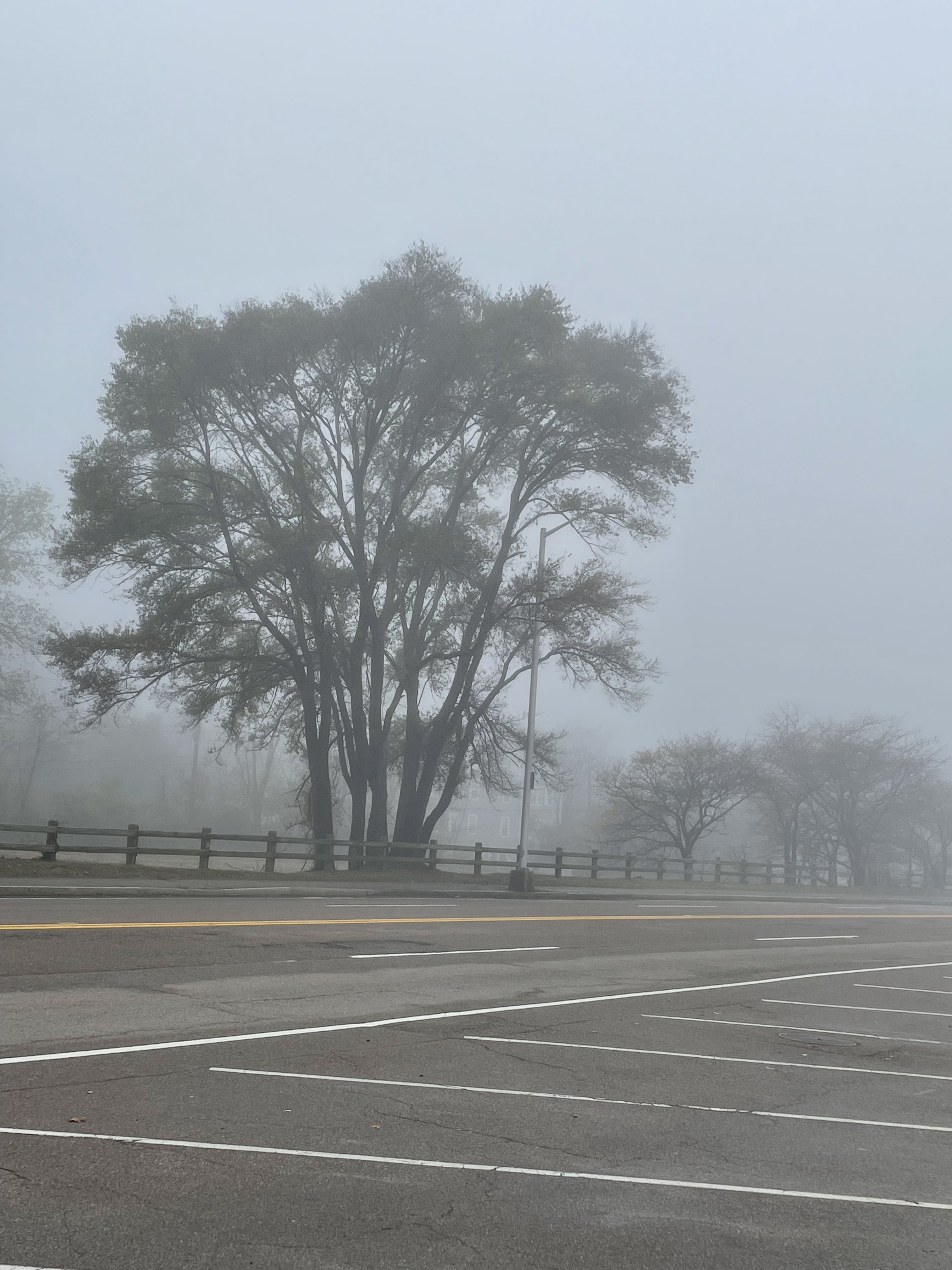
Last Tuesday, the middle of three warm, fog-blanketed days along the Massachusetts coast, I decided to walk near the salt marsh and the beach not far from my home. A primarily descriptive poem came to me as I got to the edge of the marsh on Quincy Shore Drive opposite Wollaston Beach:
I was in a fog
 
walking by the 
     marsh.
 
The green grass 
going gold 
was mist-muted, 
and the water, 
flowing seaward
with the ebbing 
     tide, 
was pale gray-
     green. 
Was the air 
     warmer 
than the water-- 
or the water 
warmer than the air? 
Just briefly
I wondered,  
warmed as I was 
by the spirits 
of the shrouded trees 
hovering above  
the damp rocks, 
the traffic lights  
barely visible, 
and all forgiven

I was surprised by "and all forgiven"--and then I knew I believed all was forgiven. That thought made me really happy.

By the end of the sixty days, I felt more peaceful--more centered, more purposeful, less frantic, less confused, and more certain that I was part of something vast and good if not apt to respond to my individual whims, moods, and wishes--than I had at the beginning of them. And equipped with this array of feelings,
I felt distinctly ready for ordinary time.

So what made experience with 60 Days different this time around? I think the answer is that I engaged with the book faithfully. I don't mean that I did it with perfect faith in and connection to G-d; that's always a struggle for me. I do mean that I was faithful to process, that I stayed the 60-day course with optimism, hope, and openness to the possibility. 
 
So here's to optimism, hope, and openness to possibility. May each of us, regardless of our spiritual and religious leanings, be able to muster those three things whenever we are next presented with the chance to do something challenging that we instinctively feel will help us live better lives in a better world. And may we especially be able to muster them if that challenging thing makes us feel uncomfortable, fearful, vulnerable, or even silly. Finally, may we all have new years marked by growth, peace, and, yes, joy.

*Since the Simon Jacobson, the author of the book that has been my High Holiday season companion, writes "G-d," I am writing "G-d" in this blog. But I've written "God" in other posts. The article linked here explains why some people write "G-d" while others write "God." I feel either spelling is fine.   
** Jacobson, S. (2008). 60 days: A spiritual guide to the high holidays. New York: Kiyum Press.  
*** Drawing accompanying Chabad.org staff. (2017). The lulav and the etrog: The four kinds. Chabad.org. Retrieved on October 28, 2022. https://www.chabad.org/library/article_cdo/aid/609564/jewish/The-Lulav-and-Etrog-The-Four-Kinds.htm
**** Photo on Twitter with hashtag #kitchenviews: https://mobile.twitter.com/hashtag/kitchenviews?src=hash

Monday, October 3, 2022

Crossings: A Poem

So already, on a mid-September morning, I was waiting for the walk light when I noticed the young man diagonally across the intersection from me. The result was this poem, entitled "Crossings."

 
I could feel him pressing forward, 
Itching to step off the curb,
Muscles tensed, shoulders hunched, 
The only other person standing at the intersection 
Already plugged with rush hour traffic. 
He must have gotten off the train, I thought. 
He must be heading to work, I thought.
 
6:45 on a Wednesday morning. 
North Quincy High*, I thought. 
Its four-story façade directly across from us both 
Loomed implacable over its nearly empty parking lot 
And a meager planting of drought-stressed trees and shrubs: 
School didn’t start for an hour. 
 
He had that new young male teacher look:
Curly black hair and black beard, barely trimmed; 
Blue-green plaid shirt, sleeves rolled up;  
Khaki pants, neither wrinkled nor pressed; 
And black shoes of cloth and leather both—for standing all day. 
One of his hands rested on a briefcase so stuffed and heavy 
That its strap was carving a gorge into his shoulder;  
His other hand cradled a covered cup of coffee against his chest.
 
At the walk light’s first flash, he turned gazelle,
Leaping across the street’s five lanes, 
Then springing through an iron gateway and down several steps 
To the parking lot, which he crossed in lightning strides, 
Coffee still held safe, sealed, and close, 
Before flinging open the silent building’s front door 
And vanishing into its dark maw. 
 
I was right. Young teacher. 
 
And walking on toward the river, 
I thought of the new teachers I’d shepherded   
Through their first weeks of school, 
Recalled how before the day’s first bell
They’d sign in, sign on, sign up, set up, 
Gather, photocopy, post, arrange,  
Bright-eyed and breathless,  
Low on sleep but high on drive, 
Intent on turning midnight’s inspiration 
Into their best class so far.
 
“You’ll breathe again in October,” I’d say. 
 
Then I recalled my own first teaching days, 
How energy and hope had kept me afloat  
When imagination outstripped knowledge and skill. 
Starting out was hard enough  
Without pandemic losses to reverse, 
Lockdown drills to supervise, 
Helicopter parents to manage, 
Cellphone use to discourage except when . . .  

When the river came into 
     view,  
The train I’d taken to 
     school for years was 
     halfway across it. 
Nostalgia and relief 
     washed over me 
     in alternating waves 
Until relief won out: 
     in an hour, I’d be home 
Drinking coffee and 
     reading the 
     newspaper. 
 
Wednesday. Hump day. And fall not even yet here. 
I’d never learned to run fast with coffee. 
But I’d learned to teach, and loved it for years. 
I hoped the young man would, too.
 
* Photograph from North Quincy High School Facebook page: https://www.facebook.com/photo/?fbid=440015274801551&set=a.440015238134888

Sunday, September 18, 2022

High Holiday Prep on the Skilled Nursing Floor

So already, last Monday as I was walking to my car after visiting my mother on the Skilled Nursing Floor (SNF) of her senior living facility in Canton, I happened upon a perfectly heart-shaped gold leaf lying on the pavement.

It seemed so right to come upon it just then. Not only was I in the midst of preparing myself for the Jewish High Holy Days, but I had just had a wonderful conversation with my mother--not a predictable occurrence given that she is in the late stages of Alzheimer's.

This year--and I wouldn't have predicted this--visiting my mother at her nursing home has been central to my efforts at repentance, repair, and return--what Jews call teshuva--during the penitential month of Elul, which precedes the Jewish new year.

Over the years, I've used several different books to guide my holiday preparation. But this year, I decided to go again with Simon Jacobson's 60 Days: A Spiritual Guide to the High Holidays.

On August 23, several days before Elul began, I had one of those visits with my mother during which she mostly slept. So while she napped, I reread sections of 60 Days to remind myself of Jacobson's sense of the season's most important aspects. Though I'd read it before, the book's discussion of prayer felt completely new to me. 
 
The following statements in particular engaged me:
  • "Prayer is a conversation, a dialogue between your heart and your soul, between your heart and G-d. It is hard because it takes practice and work to develop the skills necessary to converse from the heart" (162).*
  • "Of course, we all have emotions and feelings, but they are our natural ones, not something we have developed, cultivated or refined. . . . If study is exercise for the mind, prayer is exercise for the heart (162).*
  • "This, then, is the challenge of prayer: to learn how to access your heart, to develop courage to be vulnerable and to express your feelings, and to do so before G-d with no shame or fear (163).*
Bullet by bullet, I had--and still have--the following questions and responses:
  • When is the heart an intermediary between God and the soul, and when is it a barrier between them?
  • How can we be sure that "developed, cultivated or refined" feelings are an evolution of natural feelings as opposed to a denial of them? (You can tell I had years of therapy!) How exactly does prayer work to change the heart for the better? Do"refined" feelings feel different than natural feelings? What aspects of the natural feelings have been burned away--as in the refiner's fire?
  • Despite these questions, the tripartite challenge of prayer seems right to me--and for me.
As a result of reading on the nursing floor deck** that day, I resolved to recite daily two different prayers, one traditional and one non-traditional.*** That night,  I acknowledged in my journal the first teshuva-related  benefit of visiting my mother: "I never expected that visiting my mother would give me such an important [reading] hour today . . . .."

If it's one thing I've learned in the past few years, it's that Alzheimer's looks very different on different days. Yes, my mother always knows who I am. Usually during my visits, she combines being asleep and being awake.  
 
But, as the previous paragraphs attest, some days, she sleeps for practically my whole visit. 
 
Other days, she not only stays awake, but greets others, responds to questions, reads words, looks at photographs, identifies flowers, names birds that light on trees. The other day, she was very interested in looking at pictures of Balmoral Castle because of Queen Elizabeth's passing.
 
Yet other days--like last Wednesday--she stays awake, but she's agitated and unsettled. These days when she's most obviously in the clutches of this disease are the most difficult and heartbreaking.
When I ask if she's having a hard day, she says yes; when I ask if she has a lot on her mind, she says yes; when I ask her what's on her mind, she says she doesn't know. All I can do is hope that my being there makes her day a little bit better.
 
But whether she's having a good day or a bad day, she's perceptive emotionally: one day several weeks ago when I told her that I preferred to hug her when she and I were apart from her fellow residents since I didn't know which of them didn't have visitors to hug them, she nodded vigorously, and her facial expression reflected her compassion for those who seldom had visitors.
 
In general, teshuva requires doing, reflecting*****, and being still; attentiveness, awareness, and responsiveness are central to it. So visiting my mother generally permits me to do teshuva, or to be in a teshuva state of mind.
Though sometimes I sit there wondering what it's like to be her, what she thinks, feels, wants, and how she knows that, more often, I just be there attentively and lovingly. Most of the time, it's a peaceful kind of being together, I think for the both of us.

The daily exercises in 60 Days emphasize various spiritual and interpersonal repair and work areas: taking initiative, giving unconditional love, cultivating and expressing compassion, seeking forgiveness and forgiving others are all important during Elul. For me personally, some of this comes down to saying what hasn't been said expressly even if it's been implied and probably understood. I believe it's generally good for people to be reassured that what they believe to be true is true. 
 
One of my emotional truths is that I didn't always have an easy, positive relationship with my mother.**** Which brings me to that wonderful conversation with my mother that I mentioned at the start of this post.
 
My Mother Around 1950
We were sitting on one of the SNF decks on Elul 16 when I told her that I loved her a lot.
 
"Really?" she said, skeptically. [Note: whether I'm talking to her on the phone or sitting with her, I always tell my mother I love her. But periodically, she's skeptical.]
 
"Yeah," I said. "Really. I know that there were a lot of years--like when I was in my twenties and thirties--when we didn't get along very well. I think we understand each other better now than we did back then." 
 
She looked at me and nodded. 

"Laurie [my younger sister] once told me that at first she was surprised to hear me say that I loved you," I continued. "'You always seemed so mad at Mum,' she said. But I explained to her that over the years, you and I did much better with each other."

"Yes," my mother said. "Now we have a very nice understanding." And then we smiled and hugged.
 
My mother and I mended any fences that needed mending a long time ago, so our conversation was not desperately needed. But it was still great to hear her affirmation of the already known and achieved. It made me think about the last lines
of Fiddler on the Roof's  "Do You Love Me?" with one modificiation: "It doesn't change a thing but even so/ After thirty-five years, it's nice to know."

With my dad in 2019; he died of COVID19 in 2020.
Who knew that such an important, heart-healing moment could happen in the late stages of Alzheimer's? How wonderful is it that despite her health challenges, my mother still manages to give what she can. And that was the thing I needed to learn, and that I didn't learn until, about ten years ago, when I began writing Morning Pages daily, as directed by Julia Cameron****** in The Artist's Way: my mother, usually lovingly, has always given what she could give and what she thought she was supposed to give, even though it wasn't always exactly what I wanted or needed. 
 
That's why that gold leaf on the pavement seemed so perfectly symbolic to me.
 
If I had to say what's refined my heart, specifically in regards to my mother, I would say that it's been writing more than praying. But Julia Cameron would say that often they're the same thing. In fact, her 2004 interview in Publishers Weekly was entitled "Writing as Prayer."*******

As I reread what I've written above, I realize that this blog post is yet another example of writing as prayer. I sit here not knowing whether this is the last Elul that my mother and I will have together. So I write this hoping, praying that, whenever the moment comes for her to pass into eternal life, she will glide across the threshold gently, easily, and peacefully. In Ehyeh: A Kabbalah for Tomorrow, Arthur Green says, "The One who loves us is there in all that will happen" (5)******** This comforts me.

The Jewish new year begins one week from tonight. May all of us be inscribed for a good new year. May our hearts heal if they're broken, and may they open and stay open. Shana tova.
 
* Jacobson, S. (2008). 60 days: A spiritual guide to the high holidays. New York: Kiyum Press. 
** Screen shot from the video virtual tour of the Orchard Cove Skilled Nursing Services Community: https://www.hebrewseniorlife.org/orchard-cove/health-care-services/long-term-care-canton
***I've kept up this routine, which I genuinely like, and I do feel these two prayers have become companions in some way.
**** We clashed a lot when I was a teen and when I was in my late twenties and early thirties--for reasons that don't matter at this point. We also clashed a lot when she was in the early stages of Alzheimer's, and she still believed that she could be fully responsible for taking her medications at the right times. In many ways, early Alzheimer's is harder on families than late Alzheimer's, I believe.
***** Drawing by Scott Ketcham: https://www.scottketcham.com/image/668427944162639872 
*(6) I followed Cameron's 12-week creativity course as laid out in The Artist's Way very soon after I retired in 2014.
*(7) Nelson, M.Z. (2004). Writing as prayer. Publishers Weekly. Retrieved September 17, 2022, from https://www.publishersweekly.com/pw/by-topic/authors/interviews/article/20075-writing-as-prayer.html
*(8) Green, A. (2003). Ehyeh: A kabbalah for tomorrow. Tennessee: Jewish Lights Publishing.