So already, an original poem connected to the first anniversary of my father's death.*
Yahrzeit is the Yiddish word for the anniversary of a loved one's death.Monday, December 13, 2021
Yahrzeit: A Poem
Saturday, November 20, 2021
Monday Night, Late
So, already, here's a seasonal poem, the result of my poetry-writing group's recent poetry experiment assignment--to write a poem inspired in some way by parking lots, or a parking lot. The experiment came from Erica Goss's Vibrant Words: Ideas and Inspirations for Poets; Goss has a history of poetic parking lot inspiration.
On a forced march
Saturday, November 13, 2021
Art and Isolation: A Guest Blog Post by Scott Ketcham
So already, the other day I suggested to my husband, Scott Ketcham, that he create a kind of pandemic-era artist's statement to share along with his paintings at his open studios on Saturday, November 20 and Sunday, November 21. With his permission, I share it with you today, knowing that however we've filled our own hours during the last year and a half, the pandemic has had some effect on it. So here is "Art and Isolation" by Scott Ketcham.
As life lurches back to normal maybe,
I can reflect on the lockdown and what it was like to make my art in isolation.
I really should say, in more isolation than before Covid—because I have long
sought and needed solitude. My art flourishes in sequestration. I am no outlier
here. So many artists, especially visual artists, poets, novelists,
playwrights, composers—those who need head space to conjure from a world within—crave
seclusion (collaborative/ performing artists might experience creativity more
communally). I am so fortunate to say that the lockdown was much less
discouraging to me than to most other people.
And yet, this sequester felt different to me, eerie, grim, murky. Safety demanded unending vigilance. Humanity responded to the threat with politics of confusion. The hum of a world pulsating outside my cloister fell silent. I have come to realize how that pulse feeds my creativity, that I rely upon a safe and sane world to a greater extent than previously I would have admitted. This recluse needs assurance that the world outside is alive and well. My isolation felt more forced than self-imposed. As is my way, when I encounter something incomprehensible, I turn inward to comprehend it.
It must seem oddly disingenuous—that an artist fixated upon the human image would play the hermit. But, as you look at this body of work you will see figures wrestling alone with something—some stuff, some environment, some inner force, perhaps their selves. They are solitary and self-contained, like me. Engaged intently but not interpersonally. And never lonely. My figures have always been this way; but after more than a year in lockdown, they are even more insular. The few who make eye contact appear unapproachable. I cannot possibly separate my own broodings from the actions of these apparitions in my paintings and drawings. It is ironic that all art (figurative art most disconcertingly) embodies presence and absence simultaneously. Though a human presence is suggested here, in fact there is none—merely colored chemicals smeared across a flat surface. If art can perform its magic, perhaps you will come away with some whiff of humanity despite its absence. Indeed, after a stretch where all of us experienced absence.
Quarantine from March 2020 to June 2021 found my studio’s routine interrupted, the enigmatic relationship between artist and model suspended. I regard my imaginative, innovative, soulfully beautiful models as genuine collaborators in shaping my art. I guess I am not so insular after all. I relied on sketches, photographs, memory, outright invention—and Zoom! A resourceful model suggested it, so we did it—held life sessions via video conference. It had its ups and downs (web cams unavoidably mediate perceptual experience) but it was something, and it was fun. It was also a small way I could help those in the gig economy hit hardest by the freeze. A friend introduced me to a group out of Scotland likewise holding life sessions on Zoom with artists and models from all over the world. Many of my recent drawings were thus executed during video sessions. Additionally, my studio became my Zoom classroom for teaching painting and drawing for 3 ½ semesters. The results surpassed my expectations—mostly due to the determination of my Massasoit college students. We have been too quick to underestimate the grit of young people during this upending moment.
This era is nowhere near as challenging as others during which art nonetheless flourished. Someday I might see a lasting effect on culture, on me. For now, I am grateful to be able to keep working at my craft; as long as I can do that, life will be normal enough. Looking about me, I see that art is thriving. It is a force with momentum no pandemic can stop. Art endures.
Friday, November 12, 2021
Go Figure! Looking at Scott Ketcham's Recent Paintings
So already, Scott Ketcham's open studios are happening next weekend--the weekend before Thanksgiving--from 12:00 to 5:00 on both Saturday, November 20 and Sunday, November 21 in Rockland, MA--and like America, Scott's back. Actually, the whole 4th Floor Artists Association is back: Scott's and his fellow artists' open studios didn't happen last November because of COVID-19. Scott painted some landscapes this year, but it's his paintings of the human figure--more and less abstract treatments of it--that he's choosing to feature this November.
"Ballancing Act," one of my favorites of his recent figurative paintings, will be on view. It intrigues me without disturbing me, which I can't say about all of Scott's paintings.
So why do I love it? First of all, the painting is beautifuI. I love the shape of the figure hurtling toward whatever that sphere is, as well as her intensity and exquisite athleticism; she's got this! Then there's the way the paint is applied to create the variegated sky she's traversing and to convey the color, sheen, and texture--the aliveness--of her skin.
Second of all, the painting's colors and the figure's seemingly mid-air position remind me of the works of Marc Chagall--"The Blue Circus"* among them--that feature flying figures and canvas-dominating blues, some greener or more lavender than others, some more or less transparent than others. [Note: Scott includes animals in his paintings less often than does Chagall, but I tend to like Scott's animals more than I like Chagall's.]
Third of all, the painting intrigues me. It may be that I should be using the word "ball" rather than sphere to describe the round object practically beneath the figure's feet, given that the painting is called "Ballancing Act"--"ballancing," not "balancing." But literally speaking, the figure isn't balancing on the ball--her feet aren't even on it, just as Chagall's trapeze artist isn't actually on the trapeze. [Note: Scott just read the Preview version of this post and confessed that "ballancing" is merely a spelling error on his part--but he will accept any praise for his creative misuse of the English language.]
So what is being balanced here? And who is doing the balancing? Given that it's 2021, I can't think of balancing without immediately thinking of the degrees to which the pandemic continually requires us to balance our needs to be apart from people and to be together with them. But mostly I find myself wondering what Scott is balancing as the artist--even though I don't think Scott would ever wonder that himself.
When I asked Scott if the model had posed with something spherical, he couldn't remember off the top of his head.
Later though, he consulted the source photo: she'd posed in a semi-reclining posture with a red exercise ball during part of their photo session, and Scott had taken the liberty of rotating one of the photographs. If he hadn't rotated it, the painting might have looked more like this adjacent landscape-orientation version of it. So Scott's
decision transformed her from a semi-recumbent woman using her
feet to get her Pilates ball into position into a demi-goddess or
superhero warrior racing towards Earth.
Really, it's imagination and humans that reign in Scott's paintings. Scott is ever willing to see from alternate perspectives, ever inclined to use the literal as a mere springboard into the fantastic or at least untethered and unfamiliar--and he has faith that viewers of art can do that, too, without expectation that they will see and feel as he does .
Even his "straightforward" portraits, like the one adjacent to this paragraph, are less dedicated to creating accurate physical likeness than to capturing a moment, feeling, or personality.** While such portraits sometimes stimulate less representational paintings, more often it's sketches and photographs that galvanize Scott to alter perspective, transform or oppose the literally present, make visible the possible and suggested. The paint itself also contributes to possibility. And the objects with which some models pose offer a further invitation to Scott's imagination.
Scott definitely has some strange objects with which models can pose! When he and I walk through fields that once belonged to dairy farms in western Massachusetts, he's apt to pick up bones of deceased cows that he later hangs in his studio within easy reach. Pieces of driftwood he's come upon in various other places sometimes show up in his paintings in one way or another.
Take, for example, "Down Dog," which I find terrifying and grotesque--but also fascinating and beautiful in the very different ways its two "halves" are painted. For Scott, the piece of driftwood with which the model posed metamorphosed into a sharp-toothed, blank-eyed, pitiless dog. So what's going on here? Who's dreaming whom? Is she dead or alive? Is there a kind of balancing act going on here, too? I have to wonder why Scott painted this painting and how the act of painting it made it evolve further in meaning, mystery, and conception. I'm sure, though, that part of him was just having fun.
While I've come to expect no answers to questions about meaning and significance from Scott, I do know--know from the authority of myself--that this painting celebrates imagination and the artist's right to exercise it. With this I can be fully, exuberantly on board: I often fear that we don't sufficiently celebrate imagination, our own and others', because, unleashed--perhaps like the dog in this painting--it might easily elude our control and force us, threaten to make us confront, what we'd rather dismiss as "unimaginable." And then, there's the possibility we might discover our preference for the abnormal and strange. People can lose friends and social position over such realizations.
But back to driftwood, which sometimes remains just wood, as "Bough" shows. I'm curious about the relationship between the figure and the bough, given the figure's embrace of the wood--but wait, that left hand, extended and open, seems to be pulling away from the wood: what's going on here? I have two unconfirmed thoughts about this painting. One is that Scott exaggerated the size of the piece of wood by placing one end of it in the magnifying foreground; the other is that this painting also is based on a rotated photograph, in which the piece of wood lay across the lap of the seated model. It's a very beautiful, strange painting--I love looking at it, and the word-loving part of me loves playing with the possible connection between "bough" and "bow."
There's soft, shimmering conventional beauty teamed with mystery in others of Scott's paintings of figures presented in relationship to important objects. The figure in "Nest Madonna" with her downcast, seemingly adoring eyes and blue shawl, brings to mind the Virgin of Guadalupe. But the nest, at least at first glance, is empty. Is the figure expecting it to be filled, a kind of Mary in the moments before she prayed the Magnificat--or has she come to accept its emptiness?
But it also may be that the nest is not empty. I'm curious about the many-lined, slightly heart-shaped blue interior of the thick gray nest-suggesting ring: is that interior open and we're seeing part of the figure's shawl? Or are we seeing the cracked, many-fissured or many-veined blue heart that belongs to the figure? Or might it be that we're seeing a bunch of birch trees located in a world that one can visit only by passing through the circular nest? [Note: Scott just read the "Preview" version of this blog, and pointed out to me that there's a child's head wrapped in blue gauze in the nest.]
When I asked Scott if the model had posed with some kind of a circular object, even a tire, that he'd transformed into a nest, Scott explained that the model had posed with a relatively small harlequin mask wearing a crown. So the painting's nest was completely fabricated by Scott, though perhaps inspired by the mask and its crown's roundness. I can interpret it in so many different ways that I just have to keep looking at the painting.
There's one more painting, called Aim, that I want to share with you, only because it makes me think of Scott the artist and his relationship to the world. The figure's eye is trained on something beyond the edge of the canvas, beyond the reach of her intent gaze and leading fingertips. But really it's her whole body that's intent, aimed, directed toward whatever it is. Her strong thigh muscles are ready to hold that pose for as long as it takes; her eyes and her whole body are on the mysterious prize.
Interestingly, the model in "Aim" is the same model who is in "Make For," which has been hanging in my living room for several years. In both paintings the figure is looking intently, but if titles are to believed, the figure in "Make For" is actually heading toward, or about to head toward whatever is below. The figure in "Aim," in contrast, is both planted and bearing down. There's a searingness in "Aim," a razor-sharpness, an urgency, an impatient trust--but a simultaneous staying put, looking from afar and looking deeply into.
I'm feeling that edgy urgency in many of the paintings that Scott's displaying this year. Maybe it has something to do with the pandemic; maybe not. But just in case you find that urgency at all baffling and intimidating, please know that Scott has deliberately hung his show so that certain somehow related paintings are juxtaposed, making it easier for visitors to enter into their worlds.
If you're intrigued, I hope you'll take a drive down to Rockland next weekend. So does Scott! I "figure" it will be time well-spent!
Tuesday, November 9, 2021
What Can I Write Him, Poor As I Am?
So already, about two weeks ago, I began writing a poem--or trying to write a poem--about Donald Burroughs, my very good friend who died almost two months ago. So far, no poem.
The other day, when I was walking near the Civil War cemetery* in Merrymount Park, I came upon a memorial for a beautiful seventeen-year-old girl who died in August. It hadn't been there a few days earlier. Clearly one or more people who love and miss Liana Dararaksmey had gathered there to remember and represent who she was, to pray that her soul was in the keeping of Jesus and Mary, and to convey that she is, and will always be, in their hearts.
I hoped that both creating this installation and having a ceremony in connection with it had consoled them. But I had no way of knowing whether they had. I was glad, though, that I had happened on the memorial because something had knocked one of the candles out of place, and I was able to put things right.
In contrast to Liana's friends' memorial, my poem and the consolation it might offer seemed to be getting further out of reach. Maybe it was because of the John Berryman quotation** one of the women in my poetry-writing group had shared recently. According to Berryman, "You should always be trying to write a poem you are unable to write, a poem you lack the technique, the language, the courage to achieve. Otherwise you're merely imitating yourself, going nowhere, because that's always easiest."
O how shall I warble myself for the dead one there I loved?And how shall I deck my song for the large sweet soul that has gone?And what shall my perfume be for the grave of him I love? (Section 10)O what shall I hang on the chamber walls?And what shall the pictures be that I hang on the walls,To adorn the burial-house of him I love? (Section 11)
On such a day of penetrating rainAnd wind that willed to drive us from the path,In haste we’d trundle bundled from the train,Then cross the college yard, a flooded strath,Tread gingerly on sodden copper leaves,Avoiding chill immersion in their bath.Arrived, when we slid arms from rain-soaked sleeves,I looked to have survived a damp ordeal.But no one seeing you would such conceive—
You dripped sartorial splendor crown to heel.
Then I stopped. This wasn't it. Yes, it was regal and complex; but it wasn't bold and free. I felt like I was dressing Donald in borrowed robes. (Many of Donald's former students would catch that literary reference.)
Monday, October 18, 2021
A Poem for Stephen
So already, Stephen Tooker, a tenor with the Unicorn Singers for more than forty years, died on Friday, October 8. Stephen and I always got along, but we became real friends when the Unicorns and the Broad Cove Chorale were preparing to perform Craig Hella Johnson's "contemporary passion oratorio" Considering Matthew Shepard in March 2020.*
Stephen and I were similarly captivated and inspired by the oratorio when we first heard it in the summer of 2019, so we were immediately enthusiastic about the groups' performing it. Very soon thereafter, both of us began trying to articulate the reasons singers, audiences, and community organizations should embrace the opportunity to sing it, hear it, and support it respectively.
But the real fun--and the deeper connecting--began when we agreed to give a talk to the residents of Linden Ponds, the South Shore senior living community for whom the Broad Cove Chorale and Unicorn Singers regularly perform.
Our task was to prepare the residents for Considering Matthew Shepard's musical and narrative content and to assure them that despite the serious, disturbing events they would encounter, they could still expect the musical evening to leave them feeling uplifted and hopeful.
Stephen had been a professor of English at Massasoit Community College for years; I had been a teacher of English at Cambridge Rindge and Latin School for years. To prepare for the talk, we generated a set of questions and reservations people might have about the piece, read literature, listened to music, talked and wrote, and talked and wrote some more. Our real challenge, we soon understood, was trying to figure out how Craig Hella Johnson had managed to effect hope and healing despite his having vividly portrayed the horrific final days of Matthew's life and their aftermath. We embraced this challenge because we so believed in the power and importance of this piece.
Sadly, Stephen became ill before we could give the talk together, so I gave it on behalf of both of us. He had written so many beautiful, important things about the piece that I quoted him directly whenever I could.
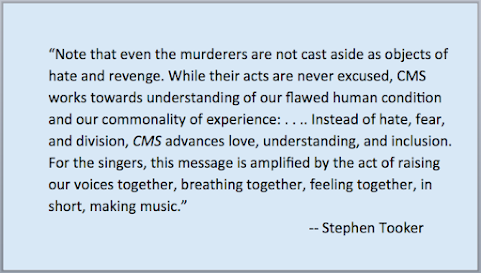
During the months following, we communicated at intervals through email. And when this past summer COVID vaccination and disease rates made it reasonably safe to visit people who were ill, another Unicorn friend and I went to visit Stephen where he was being cared for.
We had such a wonderful visit! Stephen regaled Kathleen and me with tales of his undergraduate days at Brown University, where his excellent singing was most appreciated.** Since I had earned my M.A.T. at Brown, I knew many of the places of which he spoke. His tales illuminated for me why the Brown University Bookstore always had such a huge number of early music LPs (I bought lots of them in 1978 for $1.00 or a $1.50 each at its sidewalk sales): it turns out there had been a vibrant early music scene to be found on and near campus, in part because Joel Cohen hailed from Providence and had also attended Brown before his Boston Camerata days. Meanwhile, a professor whom Stephen remembered vividly from those early music soirées was my professor in a course about English mystery and morality plays.
Stephen was so lively and so cheerful during our visit that I had to remind myself that he was ill. When he died, all I could think to do was to write something for him, since I could no longer write something with him. My poetry writing group had given itself the assignment of writing an "abecedarian,"*** so I decided I would write one about Stephen: after all, Stephen was a man of letters, and the requirement of this type of poem is letter-related: its first line must begin with an "a," its second line with a "b," its third line with a "c," etc.
So here is "Abecederian for Stephen."
At eighteen, attuned already to truth and
Beauty, curious and open, you trod the paved paths that
Crisscrossed the Brown campus quadrangle.
Drawn already to letters, notes and verse,
Eager to unlock them and hold them close, you
Found companions similarly intent and afire.
Gifted with keys to the music library, you gathered after
Hours to revel in singing seldom-circulated scores,
Inspired and exulting in the privilege you’d earned,
Journeying through musical centuries. Another
Key you alone were granted—to the college chapel’s
Loft, where the chapel’s bell hung in slant-lit silence
Most afternoons: the minister surmised that the
“New tenor” would enjoy reading in the loft’s warm solitude.
Oh, I loved these stories of how your earnest, bright humility
Prompted others to single you out, trusting that you’d
Relish the gift they proffered, plant it in the garden of yourself, then
Share it. Smiling, I rose to leave the house on the hill named for the
Turkeys that roused you every morning with their clacking.
“Until next time,” I said—then skipped a breath as I heard my
Voice speak with the certainty I longed to feel—because I knew the
Wolves were already at the door, not malign, but calmly
eXpectant—true to nature, which ordains that the
Young grow old and pass out of this world, and the very ill perish,
Zealous though they be for more mornings and more song.
Matthew Shepard died on October 12; Stephen died on October 8; I will remember both of them every year during the second week of October. And I will remember Stephen much more frequently than that.
Confession/Addendum: Upon rereading my poem late last night, I realized I had failed to include a line that began with the letter "Q." I thought about adding one, and then decided this poem was close enough to being an abecedarian to be called one. And then I had another thought: it makes sense that something's missing from this poem; Stephen is missing from the lives of so many of us.


